The visit of American President Nixon [1] to the USSR (22-30 May) was accompanied by some curious activities on the part of the authorities.
*
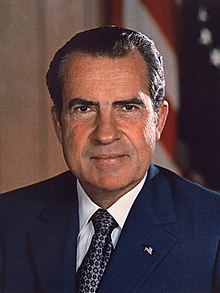
Richard M. Nixon
37th US President (1969-1974)
*
CAUTIONS
From 1 May 1972 onwards, the following were summoned to district police-stations in Moscow.
Tatyana Khodorovich, a member of the Action Group (for the Defence of Human Rights in the USSR); Alexander Volpin, a consultant of the Human Rights Committee; and fifteen active participants in the Movement for the Right of Jews to Leave for Israel.
They were required to promise that during the visit of Nixon to the USSR they would not commit “anti-social acts”. All those summoned declared that they had not intended and did not intend to commit unlawful actions.
*
Grigory Podyapolsky, a member of the Action Group, A. S. Volpin, and Yury Shikhanovich were sent away from Moscow on urgent business trips for the duration of Nixon’s visit.
*
TELEPHONES
From 19 May 1972, telephones began to be disconnected in people’s flats.
In Moscow, the telephones of Action Group member Pyotr Yakir; members of the Human Rights Committee, Academician Sakharov and Valery Chalidze; and also those of Roy Medvedev and thirteen participants in the Jewish Movement to Leave, were disconnected.
The telephones of nine of these thirteen persons have still not been reconnected two months later.
*
Chalidze’s enquiry of the telephone repair service met the reply: “There has been some complicated damage to the cable. It will be repaired on 29 May”.
During the same period, several telephones in Kiev were disconnected. The telephone of Professor Branover (of Riga) was cut off until at least June [2].
*
STREETS
In Moscow and Leningrad, citizens living in houses which overlooked streets along which Nixon was due to pass were forbidden to go near their windows on the relevant days.
In Kiev on 27 May 1972 the police ordered Tatyana Zhitnikova, wife of Leonid Plyushch (CCE 24.3), to sign an undertaking that she would not visit the city centre and public places for a period of four days. She was threatened that if she did so proceedings would be taken against her for “breach of the peace”.
*
In Minsk, Riga, Vilnius and Kishinyov several Jews were required to give written undertakings not to leave their cities for the duration of the visit.
Instances are known of the police making persons of Jewish nationality get off trains and aircraft bound for Moscow. In one case the husband, a Russian, was allowed to board a plane, but his Jewish wife was stopped.
Aeroflot ticket-desks have been known to refuse to sell tickets for Moscow to Jews: as is well known, since 1970 it has been necessary to present one’s identity document (“passport”) in order to purchase an air ticket.
*
JAILS
In Moscow at 8 am on 21 May 1972 persons in civilian clothing, accompanied by police officials, presented themselves at the apartments of V. Prussakov (CCE 25.9), and five activists in the Jewish Movement to Leave: R. Rutman, D.Sc. (Technology), L. Libov and V. Polsky, both Cand. Sc. (Technology), Vladimir Slepak, an engineer, and B. Orlov, a historian.
Without any legal grounds, they were driven to various prisons outside Moscow [3].
On 22 May Josif Begun, Cand.Sc. (Technology), and on 24 May, the 20-year-olds A. Slepak and L. Tsypin, were jailed in the same manner (CCE 21.10).
All the persons named above were held in prison until 31 May 1972 without any charge being brought against them.
*
At the police stations their relative were informed in verbal communications that the reason for the arrest was “breaches of the peace in the past. And intended breaches in the future”.
Their wives were constantly, openly and crudely shadowed: the police agents burst into telephone booths, got into lifts, and sometimes even tried to enter the apartment to which their targets had gone.
On 31 May 1972 the persons listed above were taken to their local police stations, where KGB employees told them that they had isolated them with the aim of preventing any possible breaches of the peace on their part during Nixon’s visit. (Soviet legislation does not provide for preventive detention.)
*
NIXON’S ARRIVAL
On the morning of Nixon’s arrival in Leningrad, engineer Lev Lerner [4] was detained on the street as he was on his way to work; he was taken to a police station and held there until evening with no explanation.
In Kiev two people (Zinovy Melamed and Alexander Feldman) were likewise held with no explanation for four days.
*
On 22 May V. Prestin was detained on the street in Moscow.
He was charged with “pestering a woman”. The woman who had reported this to the police was one of the police spies following Prestin that day. A people’s judge in the city’s Kalinin district sentenced Prestin to fifteen days in jail for “petty hooliganism”. Before this, on 21 May, Prestin had already declared a hunger strike in protest against the arrest of his friends, and he kept up this hunger strike until the moment of his release from prison.
*
In Leningrad solo ballet-dancer of the Kirov Theatre of Opera and Ballet Valery Panov [5] who had recently applied to emigrate to Israel, was subjected to a similar arrest for a fifteen-day period.
On 21 May the KGB seized Alexei Tumerman [6] on a Moscow street and took him to Psychiatric Hospital No. 5. He was held there until 30 May. Throughout this time Tumerman kept up a hunger strike. On 24 May Tumerman wrote a letter to Nixon requesting him to “raise the question of civil rights in the USSR”.
*
INTERVIEW
On 20 May 1972, in an interview with an Associated Press correspondent, Pyotr Yakir said:
“As far as I know, summit meetings do not usually concern themselves with problems of internal affairs. However, many problems of this kind (for instance, the question of guaranteeing the rights of the individual) have long since ceased to be the internal affair of a particular country and become international problems. The discussion of these problems by leaders of the major powers is a matter of interest both for those countries and for the whole of mankind.”
Giving examples of political persecution in our country in recent years, Yakir concluded:
“One would like to think that after the visit of Nixon the forces of reaction will not be intensified, that people will cease to be arrested and put in lunatic asylums for their beliefs. It is time to put an end to the Middle Ages.”
=========================
NOTES
- The Russian title of this news item “Knikson”* is a play on the word kniksen, which means a curtsey.
↩︎ - German Branover, 40, is a physicist specializing in hydrodynamics, and a religious Jew. In May he went on a hunger-strike.
↩︎ - The prisons used were in Zagorsk, Serpukhov, Volokolamsk and Kolomenskoye.
↩︎ - Lev D. Lerner, 36, applied to leave with his wife and daughter in May 1971.
↩︎ - See long articles about Valery Panov and his wife Galina Ragozina in the International Herald Tribune (24 April and 3 July), and a letter in their support in The Times (22 June), from eleven leading dancers and theatre figures.
↩︎ - On Alexei Tumerman see CCE 19.7.
Tumerman signed letters in defence of Bukovsky and Yakir, and was the main compiler of the samizdat record of Bukovsky’s trial (CCE 23.1). This record has now been published in P. Smirnov’s large compilation on Soviet political trials, Five years of Documents and Testimony (Za pyat let: dokumenty i pokazaniya (Paris, 1972).
↩︎
=============================
 A Chronicle of Current Events