Gabriel Superfin (b. 1943), author of articles and works on “the history of Russian literature and culture” ready for publication [1], was arrested in Moscow on 3 July 1973 (CCE 30.7).
He was then taken to Oryol (Orël) in south-central Russia. One charge against him — transmitting Eduard Kuznetsov’s Diaries to the West — provided a basis for linking his case to that of Victor Khaustov (CCE 29.4).
Subsequently, however, Superfin’s case was separated.
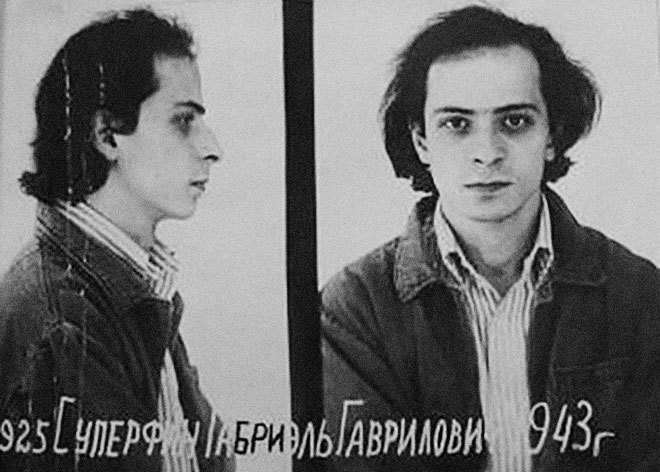
*
Gabriel Superfin, b. 1943
*
At several interrogations in the autumn of 1973, and at many interrogations in January and February 1974 (in Moscow, Leningrad, Tallinn, Tartu and Riga), witnesses were shown Superfin’s testimony. What he said about various people’s participation in transmitting the Diaries, in publishing the Chronicle of Current Events, and so on.
As became clear later, Superfin did indeed give this testimony.
As early as 5 November 1973, however, he told the investigators that all evidence given by him between 22 July and 5 November was false. The motives which led him to give false evidence, said Superfin, were base and self-centred.
Superfin repeated this statement in public on 5 March 1974 at the trial of Victor Khaustov, to which he was taken as a witness (CCE 32.2). He refused to testify as a witness at this trial, regarding his refusal as the only form of protest available to him against the expulsion from the country of Alexander Solzhenitsyn (CCE 32.1).
*
TRIAL
The case of Superfin (Article 70, pt. 1, RSFSR Criminal Code) was examined from 12 to 14 May 1974 by the Oryol City Court.
The judge was Novikov, who also presided at the trial of Khaustov. The prosecutor was Shteiman, deputy procurator of Oryol Region.
The accused’s defence counsel was the Leningrad lawyer Gurevich. The Moscow Bar Association would not allow Superfin’s relatives to engage L.A. Yudovich, the Moscow lawyer of their choice.
The main charges brought against Superfin at the trial were:
- typing and sending the Diaries of Eduard Kuznetsov to the West;
- preparing material for the Chronicle and editing issues of it;
- transmitting material for the journal Vestnik RSKhD [2], including his review of the three-volume edition of Mandelstam’s poems;
- making editorial comments on Peter Reddaway’s book Uncensored Russia (notes made on a copy of the book);
- circulating an article by Leszek Kolakowski, “Theses on Hope and Hopefulness”;
- signing a letter in 1968 in defence of Galanskov and Ginzburg [3]; and
- uttering ‘slanderous comments’ about the writers Gorky and Sholokhov.
It is known that Krasin testified in 1973 that Superfin had made editorial comments on Reddaway’s book Uncensored Russia, and that Belogorodskaya testified that he had edited the Chronicle (CCE 29.8).
*
Superfin pleaded not guilty.
He confirmed the factual side of most of the charges brought against him but rejected the interpretation of his actions as anti-Soviet.
He described Kuznetsov’s Diaries — the notes of a man facing a death sentence (lit. the “supreme penalty”) — as a remarkable human document and a work of great artistic significance. Their author, in his words, was a courageous man who had sacrificed himself for the right of Jews to emigrate to Israel.
*
Referring to the Chronicle materials (for example the notes he prepared about banned films (CCE 19.4) and about censorship (CCE 14.9) Superfin insisted that the aim and content of the Chronicle was truthful, authentic information and not “anti-Soviet libel”.
In Superfin’s opinion the Chronicle, by giving information on the punishment imposed on certain people for their actions, e.g., the CCE 1.6 report on the case of the “All-Russian Social-Christian Union for the Liberation of the People”, had a cautionary effect on many readers. It might restrain them from acting rashly.
Superfin also denied the “anti-Soviet” character of the Vestnik RSKhD (Herald of the Russian Student Christian Movement). It was an independent journal, he said, that covered religious, literary and socio-political themes. It was published through the labours of only one man, he continued, and not with money from the CIA, the People’s Labour Alliance (NTS), etc. …
He noted that references to this journal had appeared in the Soviet press.
The opinions which Superfin had expressed about these publications at the pre-trial investigation before 5 November were read out at the trial: at that time, he had acknowledged their ‘anti-Soviet’ character.
Superfin attributed these opinions, as well as a number of statements of the same period which he later repudiated (also read out at the trial), to fear and a desire to transfer his own responsibility onto other people. Superfin declared that he was prepared to answer for his behaviour during the investigation, and not only according to the Criminal Code.
*
WITNESSES
Three witnesses spoke at the trial.
Victor Khaustov repeated the evidence given by him during his pre-trial investigation, before Superfin’s arrest, and also that given at his own trial.
He then presented his version of the duplication of Kuznetsov’s Diaries and the sending of the manuscript to the West (CCE 32.2). This evidence coincided in the main with the evidence of Superfin.
Lev Ladyzhensky from Riga (CCE 32.20 [4]), who was under investigation and, like Khaustov, brought to the court from custody, confirmed that he had translated Kolakowski’s article at the request of Superfin.
*
Szandor Fodo, a final-year student from Tartu University, after expressing his high opinion of Superfin as a man and a scholar, confirmed that he had recounted to him in detail how he was sacked from his job (CCE 19.8 [1]).
Fodo stated that in conversations with Superfin he himself raised the subject of the national question, as this had always troubled him in its application, both to his own native people, the Hungarians of Transcarpathia (CCE 22.8 [13]), and to other national minorities.
*
Witnesses whose evidence was referred to in the indictment as corroborating certain points which were subsequently included in the verdict, were not summoned to court.
Thus, the evidence of Irina Zholkovskaya was mentioned as one proof of Superfin’s participation in the gathering of information for the Chronicle: yet it is known that at the pre-trial investigation Zholkovskaya stated only that she had read her husband Alexander Ginzburg’s letters from acquaintances, “and Superfin might have been amongst them”.
“Taking into consideration the poor health of the accused”, Procurator Shteiman asked for six years in the camps and three years of exile. The court sentenced Superfin to five years of strict-regime camps and two years exile.
*
Appeal
On 9 July 1974, the appeal hearing took place in the RSFSR Supreme Court. The court was presided over by Shestnov; Zverev was the prosecutor.
Superfin was defended by the Moscow lawyer L.A. Yudovich who had been chosen by Superfin’s relatives from the very beginning but was allowed to defend him only at the appeal stage. Yudovich had had difficulty in obtaining a meeting with his client, as the Praesidium of the Moscow Bar Association (chairman, Apraksin) for a long time refused to let him make the trip to Oryol.
Defence counsel asked for the sentence to be revoked and the case sent for a re-trial. The main argument of the defence was the personal interest of Judge Novikov. In the verdict in Khaustov’s case, i.e., before the beginning of the examination of this case, a court presided over by Novikov had determined the degree of Superfin’s involvement in the transmission of Kuznetsov’s Diaries.
*
This argument was not even mentioned in either the prosecutor’s reply or the judge’s decision.
The court also rejected the defence arguments on particular points of the charges, accepting as proof of Superfin’s guilt the evidence of witnesses Grebenshchikov and Ellingson, who did not appear in court.
Even the evidence “at the pre-trial investigation of witnesses Barabanov and Bonner” (also not summoned to the court) was not excluded from the verdict. The evidence of Barabanov completely contradicted the conclusions of the investigation and the court, however; while Yelena Bonner had refused to give evidence altogether. The RSFSR Supreme Court ruled that the sentence of the Oryol City Court was lawful and fully substantiated.
*
In Defence of Superfin
Many people had earlier spoken out in defence of Superfin in the USSR and abroad.
former Soviet citizens
On 12 July 1973, Valery Chalidze appealed to A. I. Mikoyan to help Superfin and, in particular, to stand bail for him [4]. Superfin had edited the memoirs of former Politburo member Anastas Mikoyan (1935-1966), published in the Novy mir monthly.
On 23 August 1973, in an interview [5] with Western correspondents Aleksandr I. Solzhenitsyn declared that Superfin had given him much assistance in his archival research. In the opinion of Solzhenitsyn, this might aggravate Superfin’s fate.
*
USA
In December 1973, a Committee for the Defence of Gabriel Superfin was formed in the USA.
The statement about the formation of the Committee was signed by nine persons: Robert Bernstein, Victor Erlich, Donald Fanger, Peter Gay, Jack H. Heckster, Octavio Paz, Meyer Shapiro, Vincent Scully and Robert Penn Warren.
According to the Chronicle of Human Rights in the USSR (No. 8) a telegram was sent to Soviet ‘president’ Podgorny on behalf of the Committee for the Defence of Superfin on 25 April 1974. It was signed by Professor Lipman Bers, Victor Erlich and Vincent Scully. The CHR also reports that the American Publishers Association sent a telegram to Podgorny in defence of Superfin at the end of March.
*
On 17 March 1974, Andrei Tverdokhlebov appealed to Podgorny to pardon Superfin.
On 18 March, Tverdokhlebov and Maria Slonim sent a letter to the International Commission of Jurists. The letter gives details of the investigation of Superfin’s case [6].
For the letter of 44 friends and acquaintances of Superfin, see CCE 32.22 (11).
=========================================
NOTES
- See details of Superfin’s published works in CHR 1973 (No. 3, ‘Bibliography’).
↩︎ - A quarterly Russian-language publication, The Herald of the Russian Student Christian Movement (founded in 1925) was published in Paris.
↩︎ - Superfin’s name as signatory of a 1968 letter in defence of Galanskov and Ginzburg was not recorded by the Chronicle (CCE 1.2);
↩︎ - Chalidze also appealed to Soviet ‘president’ Podgorny (see text in CHR 1973, No. 3).
↩︎ - Solzhenitsyn’s interview was widely published. See full text in, e.g., The New York Review of Books (4 October 1973).
↩︎ - For the texts of the appeal by Tverdokhlebov and Slonim and the previous item see CHR, 1974 (No. 8.)
↩︎
===================================
 A Chronicle of Current Events