- 1-1. Trials: 13 trials in Kyiv, Lviv and elsewhere
- 1-2. Arrests, Extra-judicial Persecution, Persecution of Jews
*
TRIALS
From June to September 1972 participants in the national and democratic movement in Ukraine were put on trial.
The prosecution case was based chiefly on samizdat and occasionally on verbal utterances. The article of indictment was Article 62 (UkSSR Criminal Code = Article 70, RSFSR Criminal Code). The investigation commenced in January-March 1972 (see “Arrests in Ukraine”, CCE 24.3 and CCE 25.2).
(For more information about those named below, see “The Dissident Movement in Ukraine“, Kharkiv Human Rights Protection Group website.)
*
Two of the arrested persons [1], engineer Leonid Seleznenko and poet Mykola Kholodny, were released before the trial after they had published statements of repentance in the press.
Kholodny’s letter to the editor of Literary Ukraine (7 July 1972) contains not merely his repentance but also the names of the people through whom he fell under the pernicious influence of bourgeois propaganda and the writings of “so-called samizdat”.
After the publication of his statement in the paper Robitnycha hazeta (“The workers’ paper’, 8 July 1972), Seleznenko was immediately released and reinstated in his job at the Institute of Oil Chemistry in Kiev.
*
Trials in Kiev
1. Alexander Serhiyenko
In June 1972 the trial took place of the 40-year-old Alexander SERGIYENKO (Ukr. Oleksandr (Oles) Serhiyenko), see CCE 24.3. A school-teacher of drawing, he worked after his dismissal as an artist and restorer. The judge was Yu.I. Matsko [2].
By court decree the trial was held in closed session: not even Serhiyenko’s mother, Oksana Meshko (1905-1991) or wife were admitted to the courtroom.
The first two months of Serhiyenko’s detention were spent in an investigation cell. Attempts were then made to extort a public repentance from him, but to no avail.
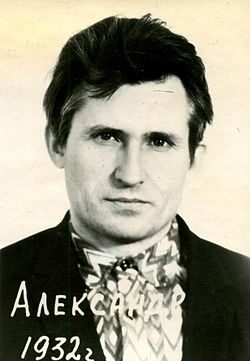
Oleksandr Serhiyenko (1932-2016)
At the trial of Serhiyenko three counts were held against him:
- Proof-correction of 33 pages of text from the book Internationalism or Russification? by Ivan Dzyuba (the book is 500 pages long).
Serhiyenko was not acquainted with the author of the book. He had found the work interesting and made notes for his own use as he read it. The court classified his markings as editorial corrections and Serhiyenko was charged with complicity in the creation of an anti-Soviet book. The court regarded this episode as the main point of the indictment. - Verbal statements critical of the “international assistance given to Czechoslovakia” (i.e. invasion); these were not confirmed by the testimony of witnesses.
- Statements regarding Ukraine’s right to self-determination.
The defence demonstrated the groundlessness of all the points of the indictment: the absence of any “agitation & propaganda”; the contradictory nature of the witnesses’ testimony in some cases; and the complete absence of testimony in others.
The defence requested that the accused be released, or the offence be reclassified, from Article 62 to Article 187-1 (UkSSR Criminal Code = Articles 70 & 190-1, respectively, RSFSR Criminal Code).
Serhiyenko was sentenced to seven years of strict-regime camps and three years exile. An appeal court upheld the verdict of the Regional Court.
*
2. Ivan Kovalenko
The trial of Ivan Yermilovich KOVALENKO, a 54-year-old teacher arrested in January 1972 (CCE 24.3), took place on 10-13 July. The judge was Yu.I. Matsko. A charge was brought under Article 62 pt. 1 (UkSSR Criminal Code = Article 70, RSFSR Criminal Code).
The court held the following episodes against Kovalenko:
- The confiscation from him on 12 January of the works: Internationalism or Russification? by Ivan Dzyuba; “Woe from Wit” by Viacheslav Chornovil (a document concerning the trials of 1965 [3]); and publicist writings by Valentyn Moroz [4] — all regarded as anti-Soviet.
- Statements criticizing the “international assistance’’ rendered to Czechoslovakia (uttered in the staffroom at the school where he worked).
The trial was held in camera, Kovalenko’s wife, who was summoned as a witness on the second or third day of the trial, was not allowed to remain in the courtroom after giving evidence.
The sentence: five years of strict-regime camps.
*
3. Zinovy Antonyuk
The trial of Zinovy Antonyuk (b. 1933), was held on 8-15 August.
The judge was Dyshel, the Procurator Popchenko; the charge was one under Article 62 pt 1 (UkSSR Criminal Code). The trial was officially open: 10-15 employees from the establishment where Antonyuk worked were brought to it by car. However, hardly any of Antonyuk’s friends managed to gain entrance to the courtroom.
*
Amongst the witnesses who appeared in court were Zinoviya Franko, L. Seleznenko, M. Kholodny, Lobko and Anna Povodid.
According to the evidence of Seleznenko and Kholodny, Antonyuk obtained and passed on to others (sometimes the witnesses themselves had been involved in these incidents) the journal Ukrainian Herald (No. 6) [5] the articles “Bolshevism and the Spirituality of the People” by Dmytro Dontsov (1883-1973), “Instead of a Final Speech” by Valentyn Moroz”, [6] and others.
According to evidence given by Franko, Antonyuk had photographed issue No. 3 of the Ukraine Herald and had the film conveyed to Czechoslovakia via A. Kocurova. Antonyuk denied having transmitted the film.
Regarding witness Lobko, who gave evidence in favour of Antonyuk, the court made a separate decision that proceedings be instituted against him for his sharply-worded speech which it considered “contempt of court”.
Witness Anna Povodid, a staff-member of the Petro-chemical Institute of where Antonyuk worked, refused to confirm that he had given her samizdat literature to read. She stated that Antonyuk had merely given her some unimportant scrap of paper to read in the corridor and that she had returned it to him there and then.
*
Antonyuk wrote a letter asking the court to take into account the fact that he had acted without conscious malice, had not indulged in the circulation of material, and did not regard the literature confiscated from him as anti-Soviet.
The court ignored Antonyuk’s letter and passed a sentence of seven years of strict-regime camps and three years exile.
*
4. Vasyl Stus
The trial of Vasyl Stus (arrested in January 1972, CCE 24.3) took place from 31 August to 7 September in the Kiev Regional Court. The judge was Dyshel. It was reported in CCE 26.4 that the investigation was initially carried out under Article 187-1 (UkSSR Criminal Code).
Stus (34) is a poet and literary critic. He graduated from a teachers’ training college and served in the army. Until 1965 he worked in the Shevchenko Institute of Literature. He was preparing to defend his thesis but after speaking out against arrests in the Ukraine in the autumn of 1965 he was expelled.
In recent years he had been working outside his professional field as an engineer in an information department and as a labourer on the construction of the Kiev underground railway. From 1965 his articles and poems ceased to be published.
*
The prosecution’s case relied to a large extent on the testimony of L. Seleznenko and M. Kholodny.
At his trial the following points were held against Stus:
(1) The rough draft of an article about the poet P. Tychyna (1891-1967), which had neither been published nor circulated: during a search of Stus’s home a letter from Stanislav Telnyuk, a specialist on Tychyna whom Stus had consulted while working on his article, was confiscated. Telnyuk had been summoned as a witness in Stus’s case. In court he commented favourably on Stus’s work.
A staff-member at the Institute of Linguistics, Nasiruk, was called upon to assess Stus’s article (although as a specialist on the poet Ivan Franko he had never studied Tychyna); his review was unfavourable.
The court ignored Telnyuk’s opinion. A book by Telnyuk about Tychyna is lying unpublished in a Moscow publishing-house; Deputy Chairman of the Ukrainian Writers’ Union Vasyl Kozachenko declared, “Let S. Telnyuk first settle his accounts with the KGB, then we’ll publish him”. Telnyuk is also being interrogated as a witness in the cases of Nadiya Svitlychna [Ru. Svetlichnaya], Ivan Dziuba, Yevhen Sverstyuk and Ivan Svitlychny.
(2) A letter which Stus had sent to the government criticizing the state of affairs in which young writers of the Ukraine are not being published. This letter, which was confiscated during a search, was held against Stus as being anti-Soviet.
(3) The fact that while staying in the “Morshino” sanatorium Stus had told two jokes judged to be anti-Soviet (confirmed by the evidence of witnesses).
(4) The fact that an anthology of poetry by Stus (Winter Trees, 1970) had appeared in Belgium.
Witness L. Seleznenko testified that he had been the one who transmitted the anthology abroad, moreover without the author’s consent. However, even this episode was held against Stus.
*
Sentence: five years of strict-regime camps and three years exile.
*
5. Volodymyr Raketsky
Volodymyr Raketsky (25). Expelled from Kiev University in his third year because when he submitted some application it transpired that he had concealed the fact that he was the son of a man who had been suppressed under Stalin, and moreover because he had been accused of having nationalist sympathies.
Prior to his arrest he had worked as a staff correspondent on the paper Molodu gvardiya [Young Guard]. The judge was Matsko. Among other things the court held against Raketsky stories and poems (by himself and other writers) confiscated during a search and classified as anti-Soviet.
The sentence: five years of strict-regime camps.
*
6. Yury Shukhevych
Yury Shukhevych (b. 1933) spent over 20 years in confinement as the son of General Roman Shukhevych, head of the Ukrainian Insurgent Army (UPA), who committed suicide in 1950.
After his release Yu. Shukhevych lived in exile, in the north Caucasian city of Nalchik (Kabardino-Balkar ASSR). Married with two children (aged two years and nine months), he worked as an electrician.
In February 1972 he was arrested in Nalchik (CCE 25.2). From there he was sent to the KGB in Kiev and then back to Nalchik. Charged under Article 62 (UkSSR Criminal Code).
Sentenced to 10 years’ imprisonment, 5 in prison and 5 in special-regime camps, and 5 years’ exile.
*
The arrest of Yu. Shukhevych followed that of Nina Strokatova (Ukr. Strokata).
She had just exchanged her flat in Odessa for one in Nalchik and given rooms there to Shukhevych and his family (who are still living there.) It is believed that Yu. Shukhevych’s memoirs of his 20-year imprisonment (see Reddaway, Uncensored Russia p. 214) have been confiscated from him.
*
Trials in Lvov
7. Danylo Lavrentevich Shumuk
The trial of Danylo Lavrentyevich SHUMUK (b. 1914; CCE 25.2) took place on 5-7 July. He was charged under Article 62 pt. 2 (UkSSR Criminal Code) for his memoirs: the first part was confiscated from him at the time of his previous imprisonment [7]; the second was discovered during a search of Svetlichny’s home).
Shumuk was also charged with having circulated articles by Djilas and Dzyuba and made anti-Soviet statements, both charges brought on the evidence of witnesses. He had written a letter to Svetlichny, which was confiscated from the addressee and judged to be a ‘‘programmatic document”.
Sentenced to 10 years special-regime camps and five years exile.
*
8-10. Also tried : Stefania Shabatura, Iryna Stasiv & Ihor Kalynets
Stefania Shabatura was sentenced under Article 62 (UkSSR Criminal Code) to five years in the camps and three years exile.
The poetess Iryna Stasiv (Kalynets) received six years in camps and three years exile [8]; her husband, the poet Ihor Kalynets obtained permission to see her, but a few days later he was also arrested.
*
11. Ivan Hel
In mid-August Ivan Gel (Ukr. Hel) was sentenced under Article 62 pt. 2 (UkSSR Criminal Code) to five years in special-regime, five years of strict-regime camps, and five years in exile [9].
*
12. Mykhaylo Osadchy
The trial of Mykhaylo Osadchy (CCE 24.3) was held on 4-5 September. Charged under Article 62 (UkSSR Criminal Code). The trial was a closed one; Osadchy was accused of having transmitted his manuscripts abroad [10].
Sentenced to seven years in strict-regime camps and three years exile.
*
ELSEWHERE
13. Ihor Holts
In April 1972 a military tribunal in Lutsk examined the case of Ihor Holts (b. 1946), a graduate of a Kiev Institute and lieutenant in the army Medical Corps.
He was charged under Article 187-1 (UkSSR Criminal Code = Article 190-1, RSFSR Code). The indictment mentioned statements and conversations, in particular a toast proposed in honour of Israel’s victory in the Six-Day War.
Sentenced to three years in ordinary-regime camps.
*
Dr. Semyon Gluzman, who was himself arrested on 12 May 1972 in Kiev in connection with the case of Lyubov Serednyak (CCE 28.7 [4]), was summoned as a witness in the Holts case.
Repression in Ukraine, pt 2 …
=========================
NOTES
Notable among Western reactions to the wave of repression in the Ukraine was a long letter of protest in The Times (London), 3 February 1972. It was signed by 11 prominent writers, artists and intellectuals, including Yehudi Menuhin, J.B. Priestley and A.J. Ayer.
*
- On Seleznenko and Kholodny, see CCE 26.9 (note 34) and CCE 25.2 (note 6), respectively.
↩︎ - At the time Judge Matsko presided at two other Ukrainian political trials (CCE 8.12 [17] and CCE 23.7 [5]). Judge Dyshel tried Antonyuk and Stus and many others in years to come (Name Index).
↩︎ - “Woe from Wit” was published in English as The Chornovil Papers (1968).
↩︎ - Moroz’s brilliant essay, “Letter from the Beria Reservation” was published in Michael Browne (ed), Ferment in the Ukraine, London, 1971 (pp. 119-157). Other writings and materials appeared abroad, e.g., Valentyn Moroz, Among the Snows (Ukrainian Information Service, London, 1971).
↩︎ - Issues 1-4 and 6 of the Ukrainian Herald were jointly published in Ukrainian as books, in France and the USA by PIUF (Paris) and Smoloskyp (Baltimore). They contain name indexes.
↩︎ - A remarkable speech included in Ukrainian Herald (No. 4) and in English in Survey 1972 (London, No. 82).
↩︎ - On Danylo Shumuk (1914-2004) and his memoirs, see Browne (1971), CCE Name Index and
KHPG entry (2005).
↩︎ - Apparently tried together, in July, Shabatura and Stasiv both arrived in Dubrovlag Camp 6 in November.
↩︎ - On Ivan Hel, this 35-year-old locksmith, see CCE 24.3 and on his earlier imprisonment (1965-1968), see Viacheslav Chornovil, The Chornovil Papers.
↩︎ - Index on Censorship 1972 (No. 3-4) gave details of the career of Osadchy, a 36-year-old poet and prose-writer. It also offered an excerpt from his vivid memoir The Mote (Ritmo) concerning his arrest, trial and life in prison in 1965-1967.
↩︎
=============================
 A Chronicle of Current Events