6 ENTRIES
[1]
KALINICHENKO
Vitaly Vasilyevich KALINICHENKO (b. 1937; CCE 34.8, CCE 41.6-2) was released in March 1976.
Kalinichenko (Ukr. Kalynychenko) settled in the Dnepropetrovsk Region at 2 Shchors Street in the town of Vasilkova. Since then, he has been constantly under administrative surveillance: on 6 October, 18 months of surveillance comes to an end.
On 5 March Colonel Kapustin (deputy head of the KGB Administration), Regional assistant procurator Bedrik and Markin (head of the Regional procuracy’s investigation department) gathered at the KGB in Dnepropetrovsk and issued Kalinichenko with a warning under the 25 December 1972 Decree. The text of the warning referred to spreading information about the creation of the Ukrainian Helsinki Group. Kalinichenko refused to sign it. He was advised to emigrate as soon as possible.
*
[2]
Nadiya Svetlichnaya [1], who has married in Kiev, has been registered for residence in Kiev. She has been placed under administrative surveillance for a year in her place of registration.
*
[3]
Lev Lukyanenko (CCE 43.15 [3]), a member of the Ukrainian Helsinki Group, has been placed under surveillance for a further year.
*
[4]
SUSLENSKY
In November 1976 Yakov Suslensky, a prisoner in Vladimir Prison, applied to the Frunze district people’s court in the city of Vladimir to register an action against the prison administration for damaging his belongings in the prison.
Judge S.V. Dmitrieva refused to allow the application, explaining that it “is not liable to investigation by a court”.
On 15 February 1977 the Vladimir Regional court, with A. G. Zimina presiding, heard Suslensky’s appeal against Dmitrieva’s decision. Zimi8na agreed with Dmitrieva’s point of view:
“According to Article 11 (RSFSR Corrective-Labour Code), supervision of the strict observance of the laws on the implementation of prison sentences is the responsibility of the Procurator’s Office, as laid down by the Statute on Supervision by the Procurator’s office in the USSR.
“These disputes are not the business of the courts.”
For a similar action taken in prison, but with a different result, see below [5.2].
*
In Tarusa (5-6)
[5]
LYUBARSKY
[5.1]
During March and April 1977, Kronid Lyubarsky (CCE 44.18, CCE 45.12 [1]) sent identical letters to 42 deputies of the USSR Supreme Soviet. After describing his situation as “a man unlawfully exiled’, deprived of the possibility of living with his family and of working in his own specialised field, and after listing many violations of the law, Lyubarsky ended his letter as follows:
“I shall find it interesting to see if a deputy of the supreme State authority in the USSR will be willing or able to ensure the fulfilment of laws which were openly and loudly proclaimed. You will agree that the answer to this question is not of minor importance.”
Lyubarsky’s wife, Galina Salova, sent a similar letter to the deputies.
Two deputies sent replies that were to some extent positive. On 30 March Marshal I. Bagramyan wrote to the chairman of Moscow Region soviet executive committee:
“In forwarding to you the letters from citizen K.A. Lyubarsky and his wife, citizen G.A. Salova, I ask you to take into account the facts given concerning K.A. Lyubarsky’s severe illness, and to review the question of registering him at his wife’s place of residence.”
Academician R. Khokhlov, the late rector of Moscow State University, wrote to Salova:
“May I inform you, in answer to your statement, that I have inquired about the establishment of the necessary living conditions for your husband and the possibility of specialised work for him. You will be informed of any decision made.”
Two of the deputies reacted extremely negatively. On 23 March V. Kudryavtsev, a columnist for the newspaper Izvestiya, wrote to Salova:
“… Firstly, I feel we must not forget that it was your husband himself who took the first step along the road which led to all the present consequences … So I can assure you that the tone and contents of your statement in no way create an atmosphere favourable to your husband …
“I cannot offer any support to such a statement, not merely as a deputy, but simply as a citizen of the Soviet Union, which I am not merely as a formality, but according to my convictions.”
On 10 June Marshal Batitsky wrote:
“Citizen Lyubarsky!
“… You have clearly come to the wrong person with your verbose statements about imaginary ‘contradictions’ between the laws and ‘secret directives’. I have served the Soviet people for more than half a century as a member of the armed forces, and I fought for our country and its laws when you were not even five years old.
“… In answer to your question — whether a deputy of the supreme State authority in the USSR is willing or able to ensure the fulfilment of the laws —- I will state briefly that there is no such problem. It has been thought up by you in a fit of obdurate fault-finding. I consider it unnecessary to discuss this subject with someone who stubbornly clings to opinions which are alien to Soviet society.”
Six of the deputies forwarded Lyubarsky’s letter to various State departments, which replied to Lyubarsky as follows: he had been refused registration “in accordance with existing legislation’.
The reply sent on 27 April by N. Amosov, Academician of the Ukrainian SSR Academy of Sciences, was out of the ordinary:
“Dear Comrade Lyubarsky K.A.!
I regret that I am unable to help you.”
*
[5.2]
On 6 April 1977, Lyubarsky sent a statement to the Frunze district people’s court in the city of Vladimir.
He was asking for proceedings to be taken against Vladimir Prison for the price of 75 books which were returned to him mutilated upon his release from prison. Judge S. V. Dmitrieva refused to allow the claim on 15 April, explaining that “this dispute is not the province of the court” (CCE 45.18 [20]).
However, the Vladimir Regional Court acceded to Lyubarsky’s appeal and instructed the people’s court to hear the claim.
On 24 June, the case was heard in the Frunze people’s court, with Judge Dmitrieva presiding. Major Sokolov, the deputy governor of Vladimir Prison, appeared as the defendant; Captain Doinikov, political education inspector, Mityukova, a prison censor, and Galina Salova who was given the mutilated books, were all called as witnesses.
The legal representative of the defendant did not admit the claim to be justified, insisting that the prison authorities had acted according to the law in cutting up the books. When the judge asked Sokolov which law he had in mind, he said it was a secret directive. The hearing was interrupted at the judge’s request so that Sokolov could present this directive to the court. The judges studied the directive, after sending out the witnesses and the few members of the public (“MVD Directives” CCE 46.10).
In his speech to the court, plaintiff Lyubarsky stated that it was not the particular amount of the claim that was important to him, but the principle of the thing. He wanted to create a precedent for the right of prisoners to make claims in court and teach the prison authorities that they were not excused from observing the law.
The court called an expert book-dealer to assess the financial cost of the damage done to the books by the prison authorities.
At one point the judge warned Lyubarsky that if the court ordered the defendant to pay the full cost of the damaged books, he would have the right to take possession of the books. After this Lyubarsky waived his claim concerning about half of the books.
The hearing lasted for seven hours. Then the verdict was announced:
“… It is apparent from the case evidence that, when the plaintiff was released from [penal] institution OD-1/ST-2, his belongings were searched according to Article 82 of the RSFSR Corrective Labour Code. However, the search involved a violation of the regulations laid down in Directive 93 of the USSR MVD, whereby Lyubarsky suffered a material loss.
“From the report given by book-dealer Trofimova it is calculated that the loss constituted 10 per cent of the total value of the books and is equivalent to 2 roubles 85 kopecks, which must be paid to the plaintiff.“… The claim made against institution OD-1/ST-2 [Vladimir Prison] by Kronid Arkadyevich Lyubarsky is to be granted to the amount of 2 roubles 85 kopecks, which with the state tax of 30 kopecks comes to 3 roubles 15 kopecks altogether.”
*
[5.3]
On 10 May 1977, Lyubarsky sent a statement to the chairman of the Tarusa town soviet executive committee, in which he asked that, if he could not be given work in his specialized field [as an astrophysicist], he should either be paid unemployment benefit, or given invalid status, or allowed to work as a private teacher.
The chairman said he would be allowed to teach privately. However, at the police station he was told that such work “didn’t count” and was offered a job as a cashier in a savings bank (CCE 45.12 [1]).
On 27 May the police gave Lyubarsky a preliminary warning (by word of mouth) about ‘parasitism’.
*
On 27 June First Lieutenant Gorshkov, the deputy police chief in Tarusa, issued a second, ‘final warning’ (in writing) to Lyubarsky about ‘parasitism’: if he did not obtain employment within a month, a criminal case would be initiated against him according to Article 209 (RSFSR Criminal Code).
On 22 July N. Startsev, chairman of the Tarusa town soviet executive committee, told Lyubarsky that he had no objection to him working as a private teacher. Lyubarsky got permission from the District Finance Department to teach privately and, in accordance with the regulations, gave the names of the pupils he had begun to teach.
On 27 July Yulin, district procurator of Tarusa, told Lyubarsky that he considered the question of his employment to have been resolved.
However, on 1 August Lyubarsky was told by the police that a decision had been taken to put off the start of criminal proceedings against him for another month; he was given another ‘final’ warning. Lieutenant Belov, who was in charge of the surveillance on Lyubarsky and Strokatova, said of the procurator’s words: “We don’t know anything about that.”
*
On 20 May 1977, Lyubarsky became a member of the Soviet Amnesty International group.
*
[6]
LYUBARSKY & STROKATA
From the end of May 1977, the authorities — largely through Gorshkov, Belov and Judge N. P. Karpezhnikov (CCE 44.18) — launched a massive attack on Kronid Lyubarsky and Nina Strokatova.
The police (mostly Belov) visit Lyubarsky and Strokatova at their homes every day or every other day, late in the evening, often at night (about 2 a.m.), and demand to be allowed into all the rooms.
On 24 May Lyubarsky and Strokata, having demonstrated their ‘presence’ at home as required, would not allow the police over the threshold. The police drew up an indictment citing “infringement of the surveillance regulations”.
*
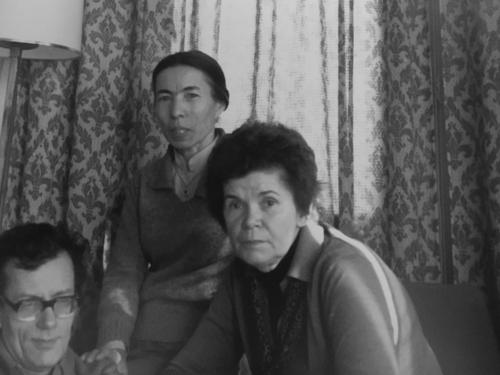
Kronid Lyubarsky, Ayshe Seitmuratova and Nina Strokata
(photo taken by Galina Salova, note 3)
*
On 31 May Judge Karpezhnikov summoned Lyubarsky but did not find that he had acted contrary to the surveillance regulations. He then fined Lyubarsky 20 roubles for “disobeying the police’, on the basis of the decree of the Praesidium of the USSR Supreme Soviet, dated 15 February 1962.
After this, Belov quickly rewrote the record in regard to Strokata, replacing “infringement of the surveillance regulations* with “disobeying the police”. Karpezhnikov also fined Strokatova 20 roubles.
Lyubarsky and .Strokatova appealed against these fines.
On 1 June Procurator L. B. Gorelov from the Kaluga Procurator’s Office came to Tarusa. Gorelov said that the police had acted “in accordance with established practice”.
On 10 June 1977, Lyubarsky was asked to give an explanation of his ‘disobedience’.
Lyubarsky wrote that he had already given all his explanations in complaints addressed to the procurator of Kaluga Region and the head of the Kaluga Region soviet executive committee’s internal affairs department (UVD). He gave the dates of the complaints and the numbers of the postal registrations. The police called this “avoidance of an explanation” and again drew up a report alleging “infringement of the surveillance regulations”.
On 16 June Lyubarsky was again summoned by Judge Karpezhnikov on another report of ‘disobedience’. Lyubarsky’s friends accompanied him to the courtroom. The judge, saying that there would be a ‘discussion’ not a trial, asked everyone except Lyubarsky to leave.
After members of the public had left, he listened to Lyubarsky’s explanations, saying “Perhaps your arguments are correct, but meanwhile we have these practices. If we’ve got instructions from above, we amend our decision” — and fined Lyubarsky 15 roubles. Strokata, who was summoned after Lyubarsky and already knew what the ‘discussion’ would consist of, asked that the public be allowed into court.
The judge at first threatened to call the police, then put off the hearing until the next day. On 17 June, as a result of Strokata’s complaint to the procurator and his intervention, the judge no longer opposed the presence of the public; he fined Strokatova 20 roubles.
*
Lyubarsky and Strokatova complained about the actions of the police to A. S. Venikov, the First Secretary of the Tarusa district Party committee.
In their presence Venikov ordered the chief of police
“to carry out the surveillance correctly, to respect the personalities of the people under surveillance, not to offend them by actions to which they react so strongly”.
In addition, he gave “his word as a deputy” that they would not be arrested for what they had done.
Visits from the police ceased immediately after the talk with Venikov. They have now been resumed.
*
On 22 June 1977, Lyubarsky’s statement “Five Months at Liberty” was read out at a press-conference in Moscow. In it he described the conditions under which former political prisoners exist when they are “set free”:
“… This then is our ‘freedom’. These are our ‘rights’.
“Of course, we possess them in full. It’s just that they are ‘slightly limited by law’. And just slightly more by secret directives. The rest is annulled by ‘the practice which has come about’, as pointed out by the Procurator’s Office which supervises the observance of the law …”
*
On 29 June 1977, Strokatova wrote to Venikov:
“My meeting with you and the mockery which I have noticed escalating since that meeting have led me to the following conclusion:
“It is unbearable to admit that I am a citizen of a State whose leaders are convinced that ‘established practice’ is superior to the guarantees laid down in the State Constitution.
“It is unbearable to admit that I am a citizen of a country whose leaders are convinced that they can safeguard the country’s security and authority only by means of an arsenal of humiliating surveillance measures.
“It is unbearable to admit that I am a citizen of a country in which the conditions of life at liberty are indistinguishable from the conditions in prisons and camps.
“Having perceived this, I painfully declare that I am ready to renounce my citizenship of the country, which, unfortunately, is My Homeland …”
On 6 July 1977, a court hearing took place concerning the new charges of ‘disobedience’.
Strokata, as she is Ukrainian, asked that the hearing be conducted in the Ukrainian language. After Karpezhnikov’s refusal to agree to her request, she declined to take part in the proceedings.
The judge had Lyubarsky put under arrest for three days and Strokata for seven days.
After a protest from the procurator, Strokata’s term of detention was cut to three days. Lyubarsky and Strokata declared themselves on hunger strike for the entire period of detention. Neither would they go out to work. Gorshkov summoned Lyubarsky’s cellmates (Strokatova was alone in her cell). He questioned them as to what Lyubarsky talked about in the cell, and forbade them to have any conversations at all with him.
On 10 July, the day after he was released from detention, Lyubarsky was visited by Belov and another man, who called himself a fireman. In spite of Lyubarsky’s protests, this man entered his house and walked through the rooms.
On 12 July Karpezhnikov again fined Strokata 20 roubles.
On 22 July he fined Strokata 20 roubles again.
*
After this, the police started to break into their houses, paying no attention to categorical protests from Lyubarsky and Strokata.
In the middle of the night, they would walk round all the rooms, switch on the lights, wake up the owners and guests and ask them for their identity documents. When Strokata’s guest, Tatyana Osipova, refused to show her documents in the middle of the night, they began to drag her out of the house, half-dressed, and marched her off to the police station.
On the evening of 24 July 1977, Strokata was hurrying home when she was stopped by Gorshkov 300 metres from her house, five minutes before “surveillance time” was due to begin (8 pm). Gorshkov told Strokata that she was breaking the surveillance regulations by being out on the street after 8 pm. He took Strokata to the police station and went out somewhere.
An hour later Gorshkov returned with witnesses and checked his watch in front of them by the radio, to prove that Strokata had indeed been late. A record alleging infringement of the surveillance regulations was drawn up.
*
On 27 July Gorshkov, acting for the police chief in Tarusa, refused Strokata permission to go and visit her husband in a camp.
Strokata’s husband, Svyatoslav Karavansky, is serving a term in Mordovian Camp 1. He was deprived of his previous visit, in February 1977 (CCE 44.17-1). At first, Strokata had been refused permission by the Tarusa police to visit him on two occasions in 1976. Later she received permission after appealing against these refusals.
On 29 July Strokata appealed to the USSR MVD and the RSFSR Procurator’s Office in the following statement:
“. . . Considering that I am preparing to leave the territory of the Soviet Union to reside permanently abroad, and that therefore the visit on 8 August may be my last meeting with my husband, I ask you immediately to reconsider the question of refusing permission for it, which would punish both my sentenced husband and myself — still formally a free citizen of the USSR.”
On 1 August 1977, the surveillance order on Strokata was prolonged for another six months.
*
On 21 July 1977, a search was carried out at Lyubarsky’s home in connection with criminal case No. 1, initiated by the KGB of the Komi ASSR against Vitaly Alexeyevich SHMELYOV.
It was stated in the search warrant that three years ago, Shmelyov, then in Vladimir Prison, had given Lyubarsky his anti-Soviet verses and songs. Lyubarsky had copied them out. The warrant included a long list of these verses and songs and an order to find them.
Instead of the verses and songs, they were looking for the card-index of the Political Prisoners Relief Fund (see the appendix to this issue, CCE 46.23-2). They found and confiscated two pages giving lists of political prisoners who needed parcels or packages sent to them, and the addresses of some families of political prisoners which were in need of material assistance. “This is a whole action programme, a programme of criminal action,” declared Captain Pokashinsky. “This is a programme to create solidarity among anti-Soviet elements.”
A collection of Amnesty International documents was confiscated, including its statutes. “We don’t recognize this organization,” said the man in charge of the search, “and any organization we don’t recognize is criminal.” (The next day Lyubarsky sent a letter describing this episode to Mr. David Ennals, secretary-general of Amnesty International).
Lyubarsky’s correspondence with Father Sergy Zheludkov, which Lyubarsky had conducted from camps and prison through the censors, was confiscated.
Also confiscated were the samizdat anthology Jews in the USSR and two books published abroad: My Country and the World by A. D. Sakharov and Self-Awareness (‘Samosoznanie’; Khronika Press, 1976).
*
On 22 July Lyubarsky was summoned to Tarusa KGB headquarters for interrogation by Captain Bykov, an investigator from Kaluga.
From the questions asked, it became clear that Shmelyov, now in one of the camps of the Komi ASSR, had given detailed evidence that Lyubarsky had corresponded with him for many years in Vladimir Prison and had even met him personally. (In actual fact, Shmelyov had been in the next cell to Lyubarsky for only a week altogether: in November-December 1975.) He said that he had given Lyubarsky many anti-Soviet works. Lyubarsky himself copied them out, edited them and disseminated them among the prisoners.
Lyubarsky had discussed with Shmelyov plans to spread his works throughout the prison, among the warders and outside the prison; Lyubarsky had asked him to write more anti-Soviet works. According to this testimony, the ‘criminal links’ between Lyubarsky and Shmelyov began at a time when Lyubarsky had not yet arrived in Vladimir Prison.
*
On 23 July Lyubarsky issued a “Declaration to the Press’:
“… I am not surprised at the deceit, far-fetched explanations or lies of KGB investigators, but so far it has always seemed to me that their work-style did preserve at least the semblance of reality. For the first time I have been confronted with a ‘case’ that has been shamelessly invented from first to last.
“There can be no doubt of the reason for this provocation. For a long time, the KGB has been mounting a purposeful attack on the Relief Fund for Political Prisoners. The regime, which rejects humanism on principle, cannot forgive the Fund its humane aims …
“Alexander Ginzburg has already been arrested. Malva Landa has already been exiled.
“Now it is apparently the turn of those who are left: Tatyana Khodorovich and myself. It seems that no decision has yet been taken as to the pretext for putting me behind bars. Three cases are being fabricated against me simultaneously.“I am being refused work and a criminal charge of parasitism is being prepared against me.
“I am subjected to provocation by bold and shameless persecution on the part of the police and threatened with criminal charges for resisting this.
“And now — the most open provocation of all! Apparently, someone felt that the year’s imprisonment I am threatened with according to the above ‘cases’ is too little: now they want to put me behind bars for ten years. After all, one can get rid of a person that way.“The fund can be robbed. That too is within the power of the KGB.
“But the humanism and solidarity which are now consciously entrenched can no longer be destroyed by anyone.”
*
Lyubarsky has decided to leave the USSR [2]. (See CCE 46.14 for his wife Galina’s position.)
=================================
NOTES
- On Nadezhda Svetlichnaya (Ukr. Nadiya Svitlichna), see CCE 41.6-2, CCE 42.11 [7, 8], CCE 43.17, CCE 44.27 and Name Index.
↩︎ - Kronid Lyubarsky and his family left the USSR on 18 October 1977 (CCE 47.8-3).
After settling in West Germany Lyubarsky started to set up and edit various publications. In November 1978, for instance, he began to issue the fortnightly “Vesti iz SSSR” (USSR News Update [R]). It provided information about human rights in the Soviet Union until December 1991.
↩︎
==========================
 A Chronicle of Current Events