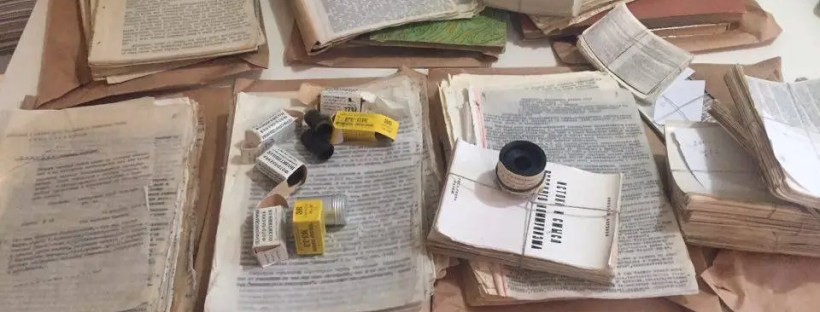
NINE ENTRIES
(Periodicals, 3, 6-9)
[1]
“Socialists as Portrayed by A. I. Solzhenitsyn” (8 pp.)
In an article signed with the pseudonym “An Old Socialist”, the author writes about “A.I.’s totally incorrect, biased and distorted description of political exile in the 1920s and 1930s” in Volume III of The Gulag Archipelago.
*
[2]
Anon
“The Soviet State System and Psychiatry” (8 pp.)
The author of this anonymous article, a psychiatrist by profession, affirms that there is no deliberate agreement between the KGB and the psychiatrists who carry out forensic-psychiatric examinations.
The KGB knows how to have political detainees placed in psychiatric hospitals, he writes, even without any such agreement — by making use of the ‘humanist’ tendencies of psychiatrists and the vagueness of diagnostic criteria in psychiatry, and the existence of psychiatrists of different ‘schools’. The author concludes:
“Then is there such a thing as psychiatric terror in the USSR, or not? There is. By whom is it carried out? By state organs (the KGB, the courts). Psychiatrists are used in this terror as an ignorant mass of people who do not understand the meaning of their actions …
“There exists the inhumane practice of placing ‘political’ patients in special prison hospitals…. And this practice… is a shameful state crime. And in the struggle against psychiatric terror in the USSR, publicizing of this shameful phenomenon must be emphasized …
“Such a change of emphasis in the struggle will be more clearly understandable to the entire psychiatric community in the USSR and will facilitate the quickest possible re-education of the mass of doctors and psychiatrists and the democratization of their views.”
*
SOKIRKO (3-4)
[3]
ECON0MIC FREEDOMS
“In Defence of Economic Freedoms“, No. 1 (262 pp.)
Compiled by ‘K. Burzhuademov’
The collection is dedicated to the analysis of the dissenting intelligentsia’s opinions on the economic problems of our country.
The collection opens with an article by the compiler entitled “I accuse intellectuals — white-collar workers and consumers — of resistance to economic freedoms” in which he proposes that the country’s economic ailments be overcome by the activity of ‘economically free people’ (i.e., by means of black-market enterprise).
Later he includes reactions to this article from people involved in the humanities, engineers, mathematicians and ‘economically free people’. The compiler analyses their replies.
The collection also contains excerpts from samizdat, tamizdat and Soviet works on economic themes, reviews of these works by the compiler, and “open letters” by Viktor Sokirko on the same subjects.
The collection ends with an article by the compiler, “Samizdat must be paid for”, as a basis for discussion.
*
[4]
Victor Sokirko
A Soviet Reader works out his Convictions (212 pp.)
The book consists of the author’s reviews of a number of samizdat books and articles (books by I. Shafarevich, M, Popovsky, A. Moskovit [Note 12], A. Yanov and the collections Self-awareness and Democratic Alternatives). Also included are notes on some officially published books (for example The Philosophy of the Common Cause by N. F. Fyodorov) and books stamped “for official use” (Max Weber: The Protestant Ethic).
In these reviews and in the final commentaries, the author states his attitude on a wide range of questions: the alternative paths of Russian history, the characteristic features of capitalism, socialism and democratic socialism, and the priority of political or economic freedoms in the struggle for human rights. The author regards works of a liberal-democratic tendency, particularly the articles in the collection Self-awareness, as nearest to his own convictions.
*
[5]
Sergei Cheremukhin
“Off they go again!” (2 pp.); “A Day in the Life of a Blood-Donor” (3 pp.); “Those who govern us” (3 pp.)
From the first article:
“‘Off they go again!’, exclaim with a sigh of sadness and indignation an ever-increasing number of people in our country, on hearing on the radio or reading in the newspaper the reports of the latest flight into the cosmos … Why all this, with our poverty? With our yearly increasing shortage of food supplies? …”
From the second article:
“On close examination, the reason for a donor’s enthusiasm turns out to be elementarily, mathematically simple. Every donor, apart from a day off work on the day he gives blood, receives one day’s paid holiday. Moreover, he is allowed… a certain amount of scarce food, usually not available in the shops.”
For the third article, “How those who govern us live” would be a more exact title.
*
PERIODICALS (6-9)
[6]
INFORMATION BULLETIN, 4
The cases of Ginzburg, Orlov & Shcharansky, No. 4 (May 1978, 97 pp.)
This issue of the Information Bulletin contains materials related to the cases of Ginzburg, Orlov and Shcharansky for the period October 1977 to May 1978.
Issue 1 was summarized in CCE 45.4 [1]; Issue 2 was summarised in CCE 47.18 (10) [2] and CCE 48.25. //(CCE 47.3 and CCE 48.2 also publicize parts of these materials.)
*
[7]
AUSRA, 10
“The Dawn” (Lithuania)
No. 10 (50), March 1978, 50 pp.
ARTICLES
(1) “The Historical Significance of Lithuania” (signed J. Medvegailis) is dedicated to the history of Lithuania, which is constantly distorted by Soviet historians. The author points out that Lithuanian schoolchildren are taught almost nothing at all about Lithuanian history.
(2) “Empire of Terror”, (signed A. Zivintas) compares the conduct of Soviet leaders and those of Western countries in their relations with their peoples.
(3) “On the Altar of Freedom” is dedicated to Balys Gajauskas, who has served 25 years, from 1948 to 1973, and has again been arrested.
(4) “Unity and Publicity” describes the fate of Jonas Matulionis. He served nine months’ pre-trial imprisonment and then received a 2-year suspended sentence (CCE 47.5): he is continually shadowed, he is not given work, or if he is, he is fired.
The author calls on all Lithuanians — including Party officials and Chekists — to remember that they are Lithuanians and are living among their own people, who do not forgive betrayal but value magnanimity.
(5) “The Significance and Theoretical Bases of Propaganda” describes the official means of receiving, distorting and circulating the information used by propaganda officials.
*
[8]
AUSRA, 11
“The Dawn” (Lithuania)
No. 11 (51), May 1978, 55 pp.
The issue is dedicated to Balys Gajauskas and Petras Paulaitis [3].
ARTICLES
(1) “The Partisan War in Lithuania” discusses the problems of the Lithuanian struggle for independence in 1944-1954 and gives some statistics. The author estimates that in all about 100,000 persons participated in the struggle and that half of them perished.
He raises the question: was the partisan movement historically justified, doomed as it was to failure and to bringing cruel repression on the peaceful population? The author answers positively.
(2) The continuation of “The Significance and Theoretical Bases of Propaganda” is printed.
(3-5) “For What?” “We will not disappear!” and “After the Belgrade Conference” discuss the contemporary internal policy of the Soviet government: [a] persecution of dissenters, [b] repression of national movements and [c] active Russification of the border lands.
*
[9]
AUSRELE
“Little Dawn” (Lithuania)
16 February 1978, 66 pp.
The journal reprints some articles from the Herald of Freedom (Laisves Sauklys) which is no longer printed — “suppressed by the secret police”. Some of them are listed in CCE 45.20.
=====================
NOTES
- The Case of Alexander Ginzburg and Yury Orlov: Information Bulletin No. I (February-April 1977).
↩︎ - Issue 2 of the Information Bulletin was mentioned late in 1977, and its details corrected the following spring. Nowhere does there seem to be any mention of Bulletin No 3.
↩︎ - On Paulaitis, see CCE 44.22, CCE 46.10-1, CCE 46.23-2 and Name Index.
↩︎
========================
 A Chronicle of Current Events