4 ITEMS
[1]
IVAN KANDYBA
On 23 September 1977 Ivan Kandyba, a member of the Ukrainian Helsinki Group, was placed under administrative surveillance for a further six months (CCE 47.10).
In November Kandyba sent a complaint to the UkSSR Procurator’s Office concerning the illegal prolongation of the surveillance order. A month later he received a reply which had no basis in fact: there had been no illegality.
In September 1977 and January 1978 Kandyba was visited in the village of Pustomyty by General Poluden, head of the Lvov KGB, who made the same proposal (CCE 47.10): that he should publicly recant.
Kandyba refused.
*
At the end of January 1978 Captain Polishchuk, head of the Pustomyty KGB, suggested to Kandyba that he should write, saying that he was not acquainted with the Austrians who had sent him an invitation (CCE 48.17-1) and had not asked them to send an invitation.
Kandyba refused.
On 20 March, in connection with the approaching end of the ‘surveillance period’, Captain Polishchuk again suggested that Kandyba make a public recantation.
Kandyba refused.
*
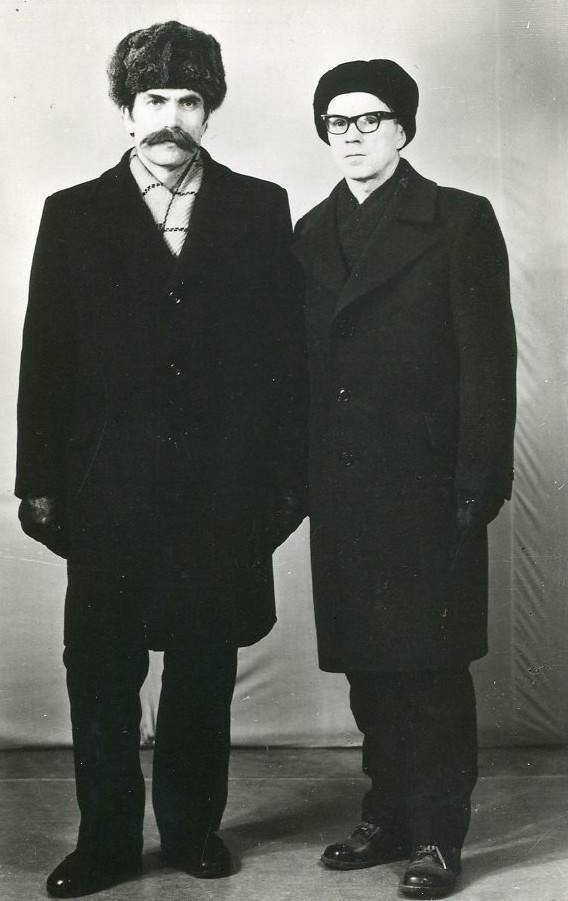
Lev Lukyanenko and Ivan Kandyba
*
SURVEILLANCE
On 22 March 1978 First Lieutenant B. P. Magurat, the head of the Pustomyty Criminal Investigation Department, handed Kandyba an order prolonging the surveillance order for another six months:
“At present it is obvious from the available evidence that the subject of the surveillance consciously does not wish to reform …”
Magurat did not want to quote any relevant evidence.
The surveillance restrictions grew even more severe. Kandyba was ordered to be at home: during the first ‘surveillance period’ (April 1976-April 1977) from 9 pm to 7 am; during the second period (September 1977-March 1978) from 8 pm to 7 am; this time it would be from 7 pm to 7 am.
On 29 March, meeting Kandyba in the street, Captain Polishchuk suggested that they should go and have a talk.
Kandyba refused.
*
WORK
On 5 April Polishchuk summoned Kandyba and gave him to understand that his employment prospects after the cold season ended (Kandyba was working as a stoker in a school) would depend on his behaviour.
On 24 April Kandyba’s brother came to visit him from Lvov. Ten minutes after the brothers had entered the house, First Lieutenant Magurat arrived and demanded to see the newcomer’s documents. It turned out he had no documents. He had to go to the police station to establish his identity. Captain Polishchuk was already there. Polishchuk asked the brother to use his influence on Ivan, He said that if the latter renounced “all that is unnecessary and hostile”, the surveillance order would immediately be lifted.
On 27 April Polishchuk came to see Kandyba at work, in order to “warn him against the wrong kind of behaviour during the holidays”.
On 30 April the cold season came to an end and Kandyba was left without work.
On 5 May Polishchuk again told Kandyba that his employment prospects depended on his behaviour.
*
[2]
BONDAR
For a number of months Nikolai Bondar (CCE 48.13-1) could find neither work (although he was prepared to take any job), nor a place to live.
A few times people agreed to give him a job if he found ‘a place to live’. Whenever anyone agreed to rent Bondar a room, he was not given a residence permit. Once, when he had an offer of work as a stevedore, the hostel caretaker refused to let him stay there:
“We’ve got young people in the hostel, and he was sentenced for a political offence.”
Bondar was not even allowed to stay at the hotel: “Not allowed without a residence permit!”
More than once, after a day spent searching, he had to pass the night at the railway station. In a letter he writes:
“There’s nowhere to sleep. The station, where I spend the night, is awfully cold. I can’t get a wink of sleep all night. I sleep in the bus during the day, when I’m travelling around”.
Finally he got a job as a labourer at a horticultural collective farm, while living in a hostel (Cherkassy, 53 Katsaeva Street).
*
[3]
STROKATA
On 1 February the administrative surveillance order on Nina Strokata, a member of the Ukrainian Helsinki group (CCE 46.5-2, CCE 47.10 [1]), was prolonged for another six months.
*
[4]
TVERDOKHLEBOV
From 21 to 24 April Andrei Tverdokhlebov (CCE 48.13) was detained for three days at a police station, a so-called ‘short-term detention’.
The conviction concerned the ‘infringement of residence regulations’. Tverdokhlebov still cannot obtain a residence permit and is living without one.
==========================================
 A Chronicle of Current Events