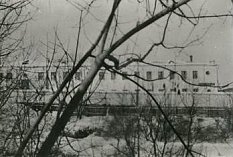
IN SPECIAL PSYCHIATRIC HOSPITALS (SPH); IN ORDINARY HOSPITALS
This section has been compiled largely from Information Bulletins 8 and 9 [1] of the Working Commission (CCE 44.10): 8 (20 April 1978), 9 (9 June 1978).
*
In Special Psychiatric Hospitals
Dnepropetrovsk SPH
*
SOROKIN
Nikolai Apollonovich SOROKIN has arrived here.
On 23 February 1978 the Voroshilovgrad Regional Court heard his case under Article 187-1 (UkSSR Criminal Code = Article 190-1, RSFSR Code). It declared him not responsible and sent him for compulsory treatment to an SPH. Sorokin’s defence counsel, A. P. Kolosov, sent an appeal to the Supreme Court of the Ukrainian SSR, asking it to restrict treatment in an ordinary hospital, but Sorokin was nevertheless sent off to the Dnepropetrovsk SPH before the appeal was even heard.
*
Nikolai Sorokin (b. 1953) is a locksmith and sanitary engineer who has been living in the town of Rovenki (Voroshilovgrad Region) since 1976 .
In 1974 and 1975 he journeyed twice to Moscow, in order to meet Andrei Sakharov and foreign journalists. On both occasions he was detained by the police and sent to Moscow Psychiatric Hospital No. 14: for three months in 1974; for nine months in 1975.
In August 1976 Sorokin again went to Moscow. After meeting American journalists there, he was once more sent to Psychiatric Hospital No. 14. In October 1976 he was transferred to the psychiatric hospital in Biryukovo village (Voroshilovgrad Region), where he suffered severe effects from the use of drugs. The doctor treating him was Sergei Ivanovich Mikhailenko; the doctor in charge was Leonid Ivanovich Isayev.
Sorokin was released on 1 March 1977.
*
On 10 March 1977, after Sorokin sent a telegram to the US embassy in Moscow, he was again sent to Biryukovo psychiatric hospital. He was discharged in June 1977.
Some time later Sorokin was detained “on suspicion of theft” at the bus station in Rovenki, as he was about to set off for Voroshilovgrad. During a search 33 exercise books containing notes were confiscated from him. From the police station Sorokin was sent to Biryukovo psychiatric hospital. On 17 November 1977 he was charged under Article 187-1 and transferred to Voroshilovgrad Prison. On 22 November, a search was carried out at Sorokin’s flat with the intention of confiscating “various notes libelling the Soviet political and social system”.
In January 1978, a forensic psychiatric commission declared Sorokin not responsible (the diagnosis was ‘schizophrenia’). It recommended compulsory treatment in an ordinary psychiatric hospital. In spite of this, the court sent Sorokin to an SPH.
*
On 9 April Alexander Podrabinek sent a statement in the name of the Working Commission to the Chairman of the Ukrainian SSR Supreme Court:
“Based on its knowledge of the evidence at the pre-trial and court investigation and the testimony of his mother, the Working Commission considers that by the nature of his activities Nikolai Sorokin does not constitute a danger to society.
“His forcible internment in a psychiatric hospital will be regarded by the Working Commission as an action which abuses psychiatry for political ends …”
At the appeal hearing the Supreme Court of the Ukrainian SSR left the decision of the court of first instance unchanged [2].
*
Chernyakhovsk SPH
The Baptist Alexander Ivanovich VANKOVICH (b. 1932) is here.
On 2 December 1976 the Krasnodar Regional Court, headed by D. N. Varaksin, heard his case under Article 190-1 (RSFSR Criminal Code): it declared him not responsible and sent him for compulsory treatment to an SPH. The court’s decision states:
“… From 1957 to 1976, Yankovich produced in his home in the settlement of Mostovskoi, and distributed in written, printed and taped form, journals and pamphlets which expressed and promoted knowingly false fabrications libelling the Soviet political and social system, the Soviet government and the CPSU.
“On 28 April 1976 handwritten and printed texts and tapes were confiscated at Yankovich’s home, which included — together with religious sermons — libellous fabrications concerning the political and social system of the USSR and the CPSU.
“The witnesses interrogated during the investigation and trial — I. Ya. Tarasov, G. D. Belousov and V. N. Shushlyanina — confirmed that Yankovich had given them literature to read in handwritten and typed form …
“According to the conclusions reached by expert psychiatrists, A. I. Yankovich is suffering from a mental illness in the form of paranoid schizophrenia …”
*
Arvydas Cehanavicius (CCE 46.13, CCE 48.12) was transferred on 20 March from the Chernyakhovsk SPH to the Vilnius Republican Psychiatric Hospital (an ordinary hospital). According to a report by the senior doctor, his condition is good.
*
Kazan SPH
On 20 February for the second time the Kiev Regional Court turned down a request by Nikolai Plakhotnyuk (CCE 48.12) to be transferred from an SPH to an ordinary hospital.
During the court hearing Judge Dyshel [3] said that Plakhotnyuk had been punished because he was against the Soviet regime (according to the actual formulation of Soviet criminal law, compulsory medical treatment is not a punishment, Chronicle).
In an appeal hearing on 6 April, the UkSSR Supreme Court decided to transfer Plakhotnyuk to an ordinary hospital. On 5 May, however, Plakhotnyuk was still in Kazan.
*
DZIBALOV
In April 1977 Vyacheslav Dzibalov [4] was transferred from Kazan to an ordinary hospital (Psychiatric Hospital No. 5 in Leningrad).
Vyacheslav Anisimovich DZIBALOV (b. 1923) was arrested in Leningrad on 16 March 1971 together with a group of like-minded people — the Purtov brothers (CCE 26.2, CCE 48.12) and others — for attempting to found a ‘Union to Struggle for the Liberation of the Personality’. The charges against him were brought under Articles 70 & 72 (RSFSR Criminal Code).
On 28 December 1971 the court declared four of the seven defendants, including Dzibalov, to be not responsible and sent them for compulsory treatment in an SPH. From January to August 1972 Dzibalov was in the Leningrad SPH. He was then transferred to the Alma-Ata SPH (Kazakhstan), and then to Kazan SPH, where he stayed until April 1977.
*
Tashkent SPH
Lev Ubozhko is here.
After escaping from a psychiatric hospital and being recaptured, CCE 47.12 stated (wrongly) that, he had been sent to the Leningrad SPH.
*
In Ordinary Hospitals
*
NIKOLAYEV
Yevgeny Nikolayev is still in Moscow’s Kashchenko Psychiatric Hospital No. 1 (CCE 48.12). He is not taken out for walks. He is allowed visits only from his close relatives.
On 20 March the Working Commission issued a ‘Press Statement’, protesting against the continued compulsory hospitalization of Nikolayev and calling for people to come to his defence. From 16 March to 10 April Nikolayev was given injections of stelazine. Because of the injections he developed a mild neuroleptic syndrome: he began to develop a twitch (tremor) in his left hand.
From the hospital Nikolayev sent statements to the World Psychiatric Association, the USSR Minister of Internal Affairs and the head of the KGB, protesting against his unlawful hospitalization.
On 14 April the hospital was visited by the British psychiatrist Gery Low-Beer (CCE 49.18). At the request of the Working Commission and of Nikolayev’s wife Tyan Zaochnaya, Low-Beer wanted to meet Nikolayev to give him a psychiatric examination. The doctor in charge of the hospital, however, Valentin Mikhailovich Morkovkin, would not allow the meeting. According to Soviet law, Morkovkin told Low-Beer, only close relatives could meet psychiatric patients. T. Zaochnaya and Alexander Podrabinek were present during Low-Beer’s conversation with Morkovkin. On 15 April Podrabinek sent a letter to B. V. Petrovsky, the Soviet Minister of Health, protesting against the refusal to let Low-Beer see Nikolayev.
On 19 April Nikolayev was prescribed cyclodol, triftazine and vitamin C.
On 1 May Nikolayev noticed in the medical record of prescriptions that he was in fact being given injections of stelazine rather than vitamins. The injections produce weakness, somnolence and a twitch in the left hand. M. I. Belikov, the head of the department, told Nikolayev that he was deliberately twitching his hand.
On 25 April Vyacheslav Bakhmin sent a letter to A. A. Churkin, Chief Psychoneurology Specialist
at the USSR Ministry of Health:
“… Nikolayev’s case has already come to the attention of world public opinion and Western psychiatrists, and further infringement of the Directives [on urgent hospitalization (CCE //), Chronicle] and illegal actions by the administrative authorities are facilitating further publicity in every way.
“The Working Commission once more draws your attention to Nikolayev’s case and hopes that you will be able to take the necessary measures for his immediate release.”
A similar letter was sent to V. P. Kotov, Chief Psychiatrist of Moscow.
On 4 May Belikov again asked Nikolayev to stop writing complaints. He said that because of his complaints there had already been ‘telephone calls’ to the hospital.
On 11 May a routine commission refused to discharge Nikolayev “because of his bad mental condition” [5].
*
ZHIKHAREV
On 13 January M. N. Zhikharev (CCE 47.12) was transferred from Krasnodar psychiatric hospital to the in-patient department (No. 3) of the Sochi psycho-neurological clinic [6].
From 21 January Zhikharev received sulfazine injections. Later they began to give him aminazine and triftazine. He is forbidden to wear his glasses, so he cannot read or write. He is not taken out for walks.
The head of Department 3, Natalya Alexandrovna Shorokhova (office telephone number 91-26-71), told Lidia Demyanovna ZHIKHAREVA that her husband was receiving treatment because he was “against the Soviet regime”. The doctor in charge of the clinic, Nina Petrovna Belyaeva (office telephone 91-26-85) promised to put L. D. Zhikhareva herself in a psychiatric hospital when she reminded Belyayeva about the outcome of the Congress in Honolulu (see CCE 47.12 and the S. S. Korsakov Journal of Neuropathology and Psychiatry, Vol XXVIII, No. 4).
On 26 March Alexander Podrabinek sent a letter to N. P. Belyaeva on behalf of the Working Commission:
“The Working Commission is aware of the cruel behaviour of the clinic’s administration and medical personnel towards Mikhail Nikolayevch ZHIKHAREV, who is now in Department 3 …
“The Working Commission hereby informs you that it will do all in its power to make sure that your clinical actions with regard to Mikhail Zhikharev are made known to the public.”
In 1978 Amnesty International included Zhikharev in its list of adopted prisoners.
The decision of the Sochi Central district people’s court, which sent Zhikharev for compulsory treatment, states:
“For some time Zhikharev systematically disseminated knowingly false fabrications, libelling the Soviet political and social system; he expounded all this in the typed text of an analytical novel.”
Zhikharev was not accused of anything else.
=======================================
NOTES
- The date of Bulletin No. 9 is 3 ½ weeks later than the cover date of CCE 49. It is, nonetheless, correct and illustrates one aspect of how the Chronicle was compiled (see CCE 49.21).
Its editors chose a cut-off date (in this case 14 May 1978), and then all material about events prior to that date was collected, edited and put in order. Given the conditions the editors were working in this process took several weeks. If important material arrived at the last moment from a fully reliable source, however, it was sometimes inserted even if its date was later than the chosen cover-date.
↩︎ - In 1982 Vesti (USSR News Update) reported that Sorokin had died in the Dnepropetrovsk SPH in 1980.
↩︎ - Judge Dyshel presided over many trials of dissidents and rights activists in Ukraine. See Name Index.
↩︎ - On Dzibalov, see CCE 26.2, CCE 27.6, CCE 39.3 and Name Index.
↩︎ - By mid-September 1978 Nikolayev had been released. He spoke at a press conference of the Moscow Helsinki Group reported in the Frankfurter Allgemeine Zeitung, 22 September 1978.
↩︎ - On 25 June 1978 Zhikharev was transferred again, to the city of Armavir (Krasnodar Region), apparently to the mental hospital there. See the Commission’s Information Bulletin No. 10.
↩︎
========================
 A Chronicle of Current Events