Since the beginning of 1978, the activity of the administrative authorities aimed at classifying a number of writers living in the USSR as ‘parasites’ or ‘persons leading a parasitical way of life’ (the best known of the previous cases of this type was the Leningrad trial of Joseph Brodsky in 1964) has been stepped up.
*
At the beginning of January police officials visited the flats of Vladimir Kornilov (CCE 45.17), Vladimir Voinovich (CCE 32.17-2) and Lev Kopelev (CCE 45.17) – all expelled at different times from the USSR Writers’ Union – and those of Georgy Vladimov, who left the Writers’ Union (CCE 47.15 [13]), and the historian, writer and publisher Roy Medvedev (//CCE 37). An ‘explanation’ of the sources of their income was demanded from each of them.
Kornilov and Kopelev were not at home when the police called.
The local policeman asked Kornilov’s wife where her husband worked: “A statement has been made that he has no employment.” “By whom?” “I am unable to say.” Kornilov’s wife said that her husband is a member of the Pen Club. “Is it on the telephone?”
Kopelev’s wife explained that her husband is a pensioner. “I told them so,” said the embarrassed policeman.
Vladimov and Kornilov, summoned next day to a police station, gave short written explanations to the effect that they live, as befits writers, on literary earnings. Kornilov was again summoned to the police station on 25 January and Vladimov on 11 March; each of them referred in addition to the agreements made with them for the publication of their works, moreover Vladimov stated that he did not consider it necessary to enter into further explanations and attempts to force him to do so would be quickly made known by him to the press and the public.
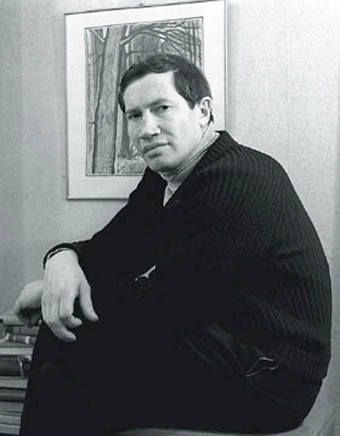
Georgy Vladimov, 1931-2003
*
At the beginning of January Voinovich was away from Moscow. On his return he received from the lift operator a summons addressed to him, but he refused to go to the police station. At the beginning of February, he was again sent for by the police. Voinovich declared that he would not go voluntarily to the police station and conveyed the following to the head of the police station:
“Explanation: in answer to the inquiry of the local police official, I hereby explain that my books are published in many countries of the world, in many languages and in large editions, and, like any well-known writer, I earn sufficient to support myself and my family. I consider the given explanation to be exhaustive.
V. N. Voinovich, writer
corresponding member of the Bavarian Academy of Fine Arts, corresponding member of the International Pen Club (an international writers’ organization), honorary member of the American Mark Twain Society.”
*
In January 1978, a man introducing himself as an acquaintance called on Lev Kopelev. He had come to convey the following information:
A certain scholar, an economist, sent the Party central committee a letter in which he expressed his anxiety about the dualization of public awareness that has been created in our country: official propaganda and information are in contradiction with the unofficial information that has now become generally available through foreign radio broadcasts. He wrote that in such a situation it was impossible to travel to the West. The scholar was invited for conversations ‘up above’.
A KGB official took part in the conversation. The scholar’s interlocutors said they were concerned by the same problem, but they assured him that it would be resolved in the very near future: the flow of unofficial information would come to an end. People who trans-mitted such information were faced by a free choice: either they left Moscow for some town that was closed to foreigners, or — and this would be best for everyone — they left the country; otherwise, it would be necessary to deal with them according to the law. The people concerned were those such as Kopelev, Kornilov, Voinovich and Vladimov. To the scholar’s question as to whether this was not a return to Stalinism, the reply was: ‘Under Stalin they would have been put straight into prison, but we are giving them a choice.’ The scholar’s interlocutors added that the people they had mentioned knew about the choice before them — they had been asked more than once to make up their minds quickly.
*
In November 1977 Yury Gastev (CCE 34.7 [11], CCE 35.10 [32] & CCE 45.18 [2]), mathematician, philosopher and writer, was given an official warning about ‘parasitism’ at a police station.
Gastev has not had a permanent job since the end of 1975, when he was forced to resign his job ‘at his own wish’. Since then he has several times tried unsuccessfully to find work within his profession.
At the end of April 1976, soon after the first summons to the police station, Gastev was expelled from the Journalists’ Union (author of several dozens of review and popular-scientific articles, he was in the scientific journalism section). At the end of July 1977 Gastev concluded a work contract under which he became literary secretary to G. N. Vladimov, but at the end of November he was summoned to the police station and told that the contract was invalid, since Vladimov himself was considered by the police to be a person without definite occupation.
There and then Gastev was given an official warning that if he did not start work within a month he would be made criminally answerable under article 209 of the RSFSR Criminal Code.
Starting from February 1978 the trade-union district committee stopped recording payment of dues on the contract between Gastev and Vladimov.
Gastev was not accepted for work at the Institute for Improvement of Professional Skills, where he had been sent at the Institute’s request by the City Labour Bureau.
At the beginning of February he started work as senior research officer at the Central Research Institute for the Technology of Tractors and Agricultural Machinery, but after a week he was told that there was no vacancy for him.
======================================
 A Chronicle of Current Events