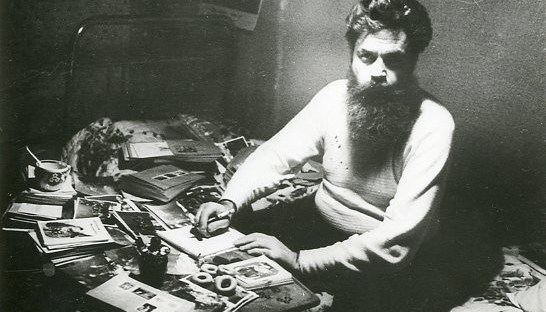
On 2 July 1977, the 8-year term of imprisonment of Mikhail Makarenko [1] came to an end. A few weeks before its completion he was transferred to Leningrad.
*
LENINGRAD
Here, in the internal KGB prison, he was told that in view of his bad character reference, the KGB chiefs had decided to prohibit his residence in Leningrad where his family lives and where he himself had lived prior to his arrest. He would be sent, instead, to the small town of Luga, southwest Leningrad Region [2].
Makarenko protested against this ’extrajudicial’ exile. He requested at least the choice of a place of residence outside Leningrad, Moscow and other restricted population centres, but to no avail.
*
CONFISCATED POSSESSIONS
Almost all his possessions were confiscated from him before his release while he was in Vladimir Prison. They included:
- The text of his sentence his own court verdict;
- 42 judicial rulings of various courts (in the Perm, Vladimir and Moscow Regions and the Mordovian ASSR) in response to suits brought by Makarenko against the KGB and MVD: for ‘insufficient issue of food’; beating up a prisoner; embezzlement of funds from prisoners’ personal accounts; and appropriation of things belonging to them;
- cuttings from newspapers and magazines to which Makarenko had subscribed during his imprisonment;
- 1,500 postal receipts;
- envelopes and forms for notifications;
- photographs;
- letters (received by Makarenko through the censor);
- postcards with pictures of writers, artists and composers;
- records of searches and confiscations;
- receipts for registered letters;
- note-pads with addresses of relatives, acquaintances and Soviet organizations;
- exercise books with published verses of Soviet poets;
- prayers;
- extracts from books by Soviet authors, from law codes and decisions of the USSR Supreme Court;
- books published in the Soviet Union, The Nuremberg Trials and in the USA, Political Thought and History;
- a letter from Marc Chagall;
- Makarenko’s business card from when he was director of the Picture Gallery of the Siberian scientific centre of the USSR Academy of Sciences;
- an envelope with dried flowers and leaves, received by Makarenko in letters ‘from outside’; and also
- 200 grams of black biscuits and 100 grams of dried sprats.
Makarenko was taken from Vladimir Prison via the Lefortovo KGB investigation prison (Moscow) to the Leningrad KGB Prison without being given any dry rations. He was not fed in Lefortovo, either.
*
1. Residence restrictions
On leaving prison, Makarenko moved in with his wife.
He and his relatives were continuously shadowed. After a few days police officials literally dragged Makarenko from the flat (breaking a window for this purpose) and took him to the police station. There a record was made out on his violation of residence regulations and he was asked to leave for Luga within three days.
*
TO LUGA
Makarenko went to Moscow. Here he was detained on 20 October 1977 and taken under escort by aeroplane to Leningrad. From there, he was escorted, in a police van and in handcuffs, to the town of Luga.
In the Luga police station it was announced to Makarenko that he would be found a job and put under surveillance [3]. An ID document (passport) was made out for him, there and then, but they did not manage to issue it to him. After a short absence, the deputy head of the district internal affairs department (UVD) returned. Everything was being cancelled, he said. Makarenko would have to stay in prison until the October Revolution celebrations (7 November) were over.
After a while Makarenko was shown the sanction of the Luga procurator for his arrest for a period of 30 days “in order to establish the individual’s identity”.
Two days later — again in a police van, again in handcuffs — Makarenko was taken to one of the Leningrad prisons, where he was held until 18 November.
*
BACK TO LUGA
On 18 November 1977, Makarenko was again taken under escort to Luga.
There he was issued with an ID document (passport) and registered as living in a hostel of the special commandant’s office; he was told that he was to be put under administrative surveillance. At the same time, he was given a second warning about violating of residence regulations.
The head of Luga UVD, Colonel Maximov, told Makarenko that a job had been selected for him. If he turned down this offer, a criminal case would be instituted against him under Article 209 (RSFSR Criminal Code: “parasitism”). A man in civilian clothes was pointed out to Makarenko. He explained that his duty included “continuous and direct” observation of Makarenko and said that he was “responsible” for him. Finally, Makarenko was handed a summons for interrogation as a witness by the Luga district KGB department.
Makarenko disappeared from Luga the same day without going to the KGB.
*
On 13 January 1978, Makarenko was caught in Moscow and again taken to Luga.
There a judge ruled on Makarenko’s violation of residence regulations and fined him. About a week later Makarenko again disappeared from Luga. From December 1977 to February 1978 the Moscow police, searching for Makarenko, came to several flats, for example those of L. Tanengolts and Yulia Zaks.
As this issue of the Chronicle was being compiled Makarenko has not yet been caught.
*
Before Makarenko was released, officials of the Leningrad KGB asked his wife and his son-in-law Ye. Murashov (CCE 46.5-1) to persuade Makarenko to leave the USSR.
However, when Murashov went to the Leningrad Visa & Registration department (OVIR) they refused to accept documents from him, saying that neither he nor Makarenko were Jews. (Makarenko is, in fact, by origin a Rumanian Jew: his birthname was Moishe Hershkovich).
*
2. LETTERS TO BALLERINA
On 23 December 1977, Makarenko sent a letter (26 handwritten pages) to I.A. Kolpakova, USSR Supreme Soviet deputy and USSR People’s Artist (ballerina).
In the text he explained his choice of addressee. Kolpakova’s electoral district included the KGB prison from which Makarenko was released, the prison where they “established his identity”, and also the “Big House” (the Leningrad KGB headquarters).
A considerable part of the letter consists of a description of illegalities committed in precisely these establishments. Makarenko tells of his pillar-to-post existence since his release (see above). Besides which he wrote:
“After my ‘release’, I discovered that:
- “the Leningrad KGB (Pushkin suburb), over and above the official sentence, confiscated at their own discretion items not belonging to them to the value of 645 roubles;
- “the Moscow KGB pinched belongings worth 7,000 roubles;
- “the USSR (Lefortovo Prison) KGB appropriated nine parcels of items which I value at 30 roubles each, total 270 roubles;
- “Mordovian Camp 17 (ZhKh-385/17) stole provisions worth 50 roubles and caused my family to incur expenses of 147 roubles, total 197 roubles;
- “Perm Camp 36 (VS-389/36) stole 272 roubles;
- “Vladimir Prison stole 140 roubles in cash.”
Makarenko included certain other calculations in his letter.
In Perm Camp 36, for example, the cost of the onions fed to the prisoners were 45 kopecks per kilogram but reckoned by the camp authorities at 65 kopecks. Sub-standard meat products sold for 40 kopecks per kg., were valued as meat, at two roubles per kilo. Cod, sold for 39 kopecks, was reckoned at 65 kopecks.
Referring to his present situation Makarenko says at the end of his letter:
“I ask you for one thing: that my exile should be revoked and that I be given the right to choose my own place of residence and work on an equal basis with other political prisoners.”
*
SECOND LETTER
Receiving no reply, on 22 January 1978, Makarenko sent I.A. Kolpakova a second letter. In it he adds to his previous letter:
“… even in the hostel of the special commandant’s office I am subjected to restrictions which are not applied to others.
“When the children, my grandson and relatives, came to see me it was announced to them in the coarsest manner by the head of the special commandant’s office that their visit was ‘making things worse for you yourselves and for him’ (i.e., me!) They were asked to leave the building of the special commandant’s office and not to come again to see me.
“On returning to Leningrad, they were interrogated about the circumstances of the trip by the police; they were threatened and asked to break off relations with me …”
======================================
*
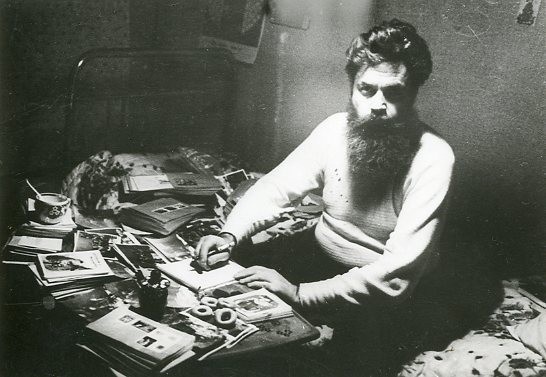
Mikhail Makarenko in 1977
*
NOTES
- On Makarenko (Hershkovich), see CCE 23.7 [22], CCE 33.6-3 [119], CCE 40.9-1 and Name Index.
↩︎ - Several other convicted rights activists and dissidents were sent to Luga, 1970s population 30-40,000 (cf. Leningrad, 1970s pop., 4-5 million).
↩︎ - See published and unpublished official documents concerning residence, ID documents and registration, CCE 34.21 [1,4,5].
↩︎
========================
 A Chronicle of Current Events