
FOUR ENTRIES
[1]
PETROV-AGATOV
In 1963 Lenizdat published The Enemy Will Not Achieve His Aim by V.N. Lyakin, P.M. Petrov, K.G. Rogov and N.P. Chursinov.
It has this to say about Alexander Petrov-Agatov (CCE 44.3), pp. 175-176:
“In October 1961, a certain Petrov-Agatov addressed himself to a manager of an institution and stated that the editors of the newspaper Izvestiya had commissioned him to find out and write an article about the application to industry of the new inventions of a Leningrad professor.
“The manager of the institution called a full-scale conference, to which he invited scholarly specialists from various Leningrad organizations and the author of the inventions. During the conference Petrov put questions ‘on points of detail’ to all of them.
“When they found out about this episode the employees of the newspaper’s Leningrad department were amazed. For there was not and never had been a correspondent called Petrov among the employees of Izvestiya. It turned out that no-one had even checked his documents.
“Who then was Petrov, and why was he interested in inventions? Petrov turned out to be a rogue and a trickster. In the past ten years alone, he had seven times been condemned for swindling, anti- Soviet agitation and repeated escapes from his place of imprisonment.
“In his time, he had got to know an inventor. On his arrival in Leningrad Petrov sought him out and offered to ‘push through’ an invention, but the author of the invention was to pay him 400 roubles for doing so. In order to demonstrate his ‘powers’ and ‘potentialities’ to him, Petrov ‘organized’ the conference of high-ranking specialists. In a similar fashion he had deceived a number of managerial officials in Baku, Riga and other towns.
“At the end of December 1961, a feature was broadcast on Leningrad radio about how a certain trickster posing as a consultant of the Ossetian Ministry of Culture had deceived several trusting Leningrad musicians and artists, taking money from them for the acquisition of two pianos. The ‘consultant’ was the same Petrov.
“Petrov has been brought to trial.”
*
In 1978 issue No. 1 of the journal Fatherland (published by the Soviet Society for Cultural Links with Compatriots Abroad) printed a cycle of five poems by Petrov-Agatov [1] under the title “Motherland”. The verses are prefaced by the following text:
“As Goethe, the great thinker and sage, once said, ‘He who has lost courage has lost all.’ It is impossible to doubt the justice of this utterance …
“The writer Alexander Alexandrovich Petrov (literary pseudonym Agatov) started down the slippery path of ideological zigzags and errors after falling under the influence of elements alien to Soviet reality. Petrov-Agatov paid dear for his eventual enlightenment … However, Alexander Alexandrovich found in himself the courage to recognize the full depth of his errors and to make a decisive break with the so-called dissidents. When the Western patrons of the dissidentizing loud-mouths suggested that he emigrate from the USSR, Petrov-Agatov categorically refused to become a ‘former son of Russia’.
“Petrov-Agatov’s verses have been published in the journals Ogonyok, Novy Mir, Neva [Leningrad], and Expanse (Prostor [Kazakhstan]). He is the author of a collection of verses, In the Time of Storms, and the long poem Gennady Golenes.
“Petrov-Agatov’s verses are being published for the first time in the journal Fatherland.”
*
In one poem a verse was published in a different form to that in which the author recited it in 1968:
In this prodigal world l also
Had both wife and son.
They shot us all at daybreak.
I was resurrected and now live alone.
(1968 version)
For I also had children.
Had everything: family and son.
I left it all, raced off, just like the wind
And — alone. You hear? Alone!
(1978 version)
*
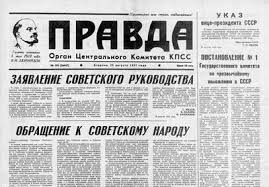
Pravda (front page)
*
[2]
VLADLEN PAVLENKOV
On 22 November 1977, an article by M. Nazarov was published in Gorky Pravda, “But the King is Naked!” It concerned Vladlen Pavlenkov, his wife Svetlana Pavlenkova and the Ponomaryov family (see “The Ginzburg Case”, CCE 47.3-1).
On 5 January 1978, the same newspaper carried an article “People, Be Vigilant!” by V. Gorlyansky (D.Sc., Philosophy), head of the Marxism-Leninism department at the Gorky Conservatory. Again, it was about the Pavlenkovs and M. Pankratov.
The author writes in particular:
“And it is in vain that they affirm that this work” [one of Vladlen Pavlenkov’s ‘criminal’ works, Chronicle] “has to this day not been found.
“It has been found. I read it as long ago as the beginning of 1974,” [when Pavlenkov was in the camps, Chronicle].
The author recalls that in 1974 he visited Pavlenkov [2] in a camp.
The article contains a transparent hint: “I don’t know what keeps Pavlenkov here,” [in the USSR, Chronicle] and ends:
“In order that there should be no new Pavlenkovs, Ponomaryovs or Pankratovs one wants to cry out to everyone: ‘People, be Vigilant!’”
*
On 9 January KGB officials came to Sergei Ponomaryov (CCE 47.3-1) and took him away for a “chat”.
At the KGB he was asked whether he had read the articles about himself and his friends. Then they told him that they were not going to ‘play cat and mouse’ with him any longer.
Certain publications had appeared abroad. He had not put an end to his activities, and people were being drawn to him. The KGB had no more time to waste. It was time for him to choose “to live normally in future — or you’re for it!” Especially since his second daughter had been born, while his living conditions and work left something to be desired.
He was also told that he had no prestige either in Moscow or Gorky, neither did he have any relatives abroad. His ‘interlocutors’ put it to Ponomaryov. Either he gave them a written guarantee that he would become a “normal person”: then he and his wife would be given work in their profession, supplied in the very near future with a flat, and his works would be published. Or else an article would be published which compromised him “from a moral as well as from a dissident angle” in such a way that people whose opinion he valued would turn away from him.
Ponomaryov was given three days to think it over.
Three days later, when KGB officials again came to see him at work, they did not find him: he was ill. So far, they have not bothered him anymore.
*
[3]
“DEFAMATION”
On 12 February 1978, the Vladimir Region newspaper The Call [Prizyv], talked of attempts to circulate “slanders on Soviet reality”: N. Demyanov, “Why do ‘weeds’ sprout up?”
Gennady Kalyakin, from Vladimir (about 40 years old)
“has composed such a letter, supposedly in the name of a group of foreign tourists, that you couldn’t think it up if you tried”.
He explained his act as due to the influence of his religiously-oriented father. Since it is a long time since Gennady lived with his father, the article’s author considers
“there is another reason — his narrow interests: he performs no publicly useful work, he does not go to the cinema or theatre, and he has no close contacts with his neighbours”.
*
It may be understood from the article that Vyacheslav Gundorov, a lathe operator from Stepantsev (Vyazniki district, Vladimir Region), has distributed leaflets:
“One day Vyacheslav was present at a conversation.
“The subject was the pitiful renegades called dissidents. Many of those present at the conversation indignantly condemned this rabble. Vyacheslav’s mind worked in the opposite direction — he hardly read newspapers and journals, after all, but listened mostly to Western radio.
“And so, arriving for the night shift and left by himself in the metal workshop, he began to compose a proclamation…”
The cause of Gundorov’s fall was drunkenness.
Both Kalyakin and Gundorov, “faced by incontrovertible proofs, were forced to admit that they had got onto the slippery slope”.
Since both repented, as described in the article, judicial proceedings were not instituted, although
“their actions fell under definite articles of the Criminal Code and they could have been made strictly answerable for slandering Soviet reality”.
*
[4]
“VALENTINOV”
Victor ‘Valentinov’ is the author of numerous articles about dissidents in Literaturnaya gazeta. For example in 1977 articles by him, written jointly more often than not with Boris Roshchin, were published six times [3].
“Victor Valentinov” is the pseudonym of KGB Colonel Viktor Vasilyevich Ponomaryov (b. 1938), an official of the KGB’s Second Main Administration [4].
The last of these articles, “Blackmail: about a Certain Anti-Soviet Campaign”, concerns Anatoly Shcharansky (CCE 48.2 [4]).
=======================================
NOTES
- On Petrov (Agatov), see CCE 10.15 [21], CCE 11.3, CCE 12.10 [18], CCE 17.12 [9] and Name Index.
↩︎ - On Pavlenkov, see CCE 12.4 & CCE 13.3, CCE 15.4 [4], CCE 33.6-2 [5], CCE 34.8 [8] and Name Index.
↩︎ - 2 February, 31 August, 14 & 21 September, 23 November and 28 December 1977.
↩︎ - According to Wikipedia, the KGB’s 2nd chief directorate was “primarily responsible for internal security, including counter-intelligence, internal political control, and the surveillance of Soviet citizens and foreign nationals within the USSR”.
It was also engaged in “monitoring foreign embassies and countering their activities.”
↩︎
=============================
 A Chronicle of Current Events