On 10 December 1968 it will be twenty years since the United Nations General Assembly adopted “the Declaration of Human Rights“.
“Human Rights Year” began all over the world on 10 December 1967.
On 11 December 1967 the trial of Yury Galanskov, Alexander Ginzburg, Alexei Dobrovolsky and Vera Lashkova was due to begin in Moscow. The trial was postponed, however, and only began on 8 January 1968 [1].
*
THE ACCUSED
All four were charged under Article 70 (RSFSR Criminal Code: “Anti-Soviet Agitation & Propaganda”); Galanskov was additionally charged under Article 88-1 (“Illicit currency transactions”).
The four were all arrested in January 1967 and spent nearly a year in Lefortovo Prison (Moscow). This was in violation of Article 97 of the RSFSR Criminal Procedural Code: it states that the maximum period of pre-trial detention may not exceed nine months [2].
*
Before his arrest Yury Galanskov (b. 1939) was a manual worker at the State Literary Museum and a 2nd-year student who attended evening courses at the Historical Archives Institute. Galanskov compiled and issued the typewritten literary collection Phoenix 66. Galanskov’s poems were printed in the first Phoenix (1961) and also circulated separately [3].
*
Alexander Ginzburg (b. 1936) was also a manual worker at the State Literary Museum and a 1st-year student who attended evening courses at the Historical Archives Institute.
He put together a collection of materials on the case of Sinyavsky and Daniel (the so-called White Book), and in November 1966 sent copies to certain deputies of the USSR Supreme Soviet and to the State Security Committee of the USSR (KGB).
In 1960, Ginzburg was arrested by the KGB in connection with the issuing of the Syntax poetry collections, three issues: he was convicted under Article 196, pt. 1 (RSFSR Criminal Code: “Forgery of documents”). Ginzburg was sentenced to two years in corrective labour camps, the maximum term under Article 196-1, despite the insignificance of the crime: forging a certificate in order to sit an exam on behalf of a friend, and the complete absence of mercenary motives for his actions. He served the sentence in the camps of the Komi ASSR (Northwest Russia).
In 1964 the KGB again tried to bring charges against Ginzburg under Article 70. They accused him of being in possession of ‘anti-Soviet’ literature; the case was dismissed for lack of a corpus delicti.
*
Alexei Dobrovolsky (b. 1938) worked as a book-binder [4] in the State Literary Museum and was a 1st-year student at the Moscow Institute of Culture.
In 1957 he was sentenced under Article 58-10 (1924 RSFSR Criminal Code) to six years’ corrective labour. He served the sentence in Potma in Mordovia SSR (Volga Federal District). Dobrovolsky was released from the camp in 1961.
In 1964 he again faced criminal charges. After a forensic psychiatric examination, however, he was pronounced insane (schizophrenia was diagnosed) and sent to the Special Psychiatric Hospital in Leningrad. The Phoenix 1966 collection published an article by Dobrovolsky, “Relations between Knowledge and Faith”.
*
Before her arrest Vera Lashkova (b. 1945) worked as a typist at Moscow University and was a 2nd-year student at the Institute of Culture.
*
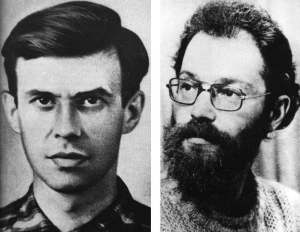
Yury Galanskov and Alexander Ginzburg
*
TRIAL
The court proceedings lasted five days (8-12 January 1968).
Twenty-five witnesses were heard, and the court was shown material evidence (CCE 2.8) confiscated during searches:
- NTS books and pamphlets, money and a hectograph, all discovered in Dobrovolsky’s flat;
- two copies of the Phoenix collection, found in Galanskov’s and Ginzburg’s flats;
- also an edition of the White Book published abroad in March 1967, and several typewriters, on which the White Book and Phoenix materials had been copied.
*
The trial was formally open to the public, but admission was by permit.
In November 1967 a letter bearing 116 signatures was sent to the Moscow City Court, referring to the current practice of refusing access to public trials, and asking in advance that the signatories should be given the opportunity to attend these proceedings. Not one of the signatories of the letter was given such an opportunity; the procedure used for allocating permits to attend the trial has still not become entirely clear.
All that is known is that, apart from a large number of KGB agents and members of Komsomol operational squads, and a few representatives [5] of the legal profession (e.g. only two passes were issued to the Moscow Collegium of Lawyers or Bar Association), the remainder of the audience obtained their permits principally from district committees of the Communist Party.
*
The closest relatives of the accused were present in the courtroom: Galanskov’s parents, sister and wife; Ginzburg’s fiancée; Dobrovolsky’s mother; Lashkova’s mother; and, after the testimony of witnesses had been heard (i.e. towards the end of the third day of the hearing), Ginzburg’s mother and Dobrovolsky’s wife.
On the second day of the hearing Galanskov’s sister Yelena Galanskova was not allowed back into the court after going out for a few minutes to get a breath of fresh air (she was pregnant), allegedly because she had spoken to witnesses who had not yet been questioned. In spite of the severe frost a large number of people gathered near the court building, more especially towards the end of each day’s sessions. The largest number, some one hundred people — not including foreign correspondents and the huge number of informers — assembled on the last day to hear the verdict pronounced.
*
SENTENCE
The court (the prosecutor was Procurator Terekhov; the Judge, Mironov) sentenced Yury Galanskov to seven years imprisonment to be served in strict-regime camps, Alexander Ginzburg to five years, Alexei Dobrovolsky to two years, and Vera Lashkova to one year’s imprisonment.
The lawyers of all four convicted individuals entered appeals.
The appeals were heard in the Russian Supreme Court on 16 April 1968 (the prosecutor was Procurator Terekhov, Judge Ostroukhova). The sentence of the Moscow City Court was upheld.
Lashkova was released on 17 January 1968, having served her sentence in full.
Up to the day of the appeal hearing the three remaining accused were held in Lefortovo Prison (Article 97 of the Russian Criminal [Procedural] Code thus being further infringed).
1.2 — Protests about the Trial …
===================================================
NOTES
A fortnight after the trial ended the KGB sent a four-page report to the Central Committee about the results of the hearings (26 January 1968, 181-A [R]). The trial had proven the group’s “criminal ties with the NTS” and met with general approval, but several of the lawyers and certain members of the intelligentsia (“especially in Moscow and Novosibirsk”) were raising doubts about the verdict.
*
- As Bukovsky later discovered, Party ideologues raised serious objections to proposals as to how to handle the trial: see 25 November 1967*, SF No. 4597 and 5.2: The NTS and the dissident movement.
↩︎ - The same happened again in 1977 (CCE 48.2) with the pending trials of Helsinki Group activists Yury Orlov, Alexander Ginzburg and Anatoly Shcharansky.
↩︎ - Yury Galanskov had long been an active dissenter (see his writings of 1961).
In 1965 he staged a one-man demonstration outside the US embassy in Moscow in protest against the American intervention in the Dominican Republic. For a more extensive biography, see CCE 28.1.
↩︎ - By adding Alexei Dobrovolsky (CCE 9.6) who appears, unlike the others, to have had some genuine ties with the émigré Russian group, the NTS, the authorities hoped to induce a highly desirable atmosphere of conspiracy, subversion and foreign links.
According to official documents in the émigré press — see Russkaya mysl (Paris) 7 March 1968 and Possev (Frankfurt) 6 October 1967 — Dobrovolsky was earlier given a three-year sentence in 1958.
↩︎ - Eminent Norwegian lawyer I.A. Soerheim tried to obtain access to the trial as an observer from Amnesty International but he was persistently barred.
In their appeal “To world public opinion” (CCE 1.2) Larissa Bogoraz and Pavel Litvinov may have been encouraged by Soerheim’s presence outside the court to demand the admission of international observers.
↩︎
===================================
 A Chronicle of Current Events