<< No 33 : 10 December 1974 >>
On the railway line running from Moscow southeast to Ryazan, and northeastwards to Ruzayevka in the Mordovian ASSR, lies the station of ZUBOVA POLYANA (see bottom edge of map).
The station is 441 kilometres northeast of Moscow. The next station, POTMA, is 455 kilometres from Moscow.
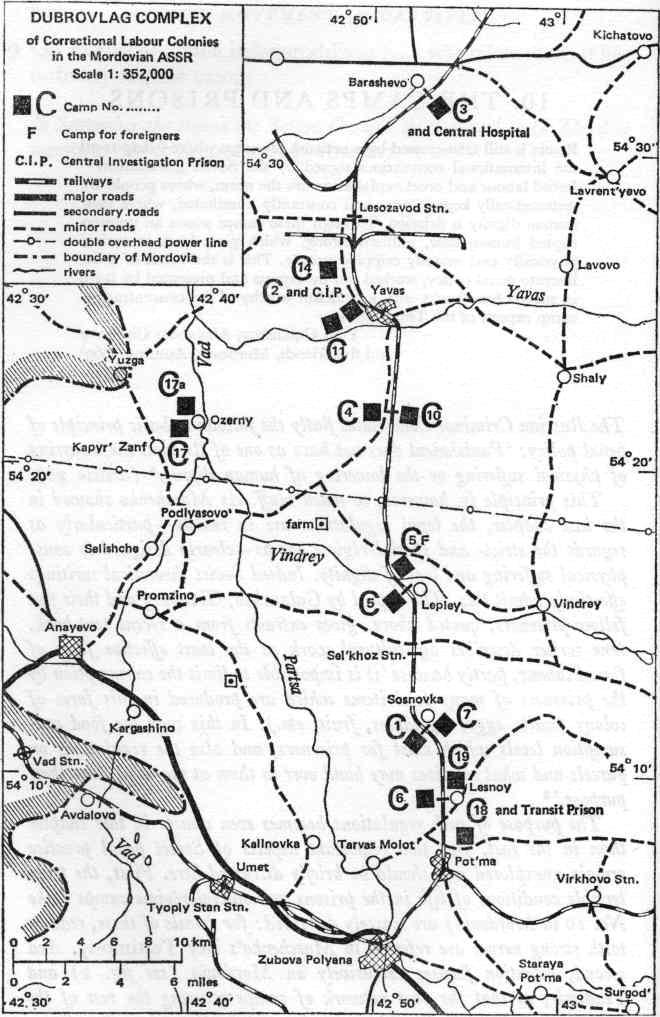
Map copied from Browne (ed.), Ferment in the Ukraine, 1971
*
From POTMA, a narrow-gauge line runs north.
It is used by wagons bearing the inscription “Property of ZhKh-385” and leads to the corrective-labour colony Institution ZhKh-385 [1], otherwise known as “DUBRAVLAG”.
This is where political prisoners are held, except for those convicted under Articles 190-1, 190-2 and 190-3 of the RSFSR Criminal Code [2] (and the corresponding articles in the other Soviet republics).
*
PERM
Other political prisoners serve their time in Institution VS-389 (CCE 33.5 “the Perm Camps”).
In both cases they share the camps with people accused of “Especially Dangerous Crimes against the State” (Articles 64-73, RSFSR Criminal Code).
The prisoners in these two penal colonies come from all over the Soviet Union, not just from the Russian Republic.
The Chronicle does not know whether such types of prisoner are also held in other camps.
♦
[1]
MORDOVIA
The political prisoners at Institution ZhKh-385 are held in CAMPS 1, 3, 17 and 19 (see Map above). Their addresses are, correspondingly, “Institution ZhKh-385/1”, etc.
CAMPS 1, 17 and 19 are situated in the Zubovo-Polyana district of the Mordovian ASSR; CAMP 3 (Barashevo) is in Mordovia’s Tengushevsky district (top of map).
*
CAMP 1
settlement of Sosnovka, the first rail station north of Potma.
The headquarters of Institution ZhKh-385 are in the urban settlement of YAVAS (pop. 5,849; 2021), roughly halfway north along the narrow-gauge branch-line.
*
CAMP 17
the tiny settlement of Ozyorny, 18 kilometres west of Yavas.
The road from Yavas to Ozyorny is in such a state that the prisoners call it “the road of death”: there have been instances when prisoners travelling over this road in Black Marias (they are divided into tiny single compartments with nothing for the person inside to hold on to) have suffered broken bones, concussion, etc.
*
CAMP 19
the settlement of Lesnoi, six kilometres from Shala rail-station.
Transport from Shala to Lesnoi is by rail trolley.
*
CAMP 3
the settlement of Barashevo, the final station on the narrow-gauge line.
Women political prisoners are kept in Zone 4 of CAMP 3.
The hospital of Institution ZhKh-385 (Dubravlag) is in Zone 2 of CAMP 3.
*
[2]
CAMP 1
(Special Regime)
The prisoners in CAMP 1 [3] are kept under special-regime conditions. (Up to 1971 or thereabouts, the special-regime camp was Camp 10, near Leplei rail the station.)
The camp building consists of 12 cells for prisoners, four punishment cells, a workshop, and rooms for the guards and administration offices. Three small exercise courtyards, with latrines, adjoin the building.
Each prison cell (15 square metres, i.e., 3 x 5) is for eight persons: it has two-tier bunks, a table, a bench, a hanging cupboard and a latrine bucket. The prisoners’ cells are dark and damp; about two mattresses per year per prisoner rot because of this.
The workshop (14m x 12m x 3.2m) is also damp: the ceiling steams up, and moisture trickles down the walls. The work is hard and extremely unhealthy – grinding glass with abrasive cast-iron wheels.
Abrasive silicose dust hangs in the air, and there is no ventilation. Nor is any special clothing provided. A medical commission ruled that the work was unhealthy, but, nonetheless, refused to grant extra milk rations for the prisoners. The working day lasts eight hours. The prisoners include many criminal offenders who have been sentenced under political articles while in the camps.
♦
GEL
Ivan Andreyevich GEL (Ukr. Hel [4]) is in Camp 1.
On 16 October he started a hunger strike, declaring it was “to the death” (i.e. with no time limit). He demanded
- the granting of special status to political prisoners;
- permission for the International Red Cross to have access to political prisoners;
- the removal of the Ministry of Internal Affairs (MVD) authority over medical services in labour camps. He himself has suffered from severe headaches for a long time, but has not received the necessary medical treatment;
- and the registration of his marriage with the woman who is his natural-law wife. They have a child, usually considered sufficient grounds for the registration of a marriage, but have been trying to get registration for nearly three years, without success.
*
[3]
CAMP 17
At the beginning of 1974 a group of political prisoners in CAMP 17 protested to the highest authorities against being held with war criminals.
♦
CHORNOVIL
In 1974, in Camp 17, Viacheslav Mikhailovich CHORNOVIL [5] went on hunger strike.
In this way Chornovil hoped to obtain permission for a visit by his common-law wife, Atena Pashko. After the hunger strike, the visit was allowed. Chornovil stated that if further visits were forbidden he would go on an indefinite hunger strike. Chornovil and his wife cannot obtain permission for their marriage to be registered.
Later Chornovil was transferred from CAMP 17 to CAMP 19.
♦
Ilya Glezer [6] is also in CAMP 17.
*
[4]
CAMP 19
There was a report in CCE 32.12 about the unsuccessful attempt by a group of political prisoners in CAMP 19 (Lesnoye settlement) to send a letter to the Committee for Human Rights in Moscow.
A subsequent attempt succeeded. The letter is dated March-April 1974, and has six signatories: Kronid Lyubarsky, Boris Azernikov, Boris Penson, A M. Goldfeld, Zoryan Popadyuk and Sergei Babich.
*
The writers describe in detail the prison regime under which political prisoners in the camps are kept: the administration’s tyranny, the continuous illegalities it practices with the aid of all kinds of supplementary orders and directives (e.g., “Order No. 020”, CCE 33.3).
They ask the Committee “to consider the conditions in which political prisoners are held in Soviet labour camps”, and
“to study not only the existing laws controlling the life of political prisoners, but also how these laws are actually implemented”.
The letter-writers also regret that the term “political prisoner” is not used in Soviet law, and that the existence of political prisoners in the Soviet Union is denied.
*
WHAT HAPPENED TO THOSE WHO WROTE THIS LETTER?
(1)
Kronid Arkadyevich LYUBARSKY
On 20 September 1974, Lyubarsky [7] was transferred from CAMP 19 to CAMP 17.
On 7 October Lyubarsky went on a hunger strike “to the death” over his books. According to camp regulations a prisoner has the right:
- one, to keep in his zone — either in his barrack or in the store [kaptyorka] — up to 50 kilograms of personal effects: any surplus has to be kept in an outer store (i.e. outside his zone);
- two, to keep up to five books with him.
Until now, prisoners, including Lyubarsky himself when in CAMP 19, have always been allowed to decide for themselves what the 50 kilograms to be kept in the zone should consist of.
Lyubarsky had selected books as the greater part of his 50 kilograms; but the administration of CAMP 17 suddenly announced that he would be allowed to keep only five books inside the zone, whether with him or in the store.
*
It was then that Lyubarsky went on hunger strike “to the death”, demanding that the administration observe its own rules, On 15 October the administration admitted they had been wrong and promised to return the books.
On 16 October, however, Lyubarsky was taken to Yavas, for trial.
It was only when he entered the courtroom that he realized he was going to be tried. This was an administrative trial, held at the request of the authorities of CAMP 17, in spite of the fact that in that camp Lyubarsky had only been penalized once – he was given a reprimand for talking to other prisoners during work. (It is known to the Chronicle that he had the permission of the foreman to do so, as he was still a “learner” and had to familiarize himself with a new type of job.)
At the trial in Yavas Lyubarsky was accused of breaking the regulations on 15 occasions: earlier he appealed against these charges, but the Procurator had replied only once.
The administration declared that Lyubarsky had not embarked on the path of reform and that he was exerting a harmful influence on younger people. The Procurator, too, declared that Lyubarsky had not embarked on the path of reform; in addition, he said, Lyubarsky had not changed his beliefs.
The court ordered Lyubarsky to be transferred to a prison for the remainder of his sentence.
*
Lyubarsky was taken at once from Yavas to Potma. On 17 October he was dispatched under convoy.
On 20 October he was already in Vladimir Prison. For the first two months there he was kept on the strict regime (as allowed by law), but for the first month he was on punishment rations: this is not provided for by law, but is applied to nearly every prisoner.
Towards the end of October, Malva Landa and the Action Group lodged protests against the transfer of Lyubarsky to Vladimir Prison.
*
(2)
AZERNIKOV, PENSON & GOLDFELD
In spring 1974, B.P. Azernikov and B.S. Penson were transferred from CAMP 19 to CAMP 3.
Before transfer, Boris S. Penson, sentenced in the trial of the “aeroplane people” (CCE 17.6-1), was put in the camp prison for 15 days for “infringement of the regulations on clothing”.
Boris P. Azernikov is a dental surgeon. In accordance with Article 70 (RSFSR Criminal Code) he was sentenced to 3 ½ years imprisonment for “participation in a Zionist organization” (CCE 23.9 [6]). His sentence was due to end in February 1975.
A.M. Goldfeld (release reported in CCE 32.12) has already left for Israel.
♦
[5]
TRANSFERS
The transfer of Babur Shakirov to VLADIMIR PRISON was reported in CCE 32.12.
As far as is known, B. A. Shakirov was sentenced to eight (?) years’ imprisonment under articles corresponding to Articles 64 & 70 (RSFSR Criminal Code); he was charged with Uzbek nationalism and attempting to cross the border.
♦
Antanas Sakalauskas (sentenced in Lithuanian “Trial of the Five”, CCE 32.10), has arrived at CAMP 19.
♦
Roman Semenyuk (CCE 27.5) has been transferred from Vladimir Prison to CAMP 19.
*
LYUBOMIR STAROSELSKY
The arrival in CAMP 19 of Lyubomir Staroselsky, arrested “at his school bench”, was reported in CCE 32.10. Additional details have now become known, which show that issue 32 was inaccurate in one respect.
Staroselsky was born on 8 May 1955; his co-defendant, Roman Kolopach, on 12 November 1954.
Staroselsky finished school after the 9th year and started working. On the night of 8-9 May 1972 Staroselsky and Kolopach put out two yellow-and-blue Ukrainian nationalist flags in the village of Stebnik (Lvov Region).
On that date neither of them had reached the age of 18.
On 19 February 1973, Lvov Region Court found Staroselsky [8] and Kolopach guilty of actions under two Articles of the UkSSR Criminal Code: 62 & 187-2 (= Articles 70 & 190-2, RSFSR Code). They were charged (Article 62) for putting out Ukrainian nationalist flags, and (Article 187-2) for “defiling the State emblem or flag”: the flags incorporated some blue cloth torn by Kolopach from the red-and-blue flag of Soviet Ukraine.
The court sentenced Kolopach to three years, and Staroselsky to two years’ imprisonment.
Both youths were taken into custody only after sentence had been passed, so their term of imprisonment began on 19 February 1973.
♦
[6]
PRISONERS IN CAMP 19
Two of the four ASCULP leaders [9] are in CAMP 19.
Yevgeny Alexandrovich VAGIN, head of the organisation’s “ideological section”, is by profession a literary scholar; Boris Anatolyevich AVEROCHKIN is a lawyer, who was “in charge of the organization’s documents”.
Their sentences began in March 1967.
♦
ANATOLY IVANOV
Anatoly Ivanovich IVANOV is a prisoner in the Mordovian camps, seemingly in CAMP 19.
*
Ivanov was born in 1939, in the large town of Vyazma (Smolensk Region).
Until his arrest he worked as a taxi driver in Moscow, living in the suburb of Odintsovo.
Ivanov is married and has one son. In February 1971 the Moscow Region Court sentenced him to five years in labour camps under Article 70 (RSFSR Criminal Code).
The charge against him was that, from 1969 onwards, he had been writing poems and other material [10] in which he had
“crudely distorted the life and history of the Soviet People, the activity of the Party and the government, had poured scorn on Soviet democracy and had exaggerated isolated shortcomings”.
In addition, he was charged with:
- an appeal to the Presidium of the USSR Supreme Soviet for permission to emigrate to the USA;
- describing the despatch of troops to Czechoslovakia as ‘occupation’;
- expressing dissatisfaction that citizens’ constitutional rights cannot be exercised in practice;
- declaring in conversations with workmates that “the policy of the Party creates disorder, is directed against the People, and it was essential to form an opposition party”.
During the pre-trial investigation Ivanov expressed his regret for “having acted wrongly when making such statements”.
At his trial, he pleaded not guilty.
♦
PETROV-AGATOV
In December 1973 Alexander Alexandrovich PETROV-AGATOV (Agatov is a literary pseudonym) arrived in CAMP 19 from Vladimir Prison.
In the past Petrov-Agatov was a Communist and a leading member of the Stavropol Region Party Committee. He wrote the words to the well-known song “Dark Night” (film “Two Warriors”).
*
Because of critical remarks about Stalin, Petrov-Agatov was accused in 1947 of anti-Soviet propaganda; in June 1948 he was sentenced to imprisonment by the extra-judicial Special Board.
He escaped from the camps on five occasions. Each escape was declared ‘counter-revolutionary sabotage’. For each he was sentenced to an additional term of imprisonment. In 1956 Petrov-Agatov was released and legally exculpated.
Following his release Petrov-Agatov worked as an assistant to the Minister of Culture in the Chechen-Ingush ASSR (North Caucasus). His works were widely published and his song “My Checheno-Ingushetia” became almost a national anthem in the Republic.
*
Petrov-Agatov was again arrested in 1960. He was released in 1967. The circumstances of this case are not known.
After his second release Petrov-Agatov continued writing and translating. He did many translations of poems by Yandiev, Raisa Akhmatova, Akhmet Vedzizhev and Mutalibov. He has translated works by almost all the Chechen and Ingush poets.
In 1967 a cycle of his own verse lyrics was published in the Prostor journal (Kazakhstan), and another selection of his poems was published in 1968, in the Neva journal (Leningrad), No. 3. His short novel The Secret of the Old Church was also published in Neva (No 8, 1968).
*
In 1968 Petrov-Agatov was arrested once more. The indictment [11] in his case reads:
“On 26 July 1968, by order of the Directorate for the Moscow City & Region KGB …, A.A. Petrov was arrested for conducting anti-Soviet agitation.
“The investigation carried out in connection with this case has established that, from 1943 onwards, Petrov wrote, kept and distributed various poems of an anti-Soviet nature … . Later, A.A. Petrov copied into notebooks the anti-Soviet verses he had written between 1943 and 1953 and kept them with the intention of distributing them at some future date.”
“In 1968 Petrov produced a handwritten book of poems which he called Songs of Hope and Faith. In this handwritten collection Petrov included anti-Soviet poems which he had written in 1943-1953, … and which contain libellous fabrications defaming the Soviet political and social system; in addition, the poems ‘To God’, ‘The United States of America’ and ‘To President Johnson’ contain calls for the overthrow of the Soviet regime. … In July 1968, moreover, he wrote an anti-Soviet text called ‘Epilogue’.”
The sentence was seven years under Article 70 (RSFSR Criminal Code).
In the camps Petrov-Agatov wrote Encounters with Convicts, a documentary work of an autobiographical nature.
This work, and a number of poems from the collection Songs of Hope and Faith (“Kolyma Track”, To God”, “Twenty-Six”, “The Sword of Gumilyov”) have been published in the West.
In November 1970 Petrov-Agatov was sent to VLADIMIR PRISON for three years.
He arrived in Camp 19 in December 1973.
♦
PUNISHMENT CELLS
During 1973, Zoryan Popadyuk, Solomon Dreizner, Kronid Lyubarsky, Paruir Airikyan, Babur Shakirov, Nikolai Budulak-Sharygin, Alexis Pasilis, Anatoly Ivanov, Vladimir Mogilyover, Izrail Zalmanson and Roman Semenyuk each spent six months in the cell-type premises (a form of camp prison, punishment cells) in CAMP 19.
Boris Azernikov spent three months in the cell-type premises during 1973.
♦
[7]
RELEASES
(from CAMP 19)
In 1973 Solomon Girshevich DREIZNER (CCE 20.1) and Paruir Airikyan (CCE 16.4, CCE 34.4) were released from CAMP 19 at the end of their terms of imprisonment.
*
In 1974 Vladimir Mogilyover (CCE 20.1) and Alexis Pasilis were released at the end of their terms of imprisonment.
*
ALEXIS PASILIS
Pasilis was sentenced in 1970, in the town of Klaipeda, to four years’ imprisonment for distributing pamphlets and for hanging out Lithuanian national flags. He was charged under Article 68 (Lithuanian SSR Criminal Code = Article 70, RSFSR Code). His co-defendants were Silinskas and Balkaitis.
In the winter of 1973-1974 Pasilis was taken to Vilnius, “to be educated”.
On 16 February 1974 he was taken back to Mordovia but to a different camp. At the end of August Alexis Pasilis was returned to Vilnius and there set free [12]. The local police have placed him under administrative surveillance for six months.
♦
[8]
PARDON & COMMUTATION
(CAMP 19)
Near the office-block in CAMP 19 a notice was posted. It read:
“THEY HAVE EARNED THE HIGHEST TRUST OF THE LAW”.
At the request of the administration, and by order of the supervisory commission, it says, the following persons have been granted a remission of the remainder of their terms by being given pardons or by commutation of their sentences. This is because of their conscientious work, exemplary behaviour and active participation in the public affairs of the camp:
M.V. Elin, M.R. Potseluiko, A.N. Vashchenko, A.V. Stapchinsky, V.A. Pupelis, J.J. Rubenis, F.F. Klimenko and P.A. Kalva.
*
WHO, IN FACT, ARE THESE PEOPLE?
Elin is a former soldier who defected to West Germany, returned voluntarily, and received a ten-year sentence in accordance with Article 64 (RSFSR Criminal Code: “Treason”). In the camp he worked as senior electrician.
Potseluiko took part in mass murders during the German occupation; he personally hanged a number of people, his sentence was 25 years. In the camp he worked as senior foreman.
Vashchenko worked as a chief of police under the Germans during the occupation and took part in mass murders; his sentence was 25 years, and in camp he was in charge of the stores.
Stapchinsky worked as a Gestapo interrogator; he was first sentenced to 25 years and later received another 25-year sentence for participating in the Vorkuta camp uprising. In the camp he was a senior foreman.
Pupelis and Rubenis served in the German army, both of them got 25 years. In the camp Pupelis was in charge of the seed-beds, and Rubenis was his assistant.
Klimenko was arrested in March 1969 on account of a manuscript (evidently of an autobiographical nature) and during his pre-trial investigation gave false evidence against Pavel Litvinov and Larissa Bogoraz (CCE 8.14 [23]); his sentence was five years; the handwritten texts of Klimenko’s denunciations have been found.
Kalva was given a ten-year sentence for participating in the Latvian partisan movement. In the camp he worked as a construction engineer; he was pardoned three months before his sentence expired.
*
[9]
WOMEN PRISONERS
CAMP 3
There are, at present, 22 women in the 4th (female) zone of CAMP 3 (cf. CCE 15.8).
*
(1) Darya Yuryevna GUSYAK: Ukrainian (b. 1924), a member of OUN (Organization of Ukrainian Nationalists); sentence, 25 years.
Imprisoned since 1950; 1950-1969 in Vladimir Prison. At present almost blind, suffers from dermatitis.
*
(2) Maria Ivanovna PALCHAK: Ukrainian (b. 1922 or 1927), member of OUN, Arrested in 1960 or 1961; sentenced to be shot, but sentence commuted to 15 years.
*
(3) Nina Antonovna STROKATA (Strokatova). Ukrainian (b. 1925), microbiologist. Arrested December 1971 under Article 62 (UkSSR Criminal Code = Article 70, RSFSR Code), sentenced to four years imprisonment.
Strokata is suffering from an oncological illness. Once every six months she is taken to a cancer clinic in Rostov-on-Don for examination. In 1974 Strokata was elected an honorary member by the American Association of Microbiologists.
Her husband Svyatoslav Karavansky [13] is now serving his 25th year of imprisonment. He is presently in CAMP 1. His term ends in 1979.
*
(4) Iryna Mikhailovna SENIK: Ukrainian (b. 1925). Was imprisoned from 1944 to 1954. In October 1972 she was arrested again (CCE 28.7, CCE 32.12). Her sentence was six years in the camps and three years in exile.
Iryna Senik is a Group II invalid: she has either tuberculosis or a fractured spine.
*
(5) Stefaniya Mikhailovna SHABATURA: Ukrainian (b. 1938), is a commercial artist. Arrested in January 1972 under Article 62 (UkSSR Criminal Code), sentenced to five years in the camps and three years in exile (CCE 28.7, CCE 32.12).
*
(6) Iryna Onufrievna STASIV-KALYNETS: Ukrainian (b. 1940), a poet. Arrested in January 1972 under Article 62 (UkSSR Criminal Code), sentenced to six years in the camps and three years in exile (CCE 28.7, CCE 32.12).
In spring 1974, Iryna Stasiv began feeling the first acute symptoms of a renal disease, the preliminary diagnosis was nephritis. After a period in hospital her condition became more stable.
Her husband Igor Kalynets (CCE 28.7, CCE 32.12) was arrested shortly after his wife’s trial. He received the same sentence and is now in Camp 35 in the Perm complex.
Their 12-year-old daughter lives with her grandmother in Lvov.
*
(7) Nadiya Alexeyevna SVETLICHNAYA (Ukr. Svitlychna): Ukrainian (b. 1936). Arrested in April 1972 under Article 62 (UkSSR Criminal Code); sentenced to four years in labour camps, to be followed by exile (CCE 29.5 [3]), Svetlichnaya is a sick woman (she has arachnitis, hepatitis and latent tuberculosis).
Her brother Ivan A. Svetlichny (CCE 29.5 [4]) is in Camp No. 35 in the Perm complex.
Her four-year-old son lives with relatives in Kiev.
*
(8) Galina Vladimirovna SELIVONCHIK (b. 1937). In 1969 she, her husband and brother tried to hijack a plane (her husband was killed in the attempt); she was sentenced to 13 years in camps and five years’ exile (CCE 15.8, CCE 16.5).
*
(9) Anna Moiseyevna KOGAN: (b. 1920), worked for the KGB, was a Party member.
Arrested in 1969, sentenced to seven years. She was tried together with her son. Her son Boris Sokolov (b. 1941), a worker, was sentenced to four years and is now in Camp 35 in the Perm complex (CCE 33.6-2 [86]). Details of their case are not known.
*
TRUE ORTHODOX CHURCH
(10) Alexandra Khvotkova, convicted for the second time for her membership of the “True Orthodox Church”or TOC [14].
(11) Irina Andreyevna Kireyeva, second conviction for being a TOC member.
(12) Anastasia Andreyevna VOLKOVA, sister of I. A. Kireyeva; second conviction for being a TOC member.
(13) Klavdia Volkova, second conviction for TOC membership.
(14) Maria Pavlovna SEMYONOVA (b. 1925); third conviction for TOC membership. Finished her second term of imprisonment, it appears, in 1971 (CCE 15.8).
(15) Nadezhda Usoyeva (b. 1942). Convicted for TOC membership.
(16) Tatyana Sokolova (b. 1934). Convicted for TOC membership.
(17) Glafira Kuldysheva (b. 1929). Convicted for TOC membership.
(18) Raisa Ivanova (b. 1929). Convicted for TOC membership.
Ivanova refused to work in the camp and was sent away for psychiatric examination, from which she never returned.
It is assumed that she was sent to a Special Psychiatric Hospital [15]. Other prisoners consider Ivanova mentally healthy.
*
(19) Natalya Frantsevna GRYUNVALD (b. 1912). Sentenced to 25 years (CCE 15.8 [17]). Her son [16], sentenced with her at the same trial, is now in Camp 35 in the Perm camp complex.
(20) Vera Josifovna KIUDENE. Lithuanian (b. 1919), a peasant. Arrested in 1967 for her participation in the post-war Lithuanian resistance movement. CCE 15.8 [7] stated that Kiudene was mentally ill. No information is available on her present state of health.
(21) Yekaterina Aleshina (?), apparently Mordovian. Sentenced for TOC membership.
(22) Tatyana Pavlovna KRASAYEVA (b. 1904). Sentenced to seven years. No information about her case.
♦
In September 1974, responding to an appeal in the Soviet New Times magazine («Новое время» No. 13, 1974), Svetlichnaya, Stasiv-Kalynets, Strokata and Shabatura handed a statement to the administration.
They requested permission to contribute to the fund for victims of the Chilean junta with money they had earned in the camp. Their request was refused.
They also asked for permission to send delegates from among the women political prisoners to a congress of the Women’s International Democratic Federation [17]. This request was also refused.
♦
Lyubarsky, Azernikov, Penson, Popadyuk, Babich, Izrail Zalmanson and Petrov-Agatov addressed an Open Letter to the Women’s International Democratic Federation:
“There are not many of these women, altogether only 20 to 30.
“We do not wish to discuss here the question of whether or not their conviction was just or lawful. Political disagreements are long-drawn-out affairs, while these women are suffering now.
“We only want to ask whether the power of a mighty State would really be undermined, whether the power which disposes of a gigantic apparatus would be weakened, by the release of two dozen women? Waging war on women cannot be a sign of strength.
“They must be freed!
“What better opportunity could there be for a State which proclaims itself the most humane in the world to prove the sincerity of its declarations? We appeal to you, women democrats: demand that the Soviet government release its women political prisoners … They are your sisters. Help them. That would be not an act of politics, but an act of humanity.”
♦
At the end of August 1974, six years before her sentence was due to end, Silva Zalmanson (CCE 17.6, CCE 32.12) was unexpectedly pardoned. She left for Israel at the beginning of September.
Silva’s husband Edward Kuznetsov, and her brother Izrail, are in the Mordovian camps: Kuznetsov is in CAMP 1; Zalmanson is in CAMP 3. Her other brother, Vulf Zalmanson, is in CAMP 36 of the Perm complex.
==============================================
NOTES
- In the Soviet era penal institutions (prisons, camps, etc) were formally designated ‘Institution’ [uchrezhdenie], with no indication of their nature or function.
For clarity’s sake, the adjective ‘penal’ has often been added to such titles on this website, but the official veiling of their function should always be borne in mind.
↩︎ - Those convicted under Article 190, and its equivalent elsewhere in the USSR (Ukraine, Article 187; Lithuania, Article 199; Uzbekistan, Article 194; and so on) formed up to half of all convicted for political offences.
They were supposed to serve their sentence alongside criminal offenders in their own republics.
↩︎ - For detailed ground plans of CAMP 1, and a typical cell there, see Amnesty International Report (1975).
↩︎ - On Ivan Gel (Ukr. Hel), see arrest (CCE 24.3) and trial (CCE 27.1 [2.3]) both in Lviv; short biography (CCE 28.7 [3]) and Name Index.
↩︎ - On Chornovil, see CCE 5.4, CCE 7.13, CCE 23.9 [3], CCE 24.3 and Name Index.
↩︎ - On Glezer, see CCE 24.11 [4], CCE 25.10 [18], CCE 27.12 [1] and Name Index.
↩︎ - On Kronid Lyubarsky, see CCE 24.2, CCE 25.2 [1], CCE 27.2 [12], CCE 28.4, CCE 32.12 and Name Index.
↩︎ - CCE 35.7 reports that Staroselsky was released, probably in early 1974, and also points to the illegality of his having been put in a camp for adults, after the verdict had specified he was to be kept in a juvenile camp for his whole term.
↩︎ - ASCULP = the All-Russian Social-Christian Union for the Liberation of the People, see CCE 1.6 and CCE 19.4.
↩︎ - A.I. Ivanov: Probably the ‘A. Ivanov’ whose samizdat essay on the desirability of a multi-party system is summarized in CCE 17.13 [14].
↩︎ - The text of Agatov’s indictment reached the West in 1975, with related documents, but was not published that year. For Petrov-Agatov and his works see CCE 10.15 [21], CCE 17.12 [9], CCE 27.5 and Name Index.
↩︎ - On the involvement of Pasilis’ mother, B. Pasiliene, in the case of Sergei Kovalyov see CCE 34.7 [10] and CCE 35.5 [7].
↩︎ - On Strokata’s husband Svyatoslav Karavansky, see CCE 11.3, CCE 13.7, CCE 15.4 [3], CCE 18.5 [7] and Name Index.
↩︎ - On the “Truly Orthodox Church” see W. C. Fletcher, The Russian Orthodox Church Underground: 1917-1970, London, 1971.
CAMP 3, Zone 4 (women): 10-18 and 21. Also see 1941 Ryazhsk executions of eight TOC members (“Map of Memory” website).
↩︎ - CCE 35.7 reports that in October 1974 Raisa Ivanova was ruled to be mentally ill and sent to the hospital in CAMP 3 (Zone 2).
↩︎ - The name (and surname) of Natalya Gryunvald’s son is not given here or elsewhere.
↩︎ - A Soviet-backed organisation (est. 1945), the Women’s International Democratic Federation had its headquarters in East Berlin. In the early 1990s, when the USSR and the German Democratic Republic vanished, it lost its funding, membership and importance and also disappeared.
↩︎
==============================
 A Chronicle of Current Events