In November 1970, Simas Kudirka (b. 1929), radio operator of a Lithuanian fishing-boat, attempted to remain on board an American cutter in US territorial waters (CCE 18.10 [16]). The captain of the cutter handed him over to the Soviet sailors [1].
Kudirka was arrested, an investigation was carried out by the KGB and he was charged under Article 62 (Lithuanian SSR Criminal Code = Article 64, RSFSR Code) with “Betrayal of the Motherland” (CCE 19.11 [8]).
*
THE TRIAL
The trial took place from 17 to 20 May in the courtroom of the Lithuanian SSR Supreme Court in Vilnius [2]. The chairman of the court was I. P. Misiunas; the Procurator, Petrauskas; counsel for the defence, Gavronskis.
When the chairman announced the name of the defence counsel, Kudirka stated that he declined to be defended.
“If defence counsel Gavronskis is an honourable man and defends me conscientiously, it will only do him harm. If he is dishonourable and plays the part of a second Procurator, as is often the case in political trials in Lithuania, then I think my case is not that complicated, and one Procurator will be sufficient.”
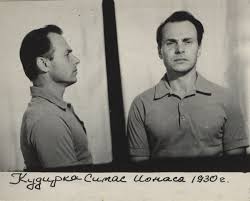
Simas Kudirka (1930-2023)
*
Kudirka pleaded not guilty, since, as he stated, he had not betrayed Lithuania, his motherland [родина]; and he did not regard Russia, now called the Soviet Union, as his motherland. Explaining the reasons which led him to try to escape to the West, Kudirka spoke for more than four hours.
He told of how he had grown up in a very poor family. In 1940, when Lithuania was joined to the USSR, poverty had been supplemented by national oppression. He remembered how people had been taken away to Siberia in 1941 [3], and he knew that it was the most public-spirited Lithuanians who were sent into exile, among them many popular teachers who were declared at the time to be “bourgeois”.
In 1944 he again witnessed people being exiled to Siberia, and had seen mass murders. Many of his comrades had joined the partisans. Almost all of them had perished. He had continued to go to school in Vilnius, completed eight classes and decided to become a sailor. He wanted to see the world, and thought that at sea he would be able to forget the tragedy of his people. He wanted to escape from frightful scenes: the mutilated corpses of Lithuanian partisans lying in heaps in the market-places.
Procurator Petrauskas expressed his outrage at Kudirka’s treachery and said that his act was a disgrace to Soviet Lithuania. He demanded a sentence of fifteen years’ confinement in strict-regime camps with confiscation of property.
*
KUDIRKA’S FINAL WORDS
Kudirka himself summed up for the defence, quoting Herzen, Marx and Lenin.
He explained the difference between socialist theory and practice in Lithuania. He told of the attempts to “re-educate” him: by First Lieutenant Urbonas, his investigator; by Colonel Kismen [or Kislin?], head of the investigation department; by Major-General J. J. Petkevicius, head of the Lithuanian KGB; and by others who had travelled from Moscow for this purpose.
They proposed that if he condemn Lithuanian bourgeois nationalism and say that it had led him to commit treachery, in return they promised to try him under Article 82 (Lithuanian SSR Criminal Code = Article 83, RSFSR Code) the much less severe offence of crossing the border. Kudirka declared that he refused to betray his fatherland, Lithuania, in return for his liberty.
Kudirka spoke of the struggle of the Lithuanian people against assimilation. He told of the ten-year struggle of the “Forest Brethren” (the post-war partisan movement), almost all of whom had been killed or had died in concentration camps. Even KGB officials confirmed that 50,000 Lithuanian partisans had perished. “Never in the history of the world has a partisan movement survived for so long or cost so many lives.”
Kudirka made a single request of the Supreme Court and Government of the USSR: to grant Lithuania her independence.
*
SENTENCE
The sentence of the court was ten years’ hard labour in strict-regime camps with confiscation of property.
Simas Kudirka has a mother, wife and two children.
During the investigation attempts were made to persuade relatives and friends of Kudirka to give evidence suggesting him to be of unsound mind. A medical commission headed by J. Gutmanas, Chief Psychiatrist of Vilnius, pronounced him healthy.
====================
NOTES
Kudirka was pardoned late in 1974 (CCE 33.8) and left to join his mother in the USA. In 2002, Kudirka returned to live in Lithuania.
*
- On Kudirka, see CCE 33.6-3 [31], CCE 34.18 [17] and Name Index.
↩︎ - Long extracts from a samizdat record of Kudirkas’s trial appeared in The Washington Post and the International Herald Tribune, 7-8 August 1971.
In 1978 a made-for-TV film about Kudirka was broadcast in the USA, with Alan Arkin in the starring role.
↩︎ - Map of Memory, “Deportation of Lithuanians, 1941-1951“.
↩︎
==========================
 A Chronicle of Current Events