<< No 22 : 10 November 1971 >>
THREE ENTRIES
[1]
“TIMES” (LONDON) LETTER
On 16 September 1971 the English newspaper The Times printed a letter signed by Professor F.A. Jenner and other English psychiatrists (44 signatures in all). They were responding to Vladimir Bukovsky’s Appeal to Western psychiatrists, published in same paper on 12 March [1].
Bukovsky asked them to make a thorough study of the official medical and other documents, which he attached to his letter, dealing with the confinement, mainly in hospital-prisons, of persons who had protested against certain actions of the Soviet government.
In his letter, which we quote from The Times, Bukovsky wrote:
“I realise that at a distance and without the essential clinical information it is very difficult to determine the mental condition of a person, and either to diagnose an illness or assert the absence of any illness.
“Therefore, I ask you to express your opinion on only this point: do the above-mentioned diagnoses contain enough scientifically-based evidence not only to indicate the mental illnesses described in the diagnoses but also to indicate the necessity of isolating these people completely from society?”
Having studied reports of the examinations of Petro Grigorenko, Ivan Yakhimovich, Natalya Gorbanevskaya, Victor Fainberg, Vladimir Borisov and Victor Kuznetsov, write Professor Jenner and his colleagues at the Sheffield University Department of Psychiatry [2], they have
“grave doubts about the legitimacy of compulsory treatment for the six people concerned, and their indefinite detention in prison mental hospital conditions”.
The authors of the letter to the Times editor go on to say
“It seems to us that the diagnoses of the six above-mentioned people were made purely in consequence of actions in which they were exercising fundamental freedoms—as set out in the Universal Declaration of Human Rights and guaranteed by the Soviet Constitution.”
And later:
“The misuse of psychiatry for political and other ends is, of course, an insidious danger, not only in the USSR, but also elsewhere.
“We also especially hope that the Soviet government will reconsider the case of Vladimir Bukovsky, who acted with courage in making his appeal and who appears to have suffered in consequence. The information we have about him suggests that he is the sort of person who might be embarrassing to authorities in any country because he seems unwilling to compromise for convenience and personal comfort, and believes in saying what he thinks in situations which he clearly knows could endanger him. But such people often have much to contribute, and deserve considerable respect.
“As he has appealed to us to make some sort of statement on persons—outspoken like himself—whom he believes to be the victims of corrupt psychiatric practice, we feel that to answer with a stony silence would be not only wrong but also inhuman …
“A deeply disquieting pattern, sometimes involving the punitive and potentially dangerous use of powerful drugs, seems to be emerging in the treatment of dissenters in Soviet mental institutions.
We therefore call on our colleagues throughout the world to study the voluminous material now available, to discuss the matter with their Soviet colleagues, some of whom we know to have doubts as grave as our own, and to raise the issue, as Vladimir Bukovsky requested, at international conferences such as that of the World Psychiatric Association in Mexico City from 28 November to 4 December. ”
(From the original text of the letter.)
*
[2]
MENTALLY-ILL LITHUANIANS
On 30 October 1971 a “group of Lithuanian intellectuals” addressed a letter to the International Congress of Psychiatrists [3].
The letter recalls that during the armed struggle against the Soviet regime from 1944 to 1953 about 50,000 Lithuanian partisans perished, while the same number died in prison or in exile: in all about 350,000 people were exiled, i.e., one-sixth of the population of Lithuania [4]. Among the political prisoners there were many who were mentally ill, but no-one treated them …
Now, the letter says, they are beginning to “treat” healthy people. The authors of the letter give the names of several Lithuanians who have been subjected to compulsory treatment in psychiatric hospitals:
[1] Algis Statkevicius, sociologist, arrested on 18 May 1970 for a number of books described by officials of the KGB as being about “red Fascism”.
For a long time he was in the “Lukiski” hospital-prison, and was then transferred to the Vilnius Psychiatric Hospital (on him see CCE 17.12 [2], CCE 17.15 //Supplement, 74);
[2] Jablaskus (corrected to Antanas Jankauskas CCE 23.7, [3]) arrested in 1971 for circulating leaflets, is now in Kaunas Psychiatric Hospital;
[3] Vaclav Sevruk [5] was not admitted to the entrance examinations for the philosophy graduate school of Vilnius University because of a “mania for Marxism and truth-seeking”; and
[4] a teacher (name unknown) of Lithuanian language and literature, who was director of studies at a secondary school in Birzai, a town north of Vilnius.
Arrested in June 1971, the teacher is at present being held in a psychiatric hospital for writing a book on the struggle of the Lithuanian partisans, which he attempted to send abroad.
*
[3]
A SLANDEROUS ARTICLE
On 24 October 1971 Izvestiya printed an article by K. Bryantsev [6] entitled “False Friends in a Quagmire of Slander”, in which the idea that mentally healthy people are placed in psychiatric hospitals in the Soviet Union is maintained to be a “slanderous fabrication”.
An anonymous reply to this article has appeared in samizdat. The author of the reply is satisfied that there were no grounds for the diagnoses made on Valeria Novodvorskaya and Zhores Medvedev (CCE 13.2 and CCE 14.3, respectively).
“All the other reports of forensic-psychiatric examinations which … specialists have managed to study”, writes the author, “similarly contain no serious scientific arguments, while their descriptive sections contain facts which have often been extremely crudely manipulated.”
The unscrupulousness of the examinations, in the opinion of the author, is the result on the one hand of interference by the investigative agencies and, on the other, of the dominance in Soviet psychiatry of the “Snezhnevsky theories”, which are thought by a number of eminent Soviet psychiatrists to be “completely unscientific and fantastic”.
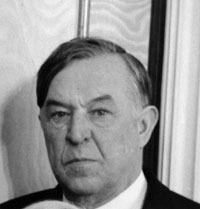
Andrei Snezhnevsky (1904-1987)
These theories, writes the author, “can be concisely defined as an unlimited expansion in the diagnostics of a disease, the symptoms of which are highly uncertain and which has acquired the name of ‘schizophrenia’.” Professor A.V. Snezhnevsky, Director of the Institute of Psychiatry (USSR Academy of Medical Sciences) is a full member of the Academy and “practically holds a monopoly over the entire science of psychiatry in the USSR”.
The triumph of Snezhnevsky’s theories
“was secured in the early 1950s after the so-called ‘Pavlov session’ of the USSR Academy of Sciences and Academy of Medical Sciences, which was followed by crude administrative repressions against the most eminent Soviet scientists on charges of ‘anti-Pavlovian activities’.
“The result of Snezhnevsky’s uncontrolled hegemony over Soviet psychiatry has been his creation of a ‘school’ — a multitude of medical practitioners, including forensic-psychiatric experts, who in defiance of the obvious, and in spite of the psychiatric experience of centuries, diagnose ‘schizophrenia’ when there are absolutely no grounds for doing so. ”
====================================
NOTES
- Compare Bukovsky’s later “Foreword” to Bloch & Reddaway’s Russia’s Political Hospitals.
↩︎ - Only Professor Jenner’s address linked him to Sheffield University. His co-signatories came from all over Britain, with a few from abroad.
↩︎ - Extracts from the Lithuanian intellectuals’ letter were quoted in the Baltimore Sun, USA (20 November 1971).
↩︎ - For a description and other figures, see “Post-war Deportations, 1947-1951“, Map of Memory.
↩︎ - Sevruk’s 200-page autobiography was summarised in CCE 15.11 (3). The summary was also published in Possev: Shestoi spetsialnyi vypusk [6th special issue], February 1971.
↩︎ - Bryantsev wrote another article “Under the Mask of Falsehood” (Izvestiya, 19 April 1971), which dealt with the arrest and deportation of the Belgians Hemschoote and Sebreghts.
See CCE 20.12 (2), for a summary of an as yet unpublished booklet by Valery Chalidze, in which he replies to Bryantsev’s “False Friends”.
A translation of “False Friends in a Quagmire of Slander” may be found, with the samizdat reply to its allegations, in Bloch & Reddaway, Russia’s political hospitals, 1977 (Appendices 4 & 5).
↩︎
============================
 A Chronicle of Current Events