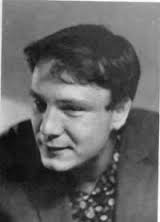
On 29 March 1971 Vladimir Bukovsky was arrested by the Moscow Region KGB.
He was charged under Article 70 (RSFSR Criminal Code) and sent to Lefortovo Prison. A search of Bukovsky’s flat was carried out in his absence: Bukovsky was driven away, questioned, detained and charged, two days later.
*
SEARCH
The search was carried out by Captain Korkach, Senior Investigator of the Investigation Division of the KGB, and four others, whose names were not given (and whose signatures on the record of the search are illegible).
The official witnesses present at the search, Natalya Korobkova and Vladimir Knyazev, arrived with the security officers, who addressed them familiarly as “Natasha” and “Volodya”. Instead of explaining their duties to the witnesses, the investigator told them:
“You’ll be able to have a look at gold coins and bars, jewels and foreign currency here”,
to which Nina Ivanovna BUKOVSKAYA, Vladimir’s mother, remarked:
“You won’t find those things here: better look for them in your own home”.
The following were confiscated during the search:
- materials on the ASCULP case (CCE 1.6, CCE 19.4) of the “All-Russian Social-Christian Union for Liberation of the People”;
- Chronicle of Current Events, No. 17 (31 December 1970);
- Borisov and Fainberg‘s letter from the Leningrad SPH (CCE 19.3);
- Anatoly Levitin-Krasnov’s “The Living Word” (CCE 19.12 [2]);
- Pyotr Yakir’s letter to the 24th Party Congress (CCE 19.12 [5]);
- What are you laughing at? a parody of Vsevolod Kochetov’s novel [1];
- poems by Boris Chichibabin and Vadim Delaunay;
- F. Ya. Mikhailichenko’s The Ideological Diversions of American Imperialism (booklet stamped “For official use”);
- a portrait of Solzhenitsyn (“portrait of a male person” in the search record);
- addresses of foreign committees for the defence of human rights;
- recording tapes (ten spools) and two note-books.
*
DISSENTER
Bukovsky has been persecuted repeatedly for activities which stem from his beliefs.
His principal belief is that freedom must be fought for, and he has acted on this without breaking the law in the process.
Vladimir has spent six of his 28 years in lunatic asylums and prisons.
Demonstrations in defence of Sinyavsky and Daniel in 1965 and of Dobrovolsky, Galanskov, Ginzburg and Lashkova in January 1967 (CCE 2.8 [5]) are linked with his name.
Bukovsky’s final speech at his trial in September 1967 is memorable [2].
On his release from a three-year term of imprisonment in January 1970, Bukovsky immediately joined the struggle for human rights (CCE 15.10 [3]).
*
PSYCHIATRIC HOSPITALS
Bukovsky’s interview on the situation of political prisoners in psychiatric hospitals is well-known [3].
He has himself experienced the prison-hospital (SPH) on Arsenalnava Street in Leningrad (CCE 8.7). He has also been held in Moscow hospitals (Lyublino, Stolbovaya) and, for examination, at the Serbsky Institute.
*
Just before his arrest Bukovsky sent to the West a collection of documents he had assembled.
These give an idea what sort of people are placed in psychiatric hospitals and the methods by which this is done: the materials [4] include copies of the diagnostic reports of forensic-psychiatric experts and letters written in confinement by persons judged to be of unsound mind.
These materials were destined for Western psychiatrists, to whom Bukovsky appealed in a letter (28 January 1971) [5].
Bukovsky’s object (CCE 22.3 [1]) was (a) to help specialists to study the question of how psychiatry is employed in this country to imprison dissenters, so that this question might then be raised at forthcoming international conferences of psychiatrists [6] and (b) to draw the attention of world public opinion to the fate of the inmates of Soviet prison-hospitals.
*
Open Letters in defence of Bukovsky have appeared: a letter by Bukovsky’s mother addressed to Soviet ‘prime minister’ Alexei Kosygin [7]; a letter by 30 of his friends and acquaintances to the 24th Party Congress [8]; an article by Anatoly Levitin-Krasnov, “Not by the Sword and the Lance”.
============================================
NOTES
Almost two months later (18 June 1971*, 1572-Ch [R]) the KGB sent the Central Committee a report about Bukovsky’s arrest, his previous activities and the current interrogation.
*
- Vsevolod Kochetov’s hardline novel What is it You Want? (Chego zhe ty khochesh?) was published in in late 1969 in several issues of the journal Oktyabr, of which he is chief editor (Nos. 9-11).
A number of parodies appeared shortly afterwards in samizdat (CCE 12.10 [8]). This one — Chego zhe ty khokhochesh? (in Russian) — is by S. S. Smirnov; it appeared in Possev No 6, 1970 (pp. 57-59).
↩︎ - The text of Bukovsky’s 1967 speech was published in Pavel Litvinov, The Demonstration in Pushkin Square, London, 1969 (pp. 87-95).
↩︎ - There is an English translation of Bukovsky’s interview in the Survey quarterly, London, No. 77, 1970 (pp. 139-145).
↩︎ - Bukovsky’s collection of documents were included in the large compilation Kaznimy sumashestviem (Punished with Madness) issued by Possev publishers.
Some of the materials are due to appear in English in Survey No. 81; they are analyzed in a booklet by Cornelia Mee, The Internment of Soviet Dissenters in Mental Hospitals (John Arliss: Cambridge).
↩︎ - For Bukovsky’s appeal to Western psychiatrists, see:
Cornelia Mee (note 4); The Times, 12 March 1971 (CCE 22.3 [1]); the British Journal of Psychiatry, London, August 1971 (p. 226), where Dr. Derek Richter calls on fellow-psychiatrists to respond to Bukovsky’s appeal.
The first large scale response, critical of Soviet practices, came in a letter to The Times from 44 prominent psychiatrists on 16 September 1971 (CCE 22.3 [1]).
↩︎ - The issue of Soviet psychiatric practices is to be discussed at the congress of the World Psychiatric Association in Mexico City (28 Nov-4 Dec 1971).
↩︎ - Nina Bukovskaya’s letter, dated 13 April, appears in summary form: in a DPA report, Suddeutsche Zeitung (Munich), 15 April 1971; also in Corriere della Sera (Milan), 14 April.
↩︎ - The letter to the 24th Party Congress is summarized by A. Astrachan in the Washington Post and The Guardian (3 April 1971). Pyotr Yakir, Alexander Volpin and Anatoly Levitin-Krasnov were among the signatories.
Krasnov-Levitin’s article was published in Vestnik RSKhD, Paris, No. 99, 1971 (pp. 136-142).
↩︎
===============================
 A Chronicle of Current Events