On 5 January 1972 (CCE 23.1-1), the Moscow City Court passed sentence on Vladimir Bukovsky [1].
For Soviet readers the only official source of information on the trial of Vladimir Bukovsky was an article by A. Yurov and L. Kolesov, “Biography of villainy”, in the Evening Moscow newspaper (6 January 1972).
To describe the article it is enough to say that it does not even give the sentence in full—the points specifying confinement in prison and the imposition of costs are omitted. Another example. The article states that Bukovsky, on the path which led him to criminality, had been sentenced by a people’s court to three years’ imprisonment for violating public order.
It does not mention that this “violation of public order” was the 1967 demonstration organised by Bukovsky in protest against the arrest of Yury Galanskov, Vera Lashkova and others.
*
Protests and Reactions
The sentence passed on Bukovsky provoked numerous protests, both in this country and abroad.
On 6 January 1972, the International Union of Resistance Fighters of the First and Second World Wars, which comprises about 80 organisations in thirteen countries and numbers 500,000 members, some of whom were inmates of Hitler’s camps, sent the USSR Procurator-General a telegram of protest demanding a re-trial of Bukovsky’s case and the presence at the hearing of international observers.
Telegrams received by Nina Ivanovna BUKOVSKAYA, Bukovsky’s mother, included some from India and Australia. A telegram from Bombay says:
“Indian writers and intellectuals are shocked by the savage cruelty of the sentence passed on your courageous son V. Bukovsky. We have addressed a protest against the sentence to President Podgorny and to Brezhnev, General Secretary of the CPSU Central Committee. We support you and Vladimir. A group of Indian writers.”
A telegram from Sydney reads:
“The members of the Australian association Cultural Freedom give you their unqualified support in your demands for the restoration of justice as regards your son. We express our sympathies and await the coming appeal with interest. President of the Association.”
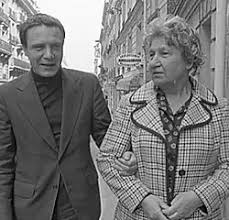
Bukovsky with his mother Nina
*
On 31 January The Times (London) newspaper published a letter from more than 30 eminent English public figures: Members of Parliament, lawyers, scholars, writers and so on [2].
The authors of the letter state that Bukovsky’s actions did not fall under Article 70 (RSFSR Criminal Code). After examining violations of procedural norms committed during the investigation and trial, they write: ‘‘Enough information has become available for the International Commission of Jurists to condemn severely the procedure at the trial” [3]. The letter also expresses the hope that the appeal court “will show more judicial objectivity than was shown by the court of first instance”.
*
Letters in defence of V. Bukovsky have also appeared in samizdat: “Who has slandered whom? My attitude to the case of V. Bukovsky” by Malva Landa, and “On the article ‘Biography of villainy’,” by cousins Sergei and Tatyana Khodorovich [4].
*
On 3 [8?] January 1972, Nina Bukovskaya sent the USSR Procurator-General a complaint about V. G. Lubentsova, the Judge at the Moscow City Court. It points out, among other things, that the court (1) had not summoned any of the witnesses whom Bukovsky and his defence counsel had requested it to summon; and (2) had not questioned, for example, the foreign correspondents who had been interrogated during the pre-trial investigation but had given ‘unsuitable’ testimony.
Bukovskaya states that she has received a legally certified copy of a letter from Sebreghts to the USSR Procurator-General and to the editors of the newspaper Izvestiya. The letter is dated 19 April 1971 [5]. On returning to Belgium from Moscow, it turns out, Sebreghts made a statement repudiating all the testimony he had given under questioning by the KGB, since this testimony had been extracted from him, as he puts it, under “physical and psychological duress”.
Bukovskaya writes:
“At his trial my son categorically denied handing any materials whatsoever to Sebreghts and demanded, together with his defence counsel Shveisky, that Chalidze and Volpin, who had been present at the meeting, should be questioned as witnesses. This, however, was refused.
“So my son was convicted on this count of the indictment solely on the basis of testimony given— under duress—by Sebreghts during the pre-trial investigation. But for some reason the letter from Sebreghts repudiating this testimony did not figure in my son’s case”.
In a statement to the RSFSR Supreme Court (dated 8 January 1972), Alexander Volpin expressed surprise that he had not been summoned as a witness. He himself was the only person who could be held responsible for one of the documents mentioned in the charge against Bukovsky, asserted Volpin, since he was its author.
Valery Chalidze, in a statement of the same date, asked the appeal court to take the following facts into account: (1) Sebreghts, when giving his testimony, was not well-versed in Soviet law; (2) he had not been questioned by the court; (3) Sebreghts had not been personally confronted by Bukovsky; (4) Sebreghts had often contradicted himself in his testimony [6].
In a 13 January letter, addressed to the RSFSR Supreme Court, the Communist Party Central Committee, the USSR Minister of Justice and Academician Sakharov, S.P. Pisarev [7] listed the numerous violations of legality in Bukovsky’s case; he asked for the guilty people to be punished, and for the proceedings against Bukovsky to be terminated at the appeal hearing on the grounds that he had no case to answer.
On 18 January Academician A. D. Sakharov made the following appeal to the General Secretary of the CPSU Central Committee and the USSR Procurator-General:
“I ask you to use your influence and authority to have the sentence passed on Vladimir Bukovsky set aside and Bukovsky himself released …
“It is in the interests of the healthy elements in the leadership of the country and among our people that this unjust sentence should be set aside, and in a broader context that this country, which has endured so much suffering and degradation, should undergo a moral regeneration. For only the moral health of the people is a true guarantee of the viability of the country in creative labour and in the face of coming trials.
“Restore legality and justice!”
*
On 23 February 1972, the RSFSR Supreme Court considered the appeal in the case of V. K. Bukovsky.
The hearing was chaired by Judge Gavrilin; the Procurator was Vorobyov; defence counsel was Shveisky.
A petition from Bukovsky was submitted, asking to be allowed to attend the hearing to explain certain matters relating to the case. Defence counsel Shveisky supported this petition. It was rejected by the court.
Defence counsel V. Ya. Shveisky asked for his client to be acquitted. Procurator Vorobyov, in his address, dwelt hardly at all on the individual counts of the indictment; his address was brief and of a general nature. The verdict of the court was to leave the sentence unaltered.
On 25 February Bukovsky was despatched to Vladimir Prison [8].
*
Transcript of Trial
A detailed transcript of the trial of Vladimir Bukovsky has appeared in samizdat [9]. In the preface the compilers of the transcript write:
“… The responsibility for the fact that this is not a verbatim transcript lies not with the compilers, who have done everything in their power to reconstruct the truth, but with those who denied the friends of the accused entry to the court-room … and the opportunity to take notes openly or to use portable recording apparatus.”
Since then the compilers of the Transcript have noticed that it contains three inaccuracies, which they wish to bring to the attention of readers of the Chronicle.
One, the Transcript said that CCE 17 (December 1970) was confiscated from Sebreghts, i.e. the same issue as was confiscated when Bukovsky was arrested at his flat on 29 March 1971. In fact, according to the records of the interrogation of Bukovsky and Sebreghts, CCE 18 (March 1971) was confiscated from Sebreghts and No. 17 from Bukovsky.
Two, in the last paragraph of the verdict, before the sentence “Bukovsky V. K. is guilty of committing a crime under Article 70”, the compilers of the Transcript omitted the following sentence: “The court finds it proven that Bukovsky pursued the aim of undermining and weakening the Soviet regime”.
Three, Nikitinsky’s first name and patronymic are Arnold Josifovich, not Arnold Eduardovich.
=============================================
NOTES
- Recent issues of the Chronicle have been published in full in Russian only in the journal Volnoye slovo (Samizdat. Izbrannoye), which is edited in Frankfurt.
No. 1 of this journal contains CCE 21, No. 2 contains CCE 22, and so on.
↩︎ - Among signatories of the 31 January 1972 letter to The Times (London) were Lord Gardiner, Arthur Koestler, Iris Murdoch. Harold Pinter and Tony Smythe.
Another letter in Bukovsky’s defence, signed by 36 psychiatrists, appeared in The Times two months later on 30 March.
↩︎ - The protest against “the persistent repression of freedom of speech in the Soviet Union” by the International Commission of Jurists was widely reported on 12 January 1972 (e.g. in The Guardian). ↩︎
- Samizdat letters in defence of Bukovsky were reprinted in Possev No 4, 1972 (pp. 5-7). On Tatyana Khodorovich, see CCE 19.8 [5] (her cousin Sergei was later in charge of the “Relief Fund for Prisoners”).
↩︎ - A condensed version of Sebreghts’ text was published in Possev No 5, 1971 (p. 24).
↩︎ - Chalidze treated these matters at length in his absorbing compilation of May 1971, “A Foreigner came to visit me”, Volnoye slovo No. 2, 1972 (pp. 55-101) and see CCE 20.12 [2].
↩︎ - On Pisarev see P. Reddaway, Uncensored Russia, London and New York, 1972 (pp. 232-233).
↩︎ - On 4 May the Daily Telegraph (London) reported that 20 of Bukovsky’s friends had just appealed to Amnesty International to help put an end to the deliberately cruel treatment of him and his relatives, and obtain his release.
↩︎ - The transcript of the trial was published in Russian in Russkaya mysl, Paris, 2 March 1972 and in Volnoye slovo No. 3. An English version was published in Survey No. 83, London.
As later became known, the transcript was compiled by Bukovsky’s friend Tsumerman.
↩︎
=========================
 A Chronicle of Current Events