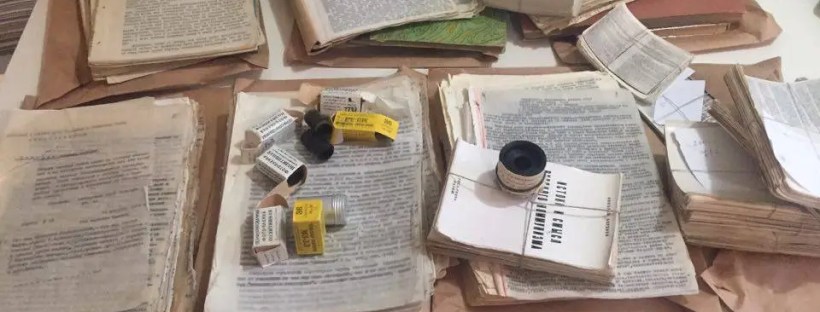
SEVEN ENTRIES
[1]
Anon.
The Ethical Goal (1970)
A philosophical sketch by an anonymous author making certain recommendations to the democratic movement in the USSR.
The work examines the possibility of a real implementation of the Principle of Good in relations between people. In this, the author thinks, lies the only chance of saving humanity from disaster.
*
[2]
Anon.
“Draft of a Common Platform”
An anonymous document. The latest attempt to “combine the principles held most in common” by programmatic samizdat works of recent years.
It is also a call for democratization, which means “the replacement of bureaucratic socialism by socialism with a human face”.
*
[3]
EXODUS, 4
This issue of Exodus (No. 4), the publication of Soviet Jews struggling for the right to emigrate to Israel [1], is devoted entirely to the Leningrad trial of the “aeroplane people” (CCE 17.6-1 & CCE 17.6-2).
The issue consists of three sections:
[1] A transcript of the Leningrad trial, including the questioning of the accused and witnesses, the addresses made by defence counsel, and the final speeches of the accused (CCE 17.6-2).
The transcript is extensively provided with commentaries and notes of an explanatory and elucidatory nature.
[2] Telegrams and letters of protest at the cruel sentences of the Leningrad Court.
[3] A transcript of the appeal hearing in Moscow.
*
[4]
Valentyn Moroz
“Day One”
This short prose sketch has been received from Ivano-Frankovsk Prison (West Ukraine). The author is Moroz (CCE 17.2); the subject of the sketch, his first day in prison.
*
[5]
Arthur London
The Confession (translated from the French)
In 1951 in Czechoslovakia 14 Party members (including the author) were arrested. The most prominent among them was Rudolf Slansky, General Secretary of the Czechoslovak Communist Party.
In 1952 Slansky and ten others were sentenced to be shot. Three — including London — were sentenced to life imprisonment. In 1962 London was released and went to live in Paris.
In 1968 all the accused in the “Slansky trial” were completely rehabilitated.
*
In August 1968 London submitted the manuscript of The Confession to a Prague publishing house.
The book tells of his arrest and the circumstances preceding it; the charges brought against him; the methods by which the state security bodies extracted “confessions”; the 1952 trial itself; and of how the script of the trial was worked out.
London asserts that Soviet advisers were the real organizers of the pre-trial investigation and the trial.
The author has published the book in Paris.
It has also come out in Czechoslovakia, but in a limited edition. It has been made into a film of the same title, starring Yves Montand and Simone Signoret (see Literaturnaya gazeta, 15 July 1970, which denounces the film).
*
[6]
VECHE, 1
The first issue of the typewritten journal Veche has appeared [2] .
The editors of Veche (1971, No. 1, January) define its orientation and aims as follows:
“… to turn our faces towards the Motherland … to resurrect and preserve the national culture, the moral and intellectual heritage of our ancestors … to perpetuate the guiding line of the Slavophiles and Dostoyevsky”.
“We are embarking on the publication of a Russian patriotic journal,” the editors announce.
*
A comparison of the journal Veche with the manifesto “Message to the Nation“, which appeared over the signature of “Russian patriots” (CCE 17.13 [16]), reveals an essential difference.
“Message to the Nation“ is a political declaration preaching racism, State despotism and Great-Power attitudes; whereas the nationalism of Veche takes the form not of a political ideology but only of a particular attitude to Russian history, culture and Orthodoxy. Judophobia and Stalinist sympathies are characteristic of some of the contributors to Veche, but by no means all of them.
The editor of the journal, Vladimir Osipov, writes [3]:
“It must be regretted that the Russian nation is judged not by Khomyakov and Kireyevsky, but by Dubrovin and Menshikov.”
*
We do not think it necessary to annotate or comment on individual issues of Veche, since its concerns are not connected with the question of human rights in our country. We introduce this journal to the reader only because it is an example of the uncensored press.
On 1 March 1971 Osipov, on behalf of the editors of the journal Veche, circulated a statement [4] stressing that Veche is a legal journal, that political problems are outside its field, and that the journal does not aim at belittling the dignity of other nations.
*
[7]
K. Demov [5]
“I am the Guardian”
A critique of A. Mikhailov’s ‘Thoughts on the ‘liberal campaign of 1968’
The points on which Demov takes issue with Mikhailov (CCE 17.13 [18]) are, essentially, as follows.
The science of society, like any other science, is a matter for professionals, not for dilettantes. Samizdat cannot construct a scientific sociology: at best it is capable of generalizing data which sociology has already obtained — and then only if academic sociologists enter the field of samizdat.
In Demov’s view, Mikhailov’s aim of “overcoming the ideological chaos” and working out a unified programme of ten or twelve points is not a scientific aspiration. It is a purely political one, which will later lead inevitably to a party-based power-struggle, like the one which took place early in the 20th century.
*
The subjugation of samizdat to such guidelines (a unified programme), the author thinks, would put an end to freedom of speech in samizdat.
Mikhailov’s notion that the intelligentsia must give the people a “model of democratic socialism” is sharply criticised. What is needed is not yet another socialist scheme, but freedom. The people themselves, Demov maintains, are capable of expressing their own interests and formulating their own demands, without external assistance (e.g., in Poland at present).
The author argues vigorously against Mikhailov’s thesis that it is ruinous to get oneself arrested: in particular he sets a high value on the demonstration of 25 August 1968 (CCE 3.3), which Mikhailov condemned. He adheres to the view that the opposition must be legal, and that in order to achieve freedom it is essential to observe legality. “Better political inactivity than political extremism”, this is K. Demov’s central idea.
The article states in conclusion that democrats must protect society from extremes, from the left as well as the right.
It is in this sense that the author declares, “I am the guardian”.
========================================
NOTES
- Exodus No 4 was published in English by the Institute of Jewish Affairs (London).
↩︎ - The word Veche means a popular assembly (moot or gathering) in mediaeval Russia.
↩︎ - A.S. Khomyakov (1804-1860) and I. V. Kireyevsky (1806-1856) were prominent Slavophiles and religious philosophers. A. I. Dubrovin was a leader of the chauvinist, early 20th-century “Union of the Russian People”; A. D. Menshikov (1673-1729) was a rather crude lieutenant of Peter the Great.
↩︎ - Osipov’s statement was published abroad in Possev 1971 (No. 5, p. 8).
↩︎ - Evidently a pseudonym. Could it be a variant of Sokirko’s ‘K. Burzhuademov’ (cf. CCE 20.12 [9])?
↩︎
==========================
 A Chronicle of Current Events