*
FEBRUARY 1969
In February 1969, the Armenian SSR Supreme Court considered a case in closed session.
A.S. Yegiazaryan, chaired the trial; G.M. Gamaryan was State prosecutor.
G. Aroyan and A. Mosoyan were counsels for the defence.
The six defendants were:
- O.M. Vasilyan (b. 1936);
- A.U. Babayan (b. 1915), a teacher who fought in the Second World War, wounded seven times and received decorations and medals;
- Sh. P. Gyunashyan (b. 1939), a construction engineer;
- S.Kh. Torosyan (b. 1930), a driver;
- A.A. Antonyan (b. 1931); and
- G.R. //Ekimyan (b. 1936).
They were accused under Articles 65-1 & 67 (Armenian SSR Criminal Code = Articles 70 & 72, RSFSR Code) of slandering Soviet reality, denying the equality of nations in the USSR, and circulating slanderous fabrications about the internal and foreign policy of the Soviet government.
The defendants had written articles calling for the creation of an independent Armenia and circulated a leaflet, “We can no longer keep silent”. They had prepared 343 copies of a journal In the Name of the Motherland.
*
The defendants pleaded guilty.
The court sentenced Vasilyan, Babayan, Ekimyan and Torosyan to six years’ imprisonment. It sentenced Antonyan to five years, Gyunashyan to four years, and Arutunyan to eighteen months: like their co-defendants, all in strict-regime corrective-labour colonies.
*
FEBRUARY 1970
In February 1970, the Armenian SSR Supreme Court — A.E. Khanamiryan, chairman; Shlepchak, State prosecutor; and Arevshatyan, Melinyan and Mosoyan, counsels for the defence — considered the case of five 20-year-old defendants:
- P.A. Airikyan (b. 1949), a student of the Yerevan Polytechnic Institute;
- A.O. Ashikyan (b. 1949), a student;
- A.Ts. Navasardyan (b. 1950), a motor mechanic [1];
- R.S. Barsegov (b. 1950), a mechanic brought up in a children’s home;
- A.Z. Khachatryan (b. 1951), a student of Yerevan University.
The charge was brought under Articles 65-1 & 67 (Armenian SSR Criminal Code = Articles 70 & 72, RSFSR Code).
*
The defendants were charged with organising “Shant” in 1967, an illegal group named after the writer Levon Shant (1869-1951).
The objects of the group were:
- to study the history of the Armenian people;
- to defend the purity of the Armenian language; and
- to struggle both against the assimilation of the Armenian people and
- for its unification (the Armenian SSR includes a large part of Eastern Armenia; Western Armenia is part of Turkey under the terms of the Soviet-Turkish treaties concluded in Moscow and Kars in 1921).
*
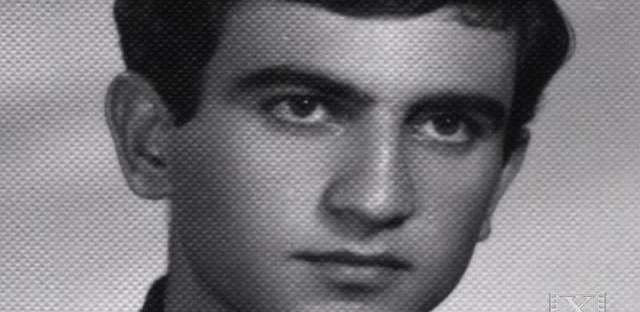
Paruir A. Airikyan [Hayrykian] [2] was charged with leading the group, and also with reading and giving to others the newspaper Paros (The Beacon) and the “Programme and Constitution of the United National Party”.
*
On 24 April 1969 the defendants organised a radio broadcast at the Monument to the Victims of the Armenian Massacre of 1915.
They were charged with reading at their meetings articles on the fate of the Armenian people and on Soviet nationalities policy (“Not by bread alone”, “Sacrificed again to Russo-Turkish diplomacy”, “Methods of solving the Armenian question” and others).
The youths had prepared and circulated leaflets protesting against “Russian chauvinism” and demanding the return to Armenia of Artsakh (Nagorno-Karabakh) and Nakhichevan, regions transferred in 1924 to the Azerbaijani Republic, and the creation of an independent Armenian State.
*
During the judicial examination Airikyan, Ashikyan, Navasardyan, Barsegov and Khachatryan admitted committing certain of the actions of which they were accused. They stated, however, that they had done so because of their national-patriotic convictions, and that their actions could not therefore be regarded as grounds for criminal proceedings.
Airikyan denied having led the group.
*
SENTENCE
The sentence of the Court took account of the youth of the defendants, their “insufficient political maturity”, the positive character-references from their places of work and study, and their participation in socially useful work.
The court noted that long-term imprisonment could have the most serious consequences for the health of the accused and for their further education.
The court sentenced Airikyan to four years’ imprisonment; Ashikyan and Navasardyan to two years in strict-regime corrective-labour colonies; and Barsegov and Khachatryan to six months. As the latter had already served their term of punishment in preliminary detention, they were to be released from custody.
As the sentence was imposed by the Armenian SSR Supreme Court, it is not subject to appeal.
======================================
NOTES
- On Navasardyan, see CCE 41.6-2, CCE 42.4-2, CCE 43.3 and Name Index.
↩︎ - On Airikyan, see CCE 33.4 [7], CCE 34.4, CCE 43.3 and Name Index.
↩︎
==========================
 A Chronicle of Current Events