At the end of September the preliminary investigation (CCE 15.3) into the case of Pimenov, Vail and Zinovieva was concluded.
The investigation was conducted by G.P. Porukov, Senior Investigator of the Leningrad Procuracy; the indictment was confirmed by the Procurator of Leningrad S.E. Solovyov.
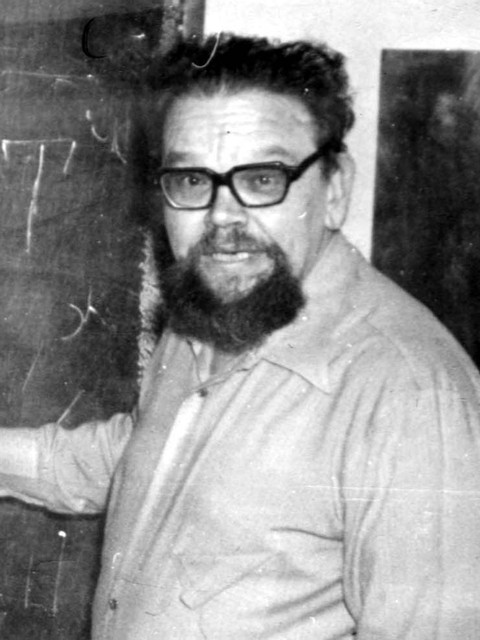
Revolt Pimenov (1931-1990)
*
Revolt Ivanovich PIMENOV is an employee of the Leningrad section of the Steklov Mathematical Institute (USSR Academy of Sciences). In November 1969 he defended his doctoral dissertation [1].
The accusation against him was that between 1967 and 1970 he committed acts covered by Article 190-1 (RSFSR Criminal Code).
In particular he verbally expounded to Valentina Zinovieva deliberate fabrications slandering the Soviet political and social system.
And he took part in the circulation of the following:
- 1. A text written by Pimenov himself, “On the Khrushchov Speech” (this refers to the speech made by Nikita Khrushchov in 1956 at a closed session of the 20th Party Congress),
- 2. Milovan Djilas, “The Russian Revolution Degenerates into Imperialism” [2],
- 3. Valentin Komarov, “September 1969” (CCE 5.1 [2])
- 4. Nikolai Alexandrov “Our short memory” (CCE 5.1 [18]),
- 5. A Chronicle of Current Events (No. 5), 31 December 1968,
- 6. “To World Public Opinion”, an Appeal by Larissa Bogoraz and Pavel Litvinov (CCE 1.2)
- 7. the Czechoslovak document “Two Thousand Words” (CCE 5.1 [1]).
*
Boris Borisovich VAIL, an artist of the Regional Puppet Theatre in Kursk (Central Russia), was charged with circulating the text “On the Khrushchov Speech” and Djilas’s work “The Russian Revolution Degenerates into Imperialism”.
Valentina Zinovieva, a laboratory assistant at the Institute of Physics & Power in Obninsk (Kaluga Region), was charged with abetting the activities of Pimenov.
*
From the day of his arrest on 22 July (CCE 15.3 did not give the exact date) until his trial, Pimenov was kept in custody. Vail and Zinovieva gave undertakings not to leave their places of residence.
At the beginning of October the case was handed over to the Kaluga Region Court, Zinovieva’s place of residence).
A group of scientists (Academician Sakharov, Valery Chalidze and others) sent a statement to the Kaluga Region Court in which, inter alia, they said:
“We intend to be present at the trial; we wish to see and hear how justice is done in such important matters as freedom of belief and the exchange of information. We are, however, not certain that the principle of legal proceedings being held in public will not in effect be violated, and we therefore apply for permission to attend the trial.”
The trial was arranged for 14 October. On the morning of that day about twenty colleagues and friends of Pimenov and Vail arrived at the Kaluga Court building; only Academician A.D. Sakharov was admitted to the courtroom.
The judicial hearing was postponed at the request of Vail, whose defence counsel was at the time engaged in another trial.
*
The judicial examination was resumed on 20 October 1970, and lasted until 22 October. A.I. Sidorkov, chairman of the Kaluga Region Court, presided.
Pimenov was defended by S. A. Kheifits; Vail by Abushakhmin.
Defendants Pimenov and Vail pleaded not guilty. Zinovieva admitted her guilt.
*
TESTIMONY & WITNESSES
During the course of the judicial investigation it became clear, among other things, that on 16 April 1970, while repair work was being carried out in Zinovieva’s room in a hostel, typewritten material was discovered which appeared to the members of the repair squad to be criminal.
A statement about this was drawn up and signed, among others, by Makeyev, head of the Building & Works Department [3]. Called as a witness at Vail’s request, Makeyev testified that the statement was signed by him on the basis of what he was told by his employees, a cleaner and a mechanic. Vail’s defence counsel Abushakhmin expressed doubts as to whether the employees were sufficiently erudite to establish that the material confiscated on their initiative was criminal. The court left this circumstance unexamined.
*
Valentina Zinovieva testified that the material confiscated from her had been passed to her by Pimenov.
Over a period of three years he had systematically expressed fabrications slandering the Soviet social system in conversations with her, and given her slanderous texts to duplicate and circulate, which she had typed and circulated among a number of people, including Vail.
Zinovieva also testified that on Vail’s instructions she had sent certain material to a person in Novosibirsk (central Siberia), whose name had not been established either by the preliminary investigation or, despite the defence counsels’ petitions, by the judicial investigation.
*
Witness Ernst Orlovsky, a Leningrad mathematician, testified to the court that the text “Two Thousand Words” mentioned in the charge against Pimenov, published in Czech newspapers that were available on subscription, was distributed in the USSR by branches of Soyuzpechat (the official Soviet press distribution agency).
He also testified that on the previous day he had obtained from the archives of the Lenin Library a file of newspapers containing the text of the “Two Thousand Words”. As a result of Orlovsky’s testimony this item was deleted from the charge.
*
In his address the Procurator sharply criticised the interest shown by some citizens in the negative aspects of Soviet life, which led them to circulate slanderous fabrications derogating the Soviet system.
The Procurator considered the guilt of the defendants to be proven and asked the Court to punish them within the limits prescribed by law.
*
DEFENCE
Defence counsel S.A. Kheifits expressed regret that such an eminent scientist as his client Revolt Pimenov took an interest in the literature circulating among the population in typewritten form.
However, he did not consider that the fact of circulation had been proven.
Defence counsel read out testimonials by leading Soviet scientists about Pimenov’s scientific work, which had been sent to the Court. He asked the Court to find Pimenov not guilty, and if it should reach a different verdict, to take Pimenov’s achievements into account and confine itself to a lenient punishment.
*
Defence counsel Abushakhmin dwelt in detail on the contradictions in the witnesses’ testimony relating to the episodes mentioned in the charge against Boris Vail.
He drew the Court’s attention to the fact that Vail, in effect, was being accused of sending texts to a person unknown. Citing Vail’s character-references from his place of work and the witnesses’ testimonials, defence counsel drew attention to Vail’s personal merits. He asked that Vail be acquitted.
*
In the first part of his speech Zinovieva’s defence counsel repeated the Procurator’s charges in a more severe form, and condemned, as he put it, the “cocks who rummage in a dung-heap hoping to find a pearl there”.
In view of Zinovieva’s remorse and her assistance in the investigation, defence counsel asked for a suspended sentence.
*
FINAL WORDS & SENTENCE
In his final address, which lasted 3 ½ hours, Pimenov analysed in detail the entire course of the judicial investigation and expressed the opinion that there was no evidence supporting the charge. Pimenov stressed the importance of the exchange of information and of samizdat literature. He re-affirmed his plea of not guilty.
In her final address Valentina Zinovieva spoke of her tragic family circumstances and asked the court for mercy.
*
The court sentenced Pimenov and Vail to five years’ exile, and gave Zinovieva a suspended sentence of one year’s imprisonment.
Boris Vail was taken into custody in the courtroom.
=====================================
NOTES
- On Pimenov, see CCE 15.3, CCE 22.8 [24], CCE 32.20 [12], CCE 51.8 and Name Index.
↩︎ - Djilas’s New Class was published in English translation in 1957. A Russian translation was made in the 1960s and circulated in samizdat. Djilas (1911-1995) was imprisoned from 1962 to 1966.
↩︎ - “Makeyev is deputy head of the department of Housing & Communal Services (ZhKU)”, the Chronicle wrote in a later issue [correction CCE 18.14]: “he does not head the department of Buildings & Works (ZhSU).”
↩︎
===========================
 A Chronicle of Current Events