On 22 August 1970 the Orthodox writer Anatoly Emanuilovich LEVITIN-KRASNOV returned to Moscow after being released from custody in Sochi (for details about A. Krasnov, CCE 10.4).
He had spent eleven months in confinement, having been held in the Armavir Prison (Krasnodar Region [Krai]) together with criminals. The investigator in the case was Akimova.
A.E. Levitin Krasnov was charged under Articles 190-1 and 143 (RSFSR Criminal Code: “slander of Soviet reality” and “incitement to violate the laws on the separation of Church and State”). The case of Levitin-Krasnov was artificially linked with that of M.O. Sevostyanov (Sochi), a search of whose flat had revealed several works by A. E. Levitin.
*
“EXPERTS”
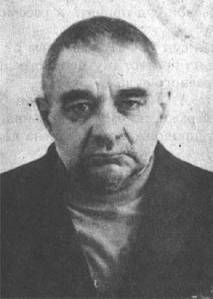
The investigating bodies had at their disposal an analysis of A.E. Levitin-Krasnov’s works prepared by professional atheists.
The commission of “experts” included Professor Novikov, head of the Department of Scientific Atheism at Moscow University, and B. T. Grigoryan, former deputy editor of the journal Science and Religion. It arbitrarily took phrases from Levitin’s works and designated as slander of the Soviet political system such remarks as: “The standard of living in Sweden is high”, “In England the workers do not vote communist” and “A Christian can no more approve of the murder of five innocent children in Yekaterinburg in 1918 than of ‘Bloody Sunday’ in 1905” [1]. The findings of the analysis were that Levitin was maliciously anti-Soviet and should, like certain sectarians, be in prison.
A. E. Levitin-Krasnov answered all the charges thus:
“I plead guilty to nothing. My works contain only the truth, exclusively the truth, nothing but the truth. My arrest simply confirms my claims that lawlessness and tyranny [proizvol] exist in this country. I categorically refuse to give the names of any persons to whom I have given my works to read.”
*
CASE REMITTED
In the middle of January 1970 the investigation was completed, the Moscow defence lawyer A. L, Zalessky being present at the signing of Article 201 of the RSFSR Code of Criminal Procedure. The case was handed over to the Krasnodar Region Court and the hearing arranged for February.
The Court refused to accept the case, however, and remitted it for further investigation, on the grounds that the charge of slander against Levitin was too vague and that it was incomprehensible exactly what law had been violated as a result of Levitin’s incitement and by whom. The court also declared that the experts’ analysis had been carried out with violations of legal standards: it was not competent to decide whether Levitin’s works contained slander of the Soviet social system – this was the affair of the investigating bodies and the court.
The Procuracy of the Krasnodar Region submitted a “private protest” to the RSFSR Supreme Court against the decision of the Region Court, demanding that it should oblige the Krasnodar Region Court to accept Levitin’s case for hearing. In a decision of 9 June 1970 the RSFSR Supreme Court rejected the protest and confirmed the decision of the Krasnodar Region Court.
*
RELEASE
On 11 August 1970, Levitin-Krasnov [2] was released from custody, but was informed that the investigation would be continued. Merely the measure of restraint on him had been changed.
In Moscow Levitin-Krasnov was warmly welcomed by his friends, both believers and non-believers, and he declared to them that he had held true to all his convictions and not changed his ideological position.
=======================================
NOTES
- A reference to the massacre of the last Tsar’s family in 1918 and to the attack on an unarmed protest march in St Petersburg in 1905.
↩︎ - Anatoly Levitin was held in Stalin’s camps from 1949 to 1956. On his subsequent activities and writings, see CCE 5.1 [16], CCE 8.10, CCE 8.13 [8], CCE 11.15 [23], CCE 15.5, CCE 17.12 [23], CCE 17.13 [10], CCE 19.12 [2] and Name Index.
↩︎
===========================
 A Chronicle of Current Events