Between 14 March and 5 April 1968 seventeen Leningrad intellectuals were tried in the Leningrad City Court.
Procurator Gusev and Judge Nina Isakova, deputy chair of Leningrad City Court, took part in the trial.
*
All the accused were charged under Articles 70 & 72 (RSFSF Criminal Code). The essence of the charge was participation in the “All-Russian Social-Christian Union for the Liberation of the People” (ASCULP).
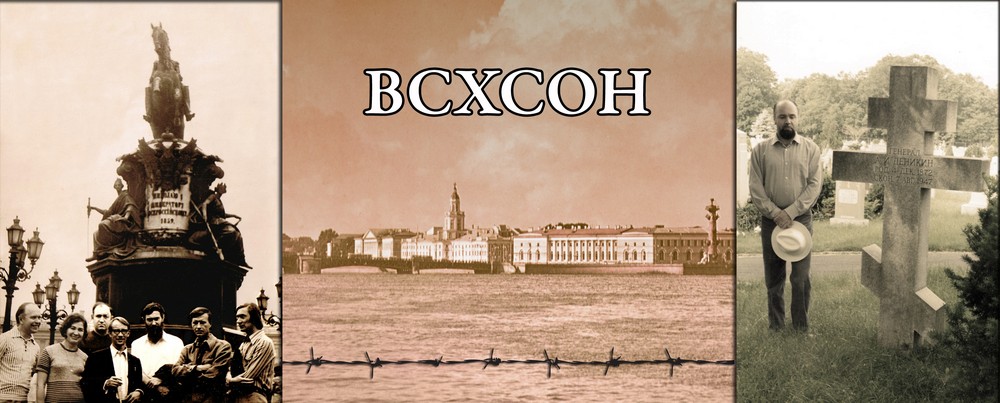
The Christian-Social Union, 2008: members (left), Ogurtsov (right)
*
THE UNION’S PROGRAMME, A BRIEF EXPOSITION
The establishment of a democratic system. The head of state is elected by the whole population and is accountable to Parliament. The upper chamber—a Sobor (representatives of the clergy) — has a right of veto vis-a-vis the Head of State and Parliament.
The land belongs to the State and is allocated to private people or collectives (exploitation forbidden); hired labour only permitted on a basis of equality. Enterprises are mostly owned by worker collectives, but the main industries — transport, electronics, etc. — to be state-owned. Basic principle of the economic system—personalism.
*
STATUTES OF THE UNION
Strict conspiracy, members operating in ‘groups of three’; each person knows the senior member of his ‘three’ and its second member. In addition, each person recruits new members, creating a new ‘three’ in which he becomes the senior. The head of the organization is not known to the members — in case of need they communicate with him in writing through the senior member of their ‘three’.
In practice the organization engaged only in recruiting new members and distributing literature.
The books and copies of books confiscated in searches included those by Milovan Djilas, Nikolai Berdyaev and VIadimir S. Solovyov; Georg von Rauch’s History of Soviet Russia (1957), Tibor Meray’s Thirteen Days that shook the Kremlin (on Hungary in 1956), Maxim Gorky’s “Untimely Thoughts” (1918), and others, even Evgenia Ginzburg’s Into the Whirlwind (1967).
♦
The organization was formed in about 1964. By mid-1965 it had some ten members.
By this time the Leningrad KGB already knew it existed but did not stop its activities and allowed it to develop and expand. In court Alexander Gidoni appeared as a witness: he had denounced the organization to the KGB in 1965, but was advised to continue to keep in touch with its members.
In February-March 1967 some sixty persons were arrested or detained, not only in Leningrad but also in Tomsk, Irkutsk, Petrozavodsk, etc.
In November 1967 the Leningrad City Court tried four leaders of the organization under Articles 64 (“Betrayal of the Motherland”), 70 & 72.
It sentenced them as follows:
- Igor Ogurtsov: translator from Japanese, 30 years old (15 years of imprisonment) [correction CCE 2.8];
- Mikhail Sado: Orientalist, 30 (13 years) [1];
- Yevgeny Vagin: literary critic from Pushkin House, 30 (10 years); and
- Boris Averochkin: lawyer, 28 (8 years imprisonment).
All terms of imprisonment were to be served in strict-regime, corrective-labour colonies.
*
The second trial lasted from 14 March to 5 April 1968.
The difference between the people brought into court as accused and those brought in as witnesses consisted basically in the fact that those on trial had engaged in recruiting people— even if only a single person—for the organization.
All 17 accused admitted their guilt, evidently in the sense of admitting the facts of the charge. Not all of them recanted: in particular, Ivoilov [4], Ivanov [2], Platonov [1] and Borodin [3].
The following were sentenced to terms of imprisonment.
These are shown after each entry in years, followed by the term demanded by the Procurator (prosecutor) in parentheses:
- Vyacheslav Platonov (b. 1941) [2], Orientalist — 7 (7).
- Nikolai Ivanov (b. 1937), art critic, lecturer in Leningrad University — 6 (7).
- Leonid Borodin (b. 1938) [3], school headmaster from the Luga district, Leningrad Region — 6 (6).
- Vladimir Ivoilov, economist (Tomsk, Siberia), graduate of Leningrad University — 2 (2) [in fact six years, CCE 19.4].
- Mikhail Kolosov (b. 1937), fitter employed in the Leningrad Gas organization; correspondence- course student of the Gorky Literary Institute — 4 (5).
- Sergei Ustinovich (b. 1938), Leningrad University graduate — 3 (4).
- Yury Buzin (b. 1936), engineer, agricultural institute graduate — 3 (4).
- Valery Nagorny (b. 1943), engineer in Leningrad Institute of Precision Mechanics and Optics (LITMO) — 3 (4).
- Alexander Miklashevich (b. 1935), engineer; agricultural institute graduate — 3 (3).
- Yury Baranov (b. 1938), engineer, graduate of institute of cine-technicians — 3 (4).
- Georgy Bochevarov, (see 2.8) (b. 1935), Leningrad University graduate — 2.5 (3).
- Anatoly Sudaryov (b. 1939), translator, Leningrad University graduate — 2 (2).
- Anatoly Ivlev (b. 1937), chemist, Leningrad University graduate — 2 (3).
- Vladimir Veretenov (b. 1936), chemist, Leningrad University graduate — 2 (3).
- Olgerd Zobak (b. 1941), LITMO mechanic — 14 months, the time already served while under pre-trial investigation (1 year).
- Oleg Shuvalov (b. 1938), LITMO — 14 months, the time already served (1 year).
- Stanislav Konstantinov, librarian — 14 months, the time already served (1 year).
The trial was characterized by violations of legality similar to those in the Moscow trial of Galanskov and Ginzburg:
- 1. For some of the accused the term of pre-trial detention exceeded the legal maximum;
- 2. Admission to an ‘open’ trial was by permit only (although the courtroom was half empty);
- 3. Most witnesses were ejected from the courtroom immediately after testifying.
*
It is also not clear why the leaders of the organization were tried separately and why they were tried under Article 64 (Treason), as well as Articles 70 & 72. Was the programme they had drawn up defined as “a conspiracy aimed at seizing power”?
If so, this was clearly illegal. In the circumstances, the trial of the first group of four every kind of illegality may have been committed: nothing was known of the trial until it was over and it was, apparently, completely closed.
It is reliably known that no one was charged with having connections with the NTS, nor with engaging in currency transactions, nor with possessing arms.
1.7 The detention of Valentin Prussakov …
===============================
NOTES
- On Sado, see CCE 10.15 [12], CCE 19.4, CCE 33.4 and Name Index.
↩︎ - On Platonov, see CCE 6.4, CCE 23.3, CCE 32.20 [11] and CCE 47.3-1.
↩︎ - On Borodin, see CCE 17.12 [9], CCE 19.4, CCE 22.4 [7], CCE 27.5 and Name Index.
↩︎
====================
 A Chronicle of Current Events