From 23 to 25 April 1980 the Leningrad City Court, presided over by one of its vice-chairs, Judge Nina S. Isakova [1], heard the case of Vladimir Yu. Poresh (b. 1949).
Poresh was arrested on 1 August 1979 (CCE 54.5) and charged under Article 70 (RSFSR Criminal Code).
The prosecutor was Leningrad City Deputy Procurator Inessa V. Katukova [2]. Poresh refused a defense lawyer provided by the Court and spoke in his own defence.
*
Trial
At the beginning of the first court session Poresh protested against persecution of the following for their religious convictions:
- Alexander Ogorodnikov: CCE 51.15, CCE 52.11 and CCE 55.2-3,
- Tatyana Shchipkova (CCE 56.11),
- Victor Popkov & Vladimir Burtsev (CCE 56.11),
- Lev Regelson (CCE 55.2),
- Sergei Yermolayev (CCE 54.12 [2]),
- Gleb Yakunin (CCE 54.1-2),
- Dmitry Dudkov (CCE 56.9) and
- Victor Kapitanchuk (CCE 56.10).
In the indictment Poresh was charged with
- producing the collection A Bulletin of the Religious-Philosophical Seminar (CCE 46.8);
- producing, possessing and circulating the journal Obshchina [Community]: CCE 49.14 [2, 4]; and CCE 51.15 [1];
- writing letters “To Our Czech Friends”, “To the Youth of the West”, and to Alexander Solzhenitsyn. (The first two letters, according to the indictment, were printed in the “White emigre weekly Russkaya Mysl, an organ of the NTS”);
- and producing a photocopy of Solzhenitsyn’s book, The Oak and the Calf (1975 [3]).
The indictment also stated that Poresh “had set himself the goal of subverting the Soviet system and talked about restoring the monarchy”.
*
Poresh’s testimony
In his speech Poresh spoke about (a) the founding in 1974 of the “Christian Seminar on Problems of the Religious Renaissance in Russia” and (b) the persecution of its members [4].
He admitted that in March 1977 he had compiled the Bulletin, which contained, in addition to material on the seminars, some articles he had written earlier, including those mentioned in the indictment. Poresh denied that the articles contained slander of the Soviet system, saying that notwithstanding repeated requests on his part, the criteria by which they were defined as anti-Soviet had not been explained to him.
Poresh recounted further that he had passed the Bulletin to Alexander Ogorodnikov, who was then in hospital, and that the only copy was confiscated during a specially organized “sanitary inspection” (CCE 46.8).
By June 1977 Poresh had written a series of articles for the journal Obshchina [Community], which the seminar members decided to issue instead of the Bulletin.
The first issue of Obshchina was named No. 2.
Material for Obshchina (No. 2) was confiscated during a search of the home of Tatyana Shchipkova (CCE 49.14 [2]). Poresh told how he had gathered all the articles and notes remaining in his possession, supplemented them with new material, and then republished Obshchina in 18 copies. Poresh said that he had asked S. Busov to put the journal on film. At Poresh’s request 14 copies of Community (No. 2) were bound by V. Gusakov.
Sometime later Poresh began to compile Obshchina (No. 3).
Poresh said that he and Victor Popkov had typed almost all the material on a typewriter borrowed from S. Busov. Poresh renounced the evidence he had given during the pre-trial investigation that the article “The Trial-Farce of Alexander Ogorodnikov” in Obshchina (No. 2) was written by V. Sokolov; he also now denied that he, Poresh, gave Regelson a letter for Solzhenitsyn and the “journal Obshchina on film” to send abroad.
In their questioning of the accused, Judge Isakova and the prosecutor Katukova were chiefly concerned with the links between the seminar (and Poresh, personally) and foreigners, and with Solzhenitsyn. Regarding the letter to Solzhenitsyn, Poresh said that it contained a description of the seminar. He added that the letter contained a request to put the seminar in touch with Christian youth groups abroad. Poresh stated that in general he shared Solzhenitsyn’s views of Marxism-Leninism; he sees the 1917 “Great October Socialist Revolution” as an enormous tragedy for Russia. He said:
“It is written in the Constitution of the USSR that the ultimate goal of socialist society is Communism, that is, the creation of a godless state. As a Christian, of course I am against this kind of State, and of course, in this sense I was undermining it. The Kingdom of God cancels out Communism.”
In answer to the question: “Did he have the opportunity to make his confession and take communion during the pre-trial investigation?” Poresh replied “Yes”.
After the questioning of the accused, the witnesses were questioned.
*
Witnesses
O. Okhapkin stated that Obshchina (No. 2) was compiled by Poresh, Ogorodnikov and himself.
He recounted in detail the extent of the participation of each in the production of the journal and added that it contained no slander.
*
Busov denied having photographed Obshchina (No. 2).
Poresh again stated that he had asked Busov to do so, and that the latter had made the film. Busov replied that he had photographed some pages in a sheaf, not a journal. He was not aware of the contents of the papers.
*
B. Dymov testified that together with Busov he had photographed a typed text without reading it.
*
Popkov, who was brought from camp to the trial, gave a detailed account of his own and Poresh’s participation in producing Obshchina (No. 3). He stated that Regelson was meant to send the film abroad.
*
Tatyana Lebedeva (CCE 54.2-1, CCE 56.11) replying to the Judge’s question, said that Poresh had not given her the journal Obshchina.
Poresh said that he had taken Obshchina (No. 2) to Lebedeva’s flat, where he had “put it on the table”.
*
V. Kovalenko (CCE 55.2-3) said that Poresh had not given him anything to sign, nor shown him any journal.
*
Gusakov testified that he had bound 14 copies of some typed text for Poresh, for which he had received 28 roubles.
*
Ogorodnikov’s wife Yelena Levashova testified that Poresh had given her his article “A Walk through Moscow” to read.
*
I. Martenov said that he had asked Poresh to show him Obshchina and had read the literary section of the journal; he did not consider the journal to be anti-Soviet.
*
P. Kulagin affirmed that Poresh had shown him Obshchina (No. 2) and material for the third issue of the journal.
In addition, he said that he had seen a filmed text of Solzhenitsyn’s book The Oak and the Calf in Lazutkin’s flat (CCE 54.2-1), and Obshchina (No. 2) at Lebedeva’s.
*
A. Golovushkin confirmed that Poresh had given him the book The Oak and the Calf.
Asked whether Poresh had conversations of an anti-Soviet nature with him, he replied that he did not remember. Golovushkin explained that the evidence he had given on this subject during the pre-trial investigation was the result of acute depression.
*
A. Arro testified that Poresh had spoken of the necessity of freeing the Church from State control, and of ours being a totalitarian state.
He had heard from “reliable sources”, Arro said, that everyone who had anything to do with Poresh would be put in prison. For this reason, Arro had sent a statement to the KGB:
“V.Yu. Poresh held anti-Soviet conversations with me, defaming everything we hold sacred. If Poresh comes in contact with people who are less mature politically, he may cause a great deal of harm.
“I request that his activities be brought to the attention of the KGB organs and stopped, because if this is not done, something terrible might happen.”
(This statement was written two months before proceedings were instituted against Poresh.)
*
The witnesses were asked many questions about Ogorodnikov.
S. Shuvalov of Ufa (CCE 43.9, CCE 44.26-1) said that Ogorodnikov had given him a collection of issues of the journal Posev over several years, the journal Kontinent and the book The Gulag Archipelago to read.
Shuvalov renounced the evidence he had given during the pre-trial investigation that Poresh called on people to overthrow the Soviet regime and restore the monarchy. Shuvalov said that Ogorodnikov referred to Solzhenitsyn as a pretender to the throne. Judge Isakova asked whether Poresh and Ogorodnikov shared the same ideas, and afterwards specified: “That is, what one says, the other might say?” Shuvalov replied: “Yes”.
*
The witness Ilyn (Kalinin) confirmed that Ogorodnikov had given him a summary of Obshchina and his own article.
*
Levashova was asked whether Ogorodnikov hadn’t spoken to her about publishing the journal. In reply Levashova asked: “Whose case is being tried in this court — Ogorodnikov’s or Poresh’s?”
*
The testimonies of G. Podosokorskaya and I. Kanysheva, who did not appear in court, were read out during the trial.
Podosokorskaya had testified that she had typed texts included in Obshchina for Poresh, and that she had read the journal and Poresh’s article “A Walk through Moscow”.
Kanysheva (a nurse at Moscow City Hospital No. 4) confirmed that books and articles of an anti-Soviet nature had been taken from Ogorodnikov, and that she had discovered them during a sanitary inspection and handed them over to the Head Doctor.
*
Tatyana Goricheva (CCE 55.2-3, CCE 56.14; see also CCE 57.18-2 this issue) also did not appear at the trial.
Poresh confirmed the evidence he had given during the pre-trial investigation that he had given Goricheva a copy of Obshchina.
*
After the witnesses had been questioned, Poresh petitioned the court to conduct an expert examination to determine whether the texts with which he was charged were of an anti-Soviet and slanderous nature. No such examination was carried out.
*
Closing speeches
Procurator Katukova stated that the CIA, by supporting reactionary emigre groups, was carrying out diversionary work against the Soviet system:
“The cornerstone of their activities is internal diversion and the use of unstable elements for their treacherous purposes. By starting a propaganda campaign about so-called ‘human rights’ and attempting to expose alleged persecution of believers in our country, certain Western groups try to cover up the repressive actions of their own henchmen. They stop at nothing, using for their purposes rabid anti-Soviet agitators and slanderers — Solzhenitsyn, who was expelled from the Soviet Union for his criminal activities, Krasnov-Levitin and others.”
Elsewhere in her speech for the prosecution Katukova said:
“Attempts to restore bourgeois ideology under the guise of Christianity include the use of works by the reactionary emigre activists Nikolai Berdyaev, Sergy Bulgakov and Georgy Fedotov.”
Then, after enumerating all the episodes mentioned in the indictment and stating that the guilt of the accused had been proven in full, Katukova suggested that it be taken into account that Poresh
“is being tried for the first time, and during the pre-trial investigation gave evidence permitting the truth on the episodes covered by the case to be ascertained”.
She asked that he be sentenced to five years’ imprisonment in a strict-regime camp, followed by five years in exile.
*
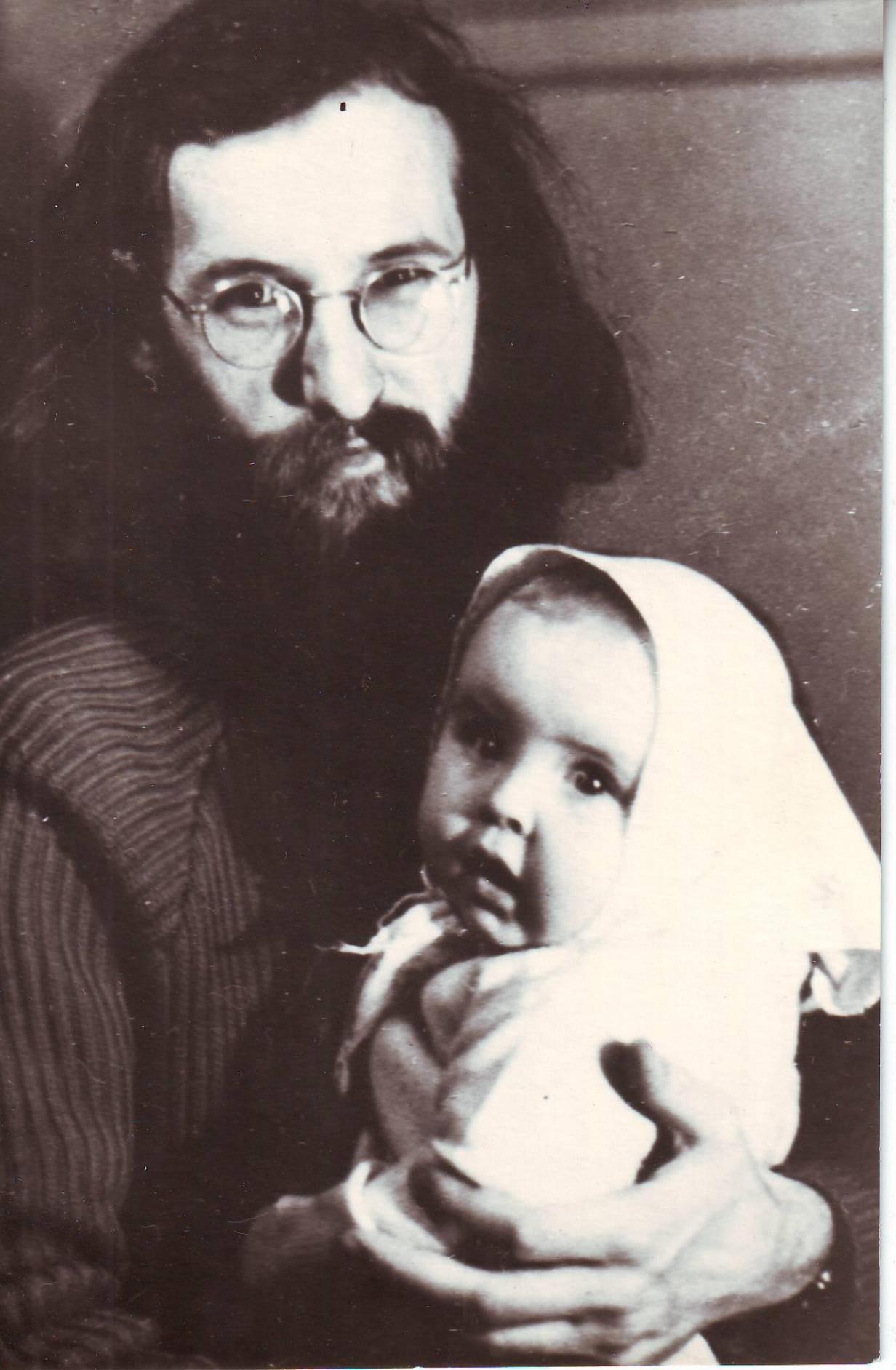
Vladimir Poresh (1949-2023)
In his defence speech Poresh stated that his activities were not anti-Soviet in nature. He denied the Procurator’s assertion that he had acted under the direction of foreign centres. He said:
“In essence I am being sentenced for my beliefs.
“If ours is a totalitarian State, I have indeed broken the law by having my own beliefs, something I have never concealed, and of which I spoke honestly and openly. I just do not understand how I could be put in prison. What I have done is the natural result of my convictions.
“According to the laws of our country I should have sat quietly, without a word; but for a Christian it is not enough to perform rites, we cannot restrict ourselves to this, we need to address the whole world.”
In his final words, Poresh said:
“Here you are, you have witnessed the trial, you have acquainted yourselves with all the materials. I do not ask for leniency; that is against my principles.
“The Citizen Procurator has requested a short sentence for me. I would ask for more, but I understand that that would be too great an honour for me. There are people who have done more for the Church than I have, I am glad that I am being sentenced under this article and on the basis of the materials to be found in the case file.”
His sentence: five years in strict-regime camps and three years of exile.
*
Relatives of Poresh attended the trial; his friends were allowed in only for the reading of the judgment.
After they started to shout, “Christ is risen!”, “Volodya [Vladimir, affectionate form], we’re proud of you!”, “Volodya, we love you!”, they were pushed out. In the corridor, Poresh’s friends sang an Easter hymn.
=========================================
NOTES
- From 1968 onwards, Nina Sidorovna Isakova (see Name Index) presided over many trials in Leningrad involving rights activists and dissidents: Yury I. Fyodorov, CCE 12.5; Eduard Lalayants, CCE 14.5; Gilel Butman et al., CCE 20.1; Boris Yevdokimov and Galina Yevdokimova, CCE 26.2 note 3; Vladimir Maramzin, CCE 35.4; Julia Voznesenskaya, CCE 43.5; Ushakov and Sarkisyan, CCE 46.22; Tsurkov and Skobov, CCE 53.6.
↩︎ - Procurator Inessa Vasilyevna Katukova (see Name Index) served as prosecution, working with or without Judge Isakova, in several cases involving dissidents and human rights activists: Yury I. Fyodorov (CCE 12.5); Zalmanson et al., CCE 17.6-1; Butman et al., CCE 20.1; and Vladimir Maramzin, CCE 35.4.
↩︎ - Alexander Solzhenitsyn, The Oak and the Calf: Sketches of literary life in the USSR, 1975. (Literal translation of title, “A Calf head-butted an Oak”.) Russian original, YMCA Press: Paris, 1975; English translation (H. Willetts), Harper & Row: USA, 1981.
↩︎ - On Persecution of Christian Seminar members, see CCE 41.2-3, CCE 43.9, CCE 46.8, CCE 49.14 [2], CCE 52.11.
↩︎
=============================
 A Chronicle of Current Events