[1]
On 21 December 1977, the critics sector of the Moscow section of the Writers’ Union held a literary discussion in the conference hall of the Central House of Writers on the theme “We and the Classics”. Discussion went on from 4 pm to 11 pm in a tightly packed hall and was, in the opinion of those present, unprecedented in the literary life of recent years for the frankness with which those who spoke expressed their literary and other opinions.
The tone of the discussion was set by the speeches of critics and literary specialists Palievsky, Kunyayev, Kozhinov and Zolotussky who belong to a grouping characterized by sharp hostility to ‘modernism’ and great hopes for the national traditions of Russian culture. (See, for example: P. Palievsky, The Paths of Realism, Moscow, 1974; O. Mikhailov Faithfulness, Moscow, 1974; the publicistic writings of M. Lifshits over the last 15 years, etc.) Their acknowledged ideologue is the critic P. N. Palievsky (since autumn 1977 he has been deputy director of the Institute of World Literature). His speech, which opened the discussion, contained a series of propositions which provoked fierce polemics. Chief of them was the thesis of the break with the Russian classical tradition which took place in the twenties, and the re-establishment of this tradition in the thirties and forties. He emphasized that the ‘complex historical conditions’ of the thirties ‘did not prevent the great writers Bulgakov and Sholokhov from creating their best works at this period’. Despite the unhappy condition of people in a purely human sense, despite the harsh fate of artists (and leftists also — ‘but they themselves raised the sword, and by the sword they died’) it was precisely in the thirties and forties that the ‘fusion of the classical tradition with popular culture’ took place.
Assessing the contemporary situation, Palievsky noted a worrying symptom — the impossibility of resisting avant-garde tendencies through the press, and also the crisis of the classical repertoire in academic theatres.
The poet Stanislav Kunyayev stated that he considered it incorrect to include the poetry of E. Bagritsky in the classical tradition. In Kunyayev’s opinion, Bagritsky broke entirely with the humanism and popular orientation of the Russian classics. His long poem ‘Ballad of Opanas’ was anti-peasant and anti-common people, while the main positive hero of this poem, food-squad commissar Kogan, was a rapist and a robber. (Retort from the hall: ‘It was Lenin, not Bagritsky, who thought up the food-squads!’). In Bagritsky’s poetry, continued Kunyayev, there was neither a sense of tragedy nor a purging, but only malice. He saw the roots of this in the poet’s hostility to the people’s way of life, including hostility to his own origins, i.e. to the way of life of the small Jewish towns of his childhood, about which he writes with hatred (the poem ‘Origin’).
To Bagritsky’s antihumanistic creed (‘But if it — the age — says “Lie”, then lie. And if it says “Kill”, then kill’) Kunyayev opposes a different moral code, whose bearer was Osip Mandelstam, who continued the Russian humanistic position (“The wolfhound-age hurls itself on my shoulders. But I am no wolf by blood.”)
Poet and critic V. Kupriyanov supported Palievsky and those who thought like him in his estimation of the gulf between the Russian classics and the present day. The cause of this, in Kupriyanov’s opinion, is the ‘loss of a metatext’, which for 19th century culture was provided by the Gospels.
Many of Palievsky and Kunyayev’s opponents spoke as frankly as they did, and considered it equally unnecessary to adorn their speeches with the ideological and political cliches usual on such occasions. Among those objecting to the advocates of a ‘return to roots’ and the opponents of the ‘avant-garde’ was the film-director A. Efros, the poet Ye. Yevtushenko, the critic A. Borshchagovsky and others.
Yevtushenko accused Palievsky of ‘retrospective complacence’ towards the life and work of Bulgakov in the 1930s. ‘How can one not understand the tragedy of an artist whose best, most loved creation was not published?’ He recalled that Russian classical literature, despite all the ‘beer-drinking’ patriotism and the official, servile patriotism, had with Chaadayev’s voice produced a patriotism ‘with open eyes’.
Borshchagovsky noted that one must not separate literary renaissance from the tragic fates of writers.
Professor S. Lominadze, in a rejoinder to Palievsky on the fruitfulness of the 1930s and 1940s in the history of Russian culture, recalled that the discussion ‘is being conducted on the anniversary of the birth of a man who laid an indelible and tragic stamp on this epoch’ (i.e., Stalin, Chronicle).
Many of those who spoke, spoke of the works of various writers of the twenties that have not been published to this day. This theme was raised by Borshchagovsky, who mentioned the fact that Vsevolod Ivanov’s novels The Kremlin and U had to this day not been published. Lominadze criticized the volume Pre-October Russian Poetry in the series ‘Library of World Literature’, from which the verses of N. Gumilyov are absent although he is mentioned in the preface. V. Kupriyanov, who had taken part in compiling this volume, said in his speech that in the initial stages of printing, Gumilyov’s verses had been retained, but then it had been ordered that they be removed. According to Kupriyanov, a certain person had arrived and said: “The Bolsheviks have already shot Gumilyov once.” (It is interesting to compare the latter piece of information with the rumours circulating recently in Moscow about a forthcoming or already accomplished judicial rehabilitation of Gumilyov in connection with the so-called ‘Tagantsev plot’, and about the publication of a collection of his verses which would supposedly follow this, Chronicle).
A. Efros after his speech (he spoke third, after Palievsky and Kunyayev) received and read out a note with the following content: ‘What is your attitude to the Russian theatre? Open your own national theatre and mutilate the classics there as much as you like.’
Evidently this note gave Yevtushenko an opportunity to express himself about anti-Semitism and to link this theme with the subject of discussion. He said that Russian classical literature had never confined itself to a cult of the soil, and the best of the Slavophiles had never permitted themselves to exalt their own people at the expense of other peoples. Russian classical literature had through the lips of Korolenko branded antisemitism, and hatred for antisemitism had ‘remained forever the heritage of the Russian intellectual’. Literary specialist V. Kozhinov stated that he was disturbed by the hysteria that had arisen after Palievsky and Kunyayev’s speeches. Judging from his speech, he had taken Yevtushenko’s philippic as directed at himself and those who thought like him.
The polemics were conducted in exceptionally sharp tones, and an attempt by the first secretary of the Moscow section of the Soviet Writers’ Union, critic Felix Kuznetsov, to return the discussion to “scholarly, theoretical consideration of the subject” had no success. The speakers did, however, restrain themselves from sticking political labels on people. Exceptions were interventions from the hall, such as during Kunyayev’s speech, and also the speech of critic Yu. Seleznev. He accused critic V. Solovyov, who had shortly before emigrated from the USSR (CCEs 45, 46), of Zionism. Seleznev endeavoured to prove that Solovyov’s articles published in the Soviet press were textually close to the works of Zionist ideologues, and was indignant at ‘the loss of vigilance and the ignorance’ of editorial workers who had given Solovyov the opportunity to publish on the pages of Soviet publications.
Several people spoke outside the framework of the unfolding polemic. Some of the speeches (for example that of the writer A. Bitov) were extremely thoughtful. However, to summarize them falls outside the scope of the Chronicle.
Closing the discussion, Ye. Sidorov, who was in the chair, said that it had been interesting and expressed a desire for a repetition of such undertakings. However, the reaction of the Cultural Department of the CPSU Central Committee to the discussion was negative. According to information that is not fully substantiated, St. Kunyayev was reprimanded at the Writers’ Union, and the official of the union’s administration responsible for the discussions at the Central House of Writers was also reprimanded.
Several independently-made records of the discussion have been circulated in samizdat. The materials of some of them have been used here.
[2]
On 10 February 1978, an evening called ‘A Meeting with Norilsk’ was held at the Central House of Writers. K. Simonov was in the chair.
After several people had spoken, talking of the heroism of the first builders of Norilsk, the Kalmyk poet David Kugultinov, who was sitting in the presidium, took his turn to speak. Kugultinov said that he too had built Norilsk and had lived in barracks — behind barbed wire, Kugultinov also spoke of the fate of his people and of other peoples deported at the end of the war.
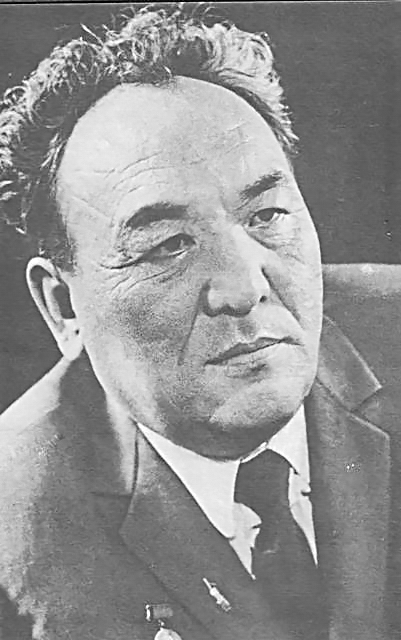
David Kugultinov, 1922-2006
*
A young poet recited his poetry at the evening; it was dedicated to the prisoners who had built Norilsk, among whom had been his parents, who were present in the hall. They were warmly greeted by the audience.
All the contributions were received very sympathetically by those present.
Summing up, K. Simonov supported the proposal put forward by several of those who had spoken — to erect a memorial in Norilsk to its first builders.
=====================================
 A Chronicle of Current Events