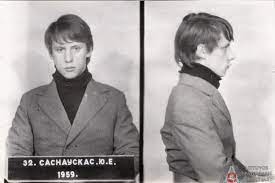
& of Terleckas and Sasnauskas (58.11)
*
The Trial of Statkevičius, August 1980
On 8 and 11 August, the trial of Lithuanian Helsinki Group member Algirdas Statkevičius (b. 1923) took place in Vilnius.
Statkevicius himself was not present at the trial. A psychiatric commission had ruled him not responsible (diagnosis: schizophrenia and megalomania). The court sent Statkevicius to a Special Psychiatric Hospital (SPH) for compulsory treatment. Many people gathered at the court building, but no one was admitted to the courtroom.
Statkevičius was arrested on the night of 14-15 February (CCE 56.18). He is now being held in Chernyakhovsk SPH [1].
*
The Trial of Terleckas and Sasnauskas, September 1980
From 15 to 19 September the Lithuanian SSR Supreme Court, presided over by Vice-Chairman Ignotas, heard the case of Antanas Terleckas (b. 1928; arrested 30 October 1979, CCE 54.18 [7]) and Julius Sasnauskas (b. 1960; arrested 11 December 1979, CCE 55.6).
Both were charged under Article 68 (Lithuanian SSR Criminal Code = Article 70, RSFSR Code). The prosecutor was Deputy Procurator of the Lithuanian SSR Bakucionis; the defence counsels were Kudaba and Aperaitis.
*
INDICTMENT
The indictment states that in 1975 Terleckas incited Sasnauskas to commit criminal acts.
The accused men, with the aim of undermining the Soviet system, systematically duplicated, circulated, collected and kept — with the intention of circulating — illegal publications:
- Terleckas had copies of the Chronicle of the Lithuanian Catholic Church (LCC Chronicle) and The Herald of Freedom [Laisves Sauklis];
- Sasnauskas had copies of The Herald of Freedom, Hearth [Pastoge], The Path of Truth [Tiesos Kelias] and the Chronicle of Current Events.
They carried out Anti-Soviet Agitation & Propaganda.
*
In June 1979 the accused began to issue the illegal publication Knight Errant [Vytis] (CCE 53.31 [8]).
Sasnauskas typed no fewer than three copies of No. 1 (confiscated in Moscow, in Jurbarkas and at the home of O. Lukauskaite-Poškiene in Siauliai) and No. 2, which he distributed among his acquaintances. In addition, he published No. 3, typed three copies, circulated one among his acquaintances and kept two at home.
*
In 1979 the accused sent the Lithuanian Minister of Health, Kleize, a letter concerning the forcible hospitalization of A. Paškauskiene (CCE 52.10): Sasnauskas typed no fewer than five copies of this letter and showed it to at least eight people.
*
The accused produced, duplicated and circulated a collective letter to mark the 40th anniversary of the Molotov-Ribbentrop Pact (CCE 54.18 [7]) and collected signatures under it: this letter was confiscated in Alytus from Šerkšnys, in Jelgava from Žukovskis, in Moscow from Tatyana Velikanova, and, in Estonia, from Alexander Lavut.
The accused collected materials on the trial of the speculator Ragaisis (CCE 54.18 [1]) and wrote an Open Letter about the trial.
*
Terleckas and Cidzikas (CCE 46.13) wrote a letter about abuses of psychiatry: Terleckas passed it on to Sasnauskas who duplicated and circulated it.
*
At a meeting at Ragasiene’s (CCE 57.9-2) Terleckas provided foreign correspondents with slanderous information about the alleged invasion of Lithuania, and Sasnauskas duplicated an account of the meeting.
Sasnauskas, with the help of Terleckas, wrote a letter about the condition of a monument to Vytautas in Jurbarkas.
*
In addition, Terleckas was charged with sending a letter to Andropov about persecution and psychiatric hospitalization for one’s convictions (CCE 40.10). The indictment noted that Terleckas supported Document No. 69 of the Moscow Helsinki Group (marking the 50th anniversary of the Universal Declaration of Human Rights, Chronicle).
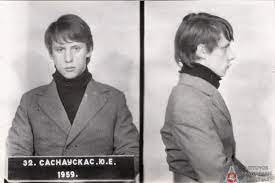
Julius Sasnauskas, b. 1959
*
Sasnauskas was also charged with writing:
(1) a letter to the CPSU Central Committee about Viktoras Petkus: he typed no fewer than three copies of this letter, showed it to at least 20 people and published it in Vytis No. 2; and
(2) a letter to the editor of the newspaper Tiesa about Balys Gajauskas: he edited it, typed copies and showed it to no fewer than eight people, who signed it.
Sasnauskas wrote an Open Letter to the Central Committee of the Lithuanian Community Party about “praying for the dead” (he typed at least five copies) and an Open Letter on the arrest of Terleckas, of which he typed no fewer than two copies and showed them to no less than 30 people.
Sasnauskas was charged with a statement about serving in the Soviet Army, a letter also signed by V. Bogusis, A. Tuckus and A. Masiulionis (CCE 47.5).
Sasnauskas, Sakalys (CCE 57.16) and Cidzikas wrote an Open Letter to the Central Committee on falsifications committed in the census (Sasnauskas typed five copies and gave one to Ragaisis).
With the aim of creating the appearance of a so-called Helsinki Group functioning in Lithuania, Sasnauskas wrote Documents 13-17 of the Group: he typed copies of these Documents and showed them to O. Lukauskaite-Poskiene and Father Laurinavičius.
Terleckas gave no evidence during the pre-trial investigation. Sasnauskas gave evidence only on facts concerning him personally. They pleaded not guilty.
*
TRIAL
At the trial Terleckas stated that the letter to the Minister of Health concerning Paskauskiene (CCE 52.10, CCE 54.18) had been written by Paskauskiene herself and brought from Jurbarkas by Bastys (CCE 57.15).
During the trial of Ragaisis he had taken notes, but had not given them to Sasnauskas.
He had received the letter to the newspaper Tiesa about Gajauskas from the priest Garuckas (died 1979, CCE 53.23).
He had taken part in the press conference in Ragaisiene’s flat on the invitation of Vyacheslav Cherepanov (CCE 57.9-2), who is known to certain people as an agent provocateur: there they had had tea and chatted; the article “A Press Conference in Vilnius” did not reflect his views.
He had not helped Sasnauskas to write the letter about the monument to Vytautas; he had only collected information from an encyclopaedia. He had not signed the letter about Petkus (CCE 50.5) or Document No, 14 of the Lithuanian Helsinki Group (about Ragaisis).
He knew nothing about the letter commemorating the 40th anniversary of the Molotov-Ribbentrop Pact or about Document No. 15 of the Lithuanian Helsinki Group on Klimaškauskas’s imprisonment in a psychiatric hospital (CCE 44.22, CCE 51.11,). He had never seen Vytis, much less had any part in its publication.
The materials allegedly confiscated from him in the search of 23 August 1977 (CEE 47.5) were found not in his flat, but in a barn and in a hole in the ground; he had been shown a copy of Herald of Freedom by K. Jokubynas (emigrated 1977 CCE 45.15), who used to clean his barn. He had signed Document No. 69 of the Moscow Helsinki Group.
*
Sasnauskas stated that the allegation that Terleckas had incited him to commit anti-Soviet acts in 1975 was groundless.
He had been illegally charged with the statement about his Soviet Army service (a request to stay and serve in Lithuania, CCE 47.5): it had been written after he was threatened that his military service would be turned into a sentence. (Sasnauskas petitioned the court to summon Bogusis, Tuckus and Masiulionis as witnesses.)
The letter about Petkus was not libellous. He had written the letter to the Central Committee about “prayers for the dead” (stating that only those who had fought, weapons in hand, against the Soviet regime were worthy of remembrance) in a categorical tone because he was under the influence of brutal actions by the police; he did not consider it criminal.
Neither did he regard as criminal the letter about the census, written jointly with Sakalys and Cidzikas: according to the official results of the census, the majority of Lithuanians speak Russian well, while linguists assert that the contrary is true.
The letter to Tiesa on Gajauskas (CCE 49.13) was given to him by Father Gamckas, who told him where to send it; he had copied the letter without editing it and sent it (he had only entitled it ‘Open Letter’); he did not agree with all the ideas contained in the letter, but had not wanted to amend it.
He had not written the letter about Paskauskiene to the Minister of Health, although he had testified to the contrary in the pre-trial investigation; he agreed with Terleckas’s evidence on the subject: the letter had been typed in his flat, on the typewriter there, by Sakalys (in summer 1980 Sakalys escaped from the USSR, CCE 57.16); he did not see anything anti-Soviet about the letter.
In summer 1979, he had seen in several places the letter marking the fortieth anniversary of the Molotov-Ribbentrop Pact; he had signed it and then duplicated the Lithuanian translation, but had not circulated it; in his opinion the document was not anti-Soviet. He had written and circulated the protest against the arrest of Ragaisis; he had taken Terleckas’s notes on the trial of Ragaisis, but had not used them; perhaps, owing to lack of time, some unsubstantiated assertions were to be found in his protest.
(Defence counsel Aperaitis: “I’m coming to the conclusion that you’re an uncritical reader. You have apparently read fiction without understanding all of It, and you haven’t read any political literature”) Terleckas had not helped him to write the letter about the monument to Vytautas: he had only given him the historical facts; he himself had been to Jurbarkas and seen the monument,
Aperaitis: The monument in Jurbarkas is a trifle. Vytautas was greatly honoured in bourgeois times. Do you know what Lithuania looked like in those days?
Sasnauskas: No.
Aperaitis: And from today’s perspective?
Sasnauskas: It looks good.
Aperaitis: What more does a man need? You’ve got enough to eat.
you can enjoy yourself, so why make an apostle of yourself without being asked?
He had written the protest against Terleckas’s arrest; he agreed that certain ideas in it were anti-Soviet; he had mentioned the letter marking the fortieth anniversary of the Molotov-Ribbentrop Pact in his protest because he had connected Terleckas’s activities with the letter; he did not know whether Terleckas had produced it. He himself had produced Documents 13 and 15-17 of the Lithuanian Helsinki Group — No. 13 about Gajauskas; No. 16 on persecution of Lithuanians in the Soviet Army; he knew nothing about No. 14 The press conference at Ragaisiene’s flat had been organized by Cherepanov. The only item in the indictment which he did not deny was Vytis; he had read the underground press and wished to try his hand at journalistic pursuits.
*
WITNESSES
Speaking as a witness, Sasnauskas’s mother described him as agood, decent lad. In secondary school he had suffered for his convictions (CCE 43.10). The letter about Petkus had been given to her to read by her son, that about Ragaisis, by Šakalys. Her son had told that the press conference had also been attended by Soviet officials.
Terleckas’s wife said that she knew nothing about the materials confiscated in the search of July 1977. and that it was Jokubynas who had cleaned up the barn.
*
In the pre-trial investigation the retired teacher Šerkšnys from Alytus testified that he had given Terleckas the text of a speech he had made at the grave of Father Gustaitis; while he was in Vilnius visiting Petruškevičiene he had met Terleckas at her home and the latter had shown him Vytis, which contained his speech under the title “Discrimination Against the Memory of Father Gustaitis in Lazdijai”; at the same place, he had received the letter on the 40th anniversary of the Molotov-Ribbentrop Pact. This evidence was read out at the trial, SerkSnys testified at the trial that he did not remember who had given him Vytis, and had found the letter about the Pact in his jacket pocket.
Terleckas’s neighbour, S. Petruškevičiene, testified that while in Poland she had read an article about the situation of Lithuanian Catholics in Seinai. She had given this article to Terleckas and apparently the same article had appeared in Vytis No. 1. Terleckas then said that he had not received anything from Petruškevičiene.
Mažukna, a worker from Kaunas, testified that he had seen the letter on the fortieth anniversary of the Molotov-Ribbentrop Pact for the first time at an interrogation, and that he had not given his consent to anyone to sign it with his name.
*
BASTYS
V. Bastys of Vilnius stated that the accused had not asked him to sign anything. He had not seen Document No. 14 of the Lithuanian Helsinki Group; he had agreed on principle to sign a protest against the sentence of Ragaišis, He had not seen the letter to the Minister of Health and did not know who wrote it. He had not seen the letter about the monument to Vytautas and did not know who wrote it, but agreed with the ideas in it; he could not remember giving his assent to anyone to sign his name to it, but it was possible that he had.
He had spoken with someone about the letter on the 40th anniversary of the Soviet-German Pact; his interlocutor had probably understood him to mean that he agreed to sign the letter. (Bastys’s evidence of the pre-trial investigation was read out; ‘He found out about the existence of the document in conversations with Terleckas and Sasnauskas. He did not agree to sign it and it was wrongly signed with his name.”’) He had taken part in the press conference, where he was present by chance; no anti-Soviet views had been expressed there. (Again, the record of his interrogation in the pre-trial investigation was read out: ‘At the beginning of the press conference Terleckas greeted the correspondents on behalf of the dissidents of Lithuania and talked about the occupation of Lithuania and the Molotov- Ribbentrop Pact. Sasnauskas talked about problems on the theological seminary and the situation of believers.’)
*
A former co-worker of Terleckas, Pečiulis, employed by the State Academic Opera and Ballet Theatre of the Lithuanian SSR (Terleckas had worked there as a fireman), testified that Terleckas had suggested that he listen to radio broadcasts from the Vatican. Terleckas was disposed against the Soviet regime. Another employee of the same theatre, Žedunas, said that Terleckas had suggested he write a description of his life (Žedunas had been imprisoned and later exculpated).
V. Abraitis, a doctor from Jurbarkas, testified that he had seen Terleckas when the latter had come and asked him to leave Paškauskiene alone and to stop summoning her for psychiatric examination.
Father Laurinavicius, a member of the Catholic Committee to Defend Believers Rights, said that he knew both the accused (Sasnauskas to a lesser extent) and knew that they were guilty of nothing. Sasnauskas had brought him Documents 15 and 16 of the Lithuanian Helsinki Group, which he had not signed.
Angele Ragaišiene handed flowers to Terleckas as she entered the courtroom. To a question about the press conference in her flat she replied that guests had dropped in for ten minutes.
I. Žukovskls (CCE 50.5) testified in Latvian, with the help of two interpreters. He said that he had met Terleckas in Riga in 1976 and there had been no talk of the Pact then. The letter about the 40th anniversary had been brought and left with him by some woman, and he had signed it.
Tuckus (CCE 47.5), a first-year student at Vilnius University, wen up to the accused and shook hands with each of them before went up to the accused and shook hands with each of them before taking his place. He refused to sign the warning about prosecution for refusing to give evidence and for false evidence. Tuckus said said he knew nothing about any anti-Soviet activities by the accused. In reply to Sasnauskas’s question he confirmed that they had written the letter of 1977 about military service under the influence of KGBthreats.
The evidence was read out of Lithuanian Helsinki Group member 0. Lukauskaite-Poškiene (Sasnauskas had brought her Group documents, but she had not signed them) and of Father N. Norkunas (an unknown man had brought him the letter about the Pact, which Norkunas had not signed; Norkunas had recognized Terleckas from a photograph shown to him).
The Judge remarked that Terleckas had not kept the promise not to act against the Soviet system which he had given in 1977 (CCE 47.5). The Procurator told Terleckas that the fact that he had promised to cease his activities meant that such activities had taken place. Terleckas replied that the explanation he had written at the time had been rejected and, as he was very tired, he had signed a text which was given to him. Terleckas pleaded guilty in part: he had taken the statement to Jurbarkas, he had gone to the press conference knowing that there would be an agent provocateur, and had taken notes on the trial of Ragaisis. Sasnauskas said that he evaluated his open letters critically: perhaps some of them were too sharp and subjective. He fully admitted to being guilty of publishing Vytis. At one time his ideal had been to be a fighter like Petkus and Terleckas, then he had developed his own convictions. Terleckas had not had an important influence on him.
*
CLOSING SPEECHES
In his speech the Procurator suggested that the charges against Terleckas of publishing Vytis Nos. 2 and 3, and of producing the letter on the 40th anniversary of the Soviet-German Pact be withdrawn for lack of proof.
He also suggested that in the formula describing the aim of the accused’s activities — ’undermining the Soviet system’ — the word ’undermining’ be replaced with ’weakening’, as the Soviet system was not so weak that Terleckas and Sasnauskas could undermine it. The Procurator asked that Terleckas be sentenced to six years’ labour camp and five years’ exile, and Sasnauskas to four years’ labour camp and three years’ exile.
*
DEFENCE
The lawyer Kudaba thanked the court for its attentive examination of the case. Terleckas had pleaded guilty in part. He was evidently the sort of person who, having lived half his life, would turn round and see that he had rushed about searching without finding anything. Kudaba hoped that his client would fully realize his guilt, and asked the court to take into consideration Terleckas’s large family and mitigate punishment.
The lawyer Aperaitis also thanked the court. He talked about people who sold themselves to foreign capital, about wild-eyed youths running around the streets telling adults how to live, and about reactionary clergy. Sasnauskas was still young: there was still time for him to reform. And if he did not reform, he would appear in the dock again. Aperaitis asked the court to take into account Sasnauskas’s poor health and mitigate punishment.
*
In his final speech Terleckas said that he admitted his guilt in failing to keep his word, and asked the court to consider his large family and impose a shorter sentence. He promised not to engage in any such activities in future.
Sasnauskas said in his final speech: ‘All my life I have searched for the truth; perhaps I have not always been right. I have always tried to help people.’ He said that he did not renounce his intention of studying, that he wished to dedicate his abilities to his Motherland and to people, and asked the court to allow him the opportunity of doing so. He asked the court again not to blame anyone else for what he had done: he himself was responsible for everything.
*
JUDGEMENT
The judgment referred to the evidence of witnesses Abraitis, Bastys, Šerkšnys, Norkunas, Petruškevičiene and Cherepanov. Taking into account the fact that the accused had pleaded guilty in part and promised not to engage in anti-Soviet activities in future, and considering Sasnauskas’s youth and state of health (he has an interspinal osteochondrosis of the chest region and a deformed spondylosis of the lumbar region of his spine) the court sentenced Terleckas to three years’ strict-regime camp and five years’ exile, and Sasnauskas to one and a half years’ strict-regime camp and five years’ exile.
The court passed a separate resolution to inform the rectorate of Vilnius University of the unseemly conduct of the student Tuckus.
*
Only close relatives of the accused were allowed into the courtroom after showing their passports.
The courtroom entrance was guarded by KGB agents under the command of Major Kalakauskas and a police detachment. The entire operation was led by the Deputy Chief of the Operations Department of the Lithuanian KGB, Lieutenant-Colonel Cesnavicius. For the first two days the courtroom was full of KGB agents from all over Lithuania; for the remaining days it was half empty.
In reply to a polite request for permission to enter the half- empty courtroom a KGB agent told Ragaisis (trial, CCE 54.18; he was released at the end of his term in July): ‘We won’t let you in if we don’t feel like it, and anyway I don’t like your face.’
On the first day of the trial the indictment was relayed to the foyer, where thirty friends and acquaintances of the accused were listening. The Judge confiscated notes on the final speeches from Terleckas’s wife and Sasnauskas’s sister.
===========================================
NOTES
=======================
 A Chronicle of Current Events