THE CASE OF “POISKI”
- 7-1. The case of “Poiski”, introduction,
- 7-2. Victor Sokirko on trial,
- 8-1. Valery Abramkin on trial,
- 8-2. Abramkin’s prison letters,
- 9-0. Yury Grimm on trial.
*
On 5 October Abramkin wrote the following letter in prison:
LETTER ONE
Friends! Brothers and sisters! My dear ones!
Thank you so much for those wonderful, joyful, festive days you organized so splendidly for the sad court period of my imprisonment.
Ten months behind a solid wall half a metre thick should have cut me off utterly from everything that makes up a person’s life: his relatives, loved ones and friends, from his cause, his work, his love and attachments, from living speech and living people. But even here, and even in the month and a half of solitary confinement in a death cell, echoes of what was happening in the outside world reached my ears. Issues 6 to 8 of Poiski, statements in defence of arrested members of the editorial board, the avalanche of letters, statements and telegrams sent to the investigators and the prison administration, the January evening with our old ‘forest’ programmes … And the fact that Katyusha [Gaidamachuk] has not been left without help and support at a difficult time — I never doubted that.
Echoes are all very well, but I was intensely bored: ten months without seeing dear, loved faces, without hearing the voice of a friend, without talking or discussing …
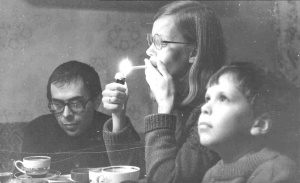
Abramkin, wife and son (Open List)
And now the trial, the long, tedious, sickening hours in the courtroom, under the indifferent gaze of the well-trained ’representatives of the public’. (There, in that bog of corruption, was an island of hope and despair: my parents, my sister, and later Katyusha.) The exhausting searches which drained my last ounce of strength, the curses of the escort guards, the stifling crush in the prison van’s box, the tragic stories of chance fellow-travellers from the Butyrka, beside which my own plight seems trivial and insignificant, again the box, even more crammed and dark, in the basement of the Moscow City Court … the guards saying: ’Hands behind your back, stand up facing the wall, faster, don’t look round, don’t look to the side, take your hands off the partition’. Tiresome wrangling for the right to say the slightest thing about the case. Late at night, the black Maria again, the Butyrka, the guards, like some impossible happiness you’re waiting for (dreaming of) your cell and its bed [shkonka] to get there, arrive, collapse, forget oneself in sleep … But insomnia falls on you like a stone, your head is buzzing: What? What can I do and say tomorrow? And before you can doze off, it’s five a.m. and the rattle of the food-tray — ‘Abramkin, with your belongings’!
And this is a holiday? Yes, a holiday! And for those seconds when they brought me out of the escorts’ room in the evening and I saw your faces and heard your voices, I would have paid ten times the price.
“Va-le-ra!”
O Lord, I don’t know how you managed it, but I heard that shout on the very first day, the 24th, in the basement cells, and I think I even made out Viktor’s voice. By what miracle did Gleb get through to the stairs? I managed to wave to him … Tanka’s face was quite near (who was that holding her — not her husband? Congratulations, Tanechka!) And through the peephole in the black Maria I managed to exchange a glance with Seryozha. And Volodya’s shout every evening of ‘Valera’ deafened even the guards [1]. And then there was the bouquet of cornflowers thrown over the fence to my feet (the soldiers fell out of step and carefully stepped over them).
What a happy day 2 October was for me!
The questioning of the witnesses. The courageous, calm behaviour of Viktor Sorokin, whose consistency and logic infuriated the Chairman until she was foaming at the mouth, and the Procurator until she howled. Even the well-trained audience couldn’t keep up the act and were laughing out loud at the court. They couldn’t do anything with Misha Yakovlev either. What a lot the poor man had to put up with! They took away his archive of the last ten years: stories, plays, tales, novels … His Odessa and Moscow ordeals — queues, interrogations and being banned from Moscow. That wasn’t enough; they had to add threats in the witnesses’ room. Mishka, your remarkable calm, your subtle sense of humour (I don’t believe I’ve been so amused in a long time, not since reading your stories) and the way you so adroitly made those servants of lawlessness fall flat on their faces — it was all simply delightful. (Misha and Natasha, you have my belated congratulations, I’m happy for you, and wish you a good life!)
And when Tomachinsky spoke, everything seemed to change in the courtroom, and the Judges and the Procurator shrivelled up inside their criminal hides.
I understand how difficult it must have been for Irina Malinovskaya to testify in this trial; her behaviour was all the more convincing, dignified and noble. All the nonsense, absurdity and falseness of the investigation was illustrated by Rubasheva. Sonechka Sorokina’s testimony at the trial was an unexpected, it made an impression on everyone present (in the black Maria the guards were already asking me questions ‘about Sorokina’). A remarkable combination of gentleness and ardour, pathos and persuasiveness. Sonechka, don’t be disappointed; I got a few petals of your bouquet and kept them through all the searches; in my cell my only cell-mate, who had also just returned from his trial, and I were both amazed; the petals weren’t wilted or dried out, they hadn’t lost their living resilience, scent or colour. A real fairy-tale miracle!
The investigators’ dupe, Kasatkin, pale and trembling, hiding his eyes … No, he couldn’t spoil my holiday. Ah, but he was pathetic and insignificant; so pathetic and insignificant that I couldn’t torture him with deadly questions and I let him go without regret.
I listened to you, my friends, and thought: well, why am I better than everyone else? Everyone … everyone … everyone … maybe on Mars there’s somebody better than I am, but on Earth? No, no, on Earth you won’t find anyone better … Don’t be offended, my friends, but to be honest, you really did overdo the praise. And what if I should start taking all this seriously, eh? What then: a prisoner with little wings? And what kind of guards would they need then? On the other hand, never mind. I’ll confess secretly that I too can fly, and I won’t tell any more tales — nobody will believe me anyway!
All through the trial I felt help and support from you: Raisa Borisovna [Lert], Mikhail Yakovlevich [Yakovlev], Pyotr Markovich [Egides], Gleb [Pavlovsky], Volodya [Gershuni], Viktor [Sorokin] and Yura [Grimm]; and from you Seryozha Khodorovich, Arina Zholkovskaya, Vityusha … and from you Felix and Vera Serebrov, Igor Myaskovsky, Volodya Kucherov, Seryozha Belanovsky, Valery Zhulikov, Tanechka Zamyatkina … Forgive me, my friends, I won’t name all of you, but I remember and love each one of you individually. Don’t think these are just fine words, but it is thanks to you that I’m proud of having been born in this land and belonging to this people. I’ve never tried to determine or calculate whether there are many honest, decent people in Russia. Hundreds of thousands — what’s the difference? I think it was Dostoevsky’s Versilov who said that, for the sake of one hundred or a thousand such people, perhaps our entire history was necessary.
I have had to spend tedious hours on end standing at the closed doors of ’open’ trials. Now the doors have been closed behind me. The trial lasted four days. So I have my own experience and can compare it with that of others. And I’m not exaggerating when I say that here in the dock it is both easier and simpler. Thank you again, my friends, for everything …
On the last day, while the court was deliberating on the sentence, a brick came flying through the window with a crash and a tinkle. The frightened guard called for reinforcements and every measure was taken to ensure that I would not see or hear you. But it was no use to them. And again there were those wonderful moments, when iron gates and walls could not separate us.
Goodbye … I could have and should have answered you. There was nothing threatening me. and one soldier even whispered on the sly. ‘All right, shout, they won’t do anything to you’. But I was gagged by a damned lump in my throat and couldn’t force out a single word.
Goodbye … Till we meet again outside. God keep you, my friends.
5 October 1980. Butyrka Prison, Cell No. 19
*
On 8 October Abramkin wrote another letter from prison:
LETTER TWO
To the editors, contributors, authors, readers and friends of Poiski,
And so the second trial of the Poiski case is over. Unfortunately I have no news of Yury Grimm, and I know little about Sokirko’s trial. But is the case against Poiski over? And will the work begun by Poiski be continued? At one of our last meetings Burtsev said unequivocally about the authorities’ future plans:
‘Strictly speaking, even after your three trials Case No. 50611/14-79 will not be closed, so there are vacancies’. As for the second question, it is up to us to answer it.
There is nothing new in the methods used to fight our journal.
The only surprising thing is how we continued so long and even managed to bring out eight issues.
From the January pogroms of 1979 to the end of August 1980 the investigation did not show us (or at least me) any charge or concrete item of libel, or a single example: such and such materials contain, in our opinion, libellous fabrications. The indictment, which I have only quite recently studied, does not depart from the traditional plan : such and such works in such and such an issue contain such and such libellous fabrications, the circulation of which damaged the international prestige of the USSR. And that’s all. As if a proof required nothing but an assertion, arguments being unnecessary. No analysis, no discussion, not a single quotation from the criminal work.
As If a proof required nothing but an assertion, arguments.
Just like the theatre of the absurd:
‘You killed a boy, therefore you’re a criminal.’
‘But what boy, when and where?’
‘What does that matter, since you killed him.’
‘But where did you get the idea that I killed him?’
‘You’re a criminal, that’s why you killed him.’
‘But why am I a criminal?’
‘Because you killed him.’
‘Who?’
‘The boy.’ (etc, etc, ad infinitum).
But why does it follow that the listed materials from the journals in fact contain such and such assertions? And then, on what grounds can these assertions be judged libellous? And not corresponding to reality? You can go on asking these questions indefinitely. They have not answered them so far, and they won’t answer them now.
The court obstructed every word, every attempt to ask questions to the point. Not a single word, not a single quotation from the journal was pronounced (except for the titles of articles). Discussion, analysis, enquiry? No, just a criminal-type investigation, an ordinary criminal investigation: where did you get it, whom did you give it to, where did you put it, who brought the typewriter, who typed it? My attempt to give even a brief account of the contents of the works in No. 1-2 (it was not difficult to establish that the judges had not read our journals) met with a furious, choking howl. And when I continued, the court ran panicking into the conference room, whereupon everyone present was sent out of the courtroom (and who were these ‘everyone’? ‘Representatives of the public’ dragged in from God knows where?) They were in such a hurry that they did not even announce that my final speech was being cut off and that the court was withdrawing to deliberate on the sentence …
And what has this trial given us? Has it shown us once again HOW THEY JUDGE US? But it did not add a single stroke to the picture clearly presented long ago: lies, coercion, lawlessness and tyranny. So to what end was all this necessary, even if only to me — why? Leaving aside all the personal aspects, such as depriving oneself of the possibility, after ten months’ imprisonment, of seeing the faces of loved ones and hearing the voices of one’s friends. In my last interview I gave the readers of Poiski a detailed account of all the pros and cons of participating in a pathetic judicial farce, and myself suggested that the ideal and logical answer to their pathetic attempts to claim the appearances of a court examination was ‘No’; and as worthy examples I cited the behaviour of Sasha Podrabinek and Balys Gajauskas in court.
I was prepared for such an eventuality, such a solution, such a way out of their dirty game, and I would have had the strength, believe me, to overcome the personal unpleasantness of appearing in the dock and remaining silent. Even though someone said this way was more complex: to get your three years without torturing yourself or your loved ones and friends.
I will try to explain my ‘betrayal’ of the principles I worked out earlier. There was something a bit new about our case. The punitive organs attempted, apparently for the first time, to harness official ideologists to their team. The ‘conclusions of the specialists’, which I studied after the investigation was closed, gave grounds for timid hopes of a dialogue; true, with our rights extremely reduced and with dishonest rules imposed by them, but a dialogue all the same.
And in these circumstances I could not, had no right, to refuse the opportunity of discussion (it was quite naive of me to believe such a thing was possible, but then Poiski itself started out of such naivety), the opportunity of a search for mutual understanding between the diametrically opposite, widely divergent forces in our society (and these forces ought not diverge so far in one country and one people). But now the trial is over, all hopes have been put to the test, and again we have been convinced that in our country dialogue with them is fundamentally impossible. One can communicate with deaf-mutes only in sign-language. So swallow your tongue and mumble, mumble the way you have been taught from childhood, mumble and put an idiotic smile on your face and pretend you like it, pretend you’re happy: everything is normal, wonderful, amazing (‘How wonderful this world is — look!’). How easy to be like a wordless cow, no worse and no better than the others, together with everyone, in unison with everyone, to walk in step, revelling in conformity.
It is unlikely that the ‘specialists’ themselves refused to appear in court without orders from above. Most probably, even such a restricted dialogue was judged inexpedient. But that was not my doing and not my fault! I honestly submitted petition after petition, I was prepared to wait for the philosophers and historians, whether they were called expert witnesses or specialists or whatever, for anyone, to wait a month, even to remain in custody for a year without trial. Failing to get the official ideologists, I requested that their reviews be read out and discussed. And nothing was read out from their pathetic works. Those of you who have read these reviews will try and answer the question: ‘Why? ’ Well, how could they possible be dangerous? Were they afraid of these distorted Md juggled quotations that the specialists ‘raked out’ of our journal? Or of the prospect of having to allow me to say one word? The funniest thing is that when I tried to quote the ‘specialists’ conclusions, the Procurator and the Judges became frantic, even promising me that they would not regard the reviews as evidence (If I am not mistaken, the judgment did not contain a word about the specialists) Well, though this is only a feeble justification of my betrayal of the principles I worked out earlier, I will stop here: it is enough for me that I used every opportunity to obtain a dialogue. And it is not my fault that it did not take place. (If I have enough time and luck I shall try all the same to make my own analysis of that remarkable document.)
In addition, I did not resist the temptation to demonstrate that lawlessness operates by using appropriately unlawful means. The witnesses’ evidence and the speeches of defence counsel and the accused (and even more so, the speeches of the Procurator and the Court Chairman) show convincingly that the case does not contain a single piece of proof (even from the purely formal point of view). Falsifications, forgeries, ordinary faked documents, ignorance of the law on the part of the investigation, gross disregard of basic procedural norms, pressurizing of participants in the trial (of witnesses even during the trial itself). Everything was done to prevent the accused from studying the case materials; I was deprived of the right to defence counsel; during the trial they started taking away (in the investigations prison) the notes that I had managed to take down and documents I had prepared in advance (the fact that they had read my papers was later apparent in the Chairman’s actions); and my final speech was broken off. And what could they hold up against us? Absolutely nothing! The criminal nature of Poiski was decided on, as Rubasheva so aptly put it, ‘by smell’. As a result, even this court did not take the risk of leaving in the judgment most of the ‘evidence’ presented in the indictment. It was a total fiasco, an unconditional defeat for our accusers. And I have every right to congratulate you on your victory, my friends!
Only in the courtroom did I read Lert and Gefter’s statement requesting to be admitted to the trial as witnesses. Unfortunately, both their request and mine were turned down without reason by the court. But you were with me at the trial, Raisa Borisovna [Lert]. And later in the proceedings, in my amputated final speech. I frequently quoted extracts from our articles in Poiski (I read them over with pleasure when I studied the case file). In the same way, the following articles helped me to substantiate my position: those by Mikhail Yakovlevich [Yakovlev] (especially ‘Notes on Pessimism’), Pyotr Markovich [Egides] (with his fundamental study of legal problems and impeccable logical system of argumentation), and Gleb Pavlovsky … My model and example, both in prison and in court, was the determination and uncompromising attitude of our Volodya Gershuni (Volodya, I take this opportunity to congratulate you, though belatedly, on your fiftieth birthday). I have constantly felt the strength and support of my fellow-prisoners Yury Grimm and Viktor Sokirko. Poiski contributors Viktor and Sonya Sorokina spoke convincingly at the trial … For reasons which you can understand I am obliged to cut short this far from complete list. I am happy and proud that I had the honour of working with you, my dear friends and colleagues!
I would like especially to say something about Viktor Sokirko. I know what kind of pressure he was subjected to here, in prison and in the investigation offices; I know what he was threatened with … In June Viktor explained his position to me; I supported him and on the whole approved. I do not think that those small concessions he was forced to make under pressure from the investigators and the court should be held against this courageous and honest man. Viktor, I am very happy for you and Lilya. I ask you, I beg you, not to torment your conscience out of a misplaced feeling of solidarity. Believe me, it would have been twice as bad If our joint solution to that June situation had not been carried out. And thank you very much … you’ll remember what for. Yes, and forgive me for a certain price which had to be paid for prison foul ups.
At the trial I repeatedly stated that I was one of the editors of the legal journal Poiski. I also said that my duties did not include circulation of the journal or sending it abroad. In my final speech (which was broken off) I intended to specify that while I was not involved in its circulation I naturally did not object, nor could I object to the journal being read by our fellow-countrymen and by people living outside the USSR. Moreover, I believe that the circulation of Poiski abroad furthers the cause of mutual understanding among different nations, promotes a better understanding of our people and country, is a genuine expression of the relevant articles of the Helsinki Agreements and the UN Statutes, and can in no way harm Russia. I was not allowed to say this. Well, never mind; I think I’ve now dotted all the i’s, and no cause for misapprehensions or vagueness remains. I am grateful and obliged to all those who have participated in the fortunes of what we created. Many thanks to all people of good will for your help and support.
My dear friends and colleagues! When I spoke of the trial which has just ended, it was perhaps not altogether appropriate to congratulate you on our victory. The defeat of the investigation and the court (or, to be more precise, their disgrace) was of course unconditional. But seen in a broader perspective, this was no victory for us. And not because of the sentence … I am not the first, nor the last, to be heading for the islands of the Archipelago. It’s just that this was not the kind of victory we dreamt of when we started our ‘search for mutual understanding’. But it would be worthwhile to reassess the significance of our journal. In all honesty, we did not manage to .surpass in quality the average standard of samizdat periodicals. The merit of Poiski lies in the fact that it was the first manifestation of fruitful collaboration among people of widely divergent views, concepts and apparent methods of solving the problems facing our society. I can’t say that we found the work easy and joyful. Almost every issue had us flaring up in heated discussions, which were not always proper; at times it looked as if such a diverse collection of people would not stick to their appointed task of cooperation and would scatter in their separate directions: the Marxists into the clouds, the Native Soil thinkers backwards, and the bourgeois democrats into the water. But we did not go our separate ways, neither did we abandon the work we had undertaken with such effort. We learned to listen and to talk with one another, and even if our views have not come any closer (it would have been naive to count on that), the important thing is that mutual understanding has been achieved, even if only among ourselves.
Strange as it may seem. Poiski’s brief span of existence has coincided with perhaps the most difficult period in the history of the democratic movement in our country. I am referring not to the repression which has hit the human-rights activists, nor to the terrible pre-Olympic wave of arrests to which the authorities attached such importance in their war on independent thought and the free uncensored word (it is not without reason that the word ‘liquidation’ appears in the ‘conclusions of the specialists’ …). It is not for us, who understand what sort of country we live in and what sort of conditions we have to work in, to wail about the methods used by a totalitarian regime to suppress dissent. That is not the worst of it.
In recent years the human-rights movement has tended more and more in the direction of intolerance, unwholesome division and alienation between the various currents which make up its stream. I shall not quote all the facts and examples. An unseemly attitude on the part of certain individuals and groups towards the [Prisoners] Relief Fund, the Helsinki Group and even victims of lawlessness; intrigues and demonstrative activity arising from vanity, excessive pride and pretensions to leadership on the part of certain ‘activists’, etc, etc. All this is clear to you without specific examples. I would like to be understood correctly. The democratic movement in our country has from its inception comprised various different tendencies and there is no harm in this; on the contrary, any attempt to reduce this multicoloured spectrum of ideas to one monochrome line would be disastrous. But variety by no means presupposes alienation and dogmatic intolerance. We can exist under present social conditions only If we coordinate our activities and assist each other in a brotherly way; we can develop only by fruitful cooperation — as exemplified in Poiski — among tendencies sometimes diametrically opposed.
However different our hopes for Russia’s future, we share the same country, the same people, the same plight, the same suffering. Is this the time to determine the exclusivity of this or that central idea in Russia’s destiny or history, when Russia’s very existence and future are threatened, without which she will have neither destiny nor history? Under these conditions, do we have the right to behave with the irresponsibility characteristic of the official ideologists, who are prepared to mumble even at the edge of the precipice: ‘the most advanced … the most progressive … the most scientific … indisputable success … genuine rights … hurrah, hurrah …’
My present situation does not give me the moral right to make any definite suggestions or to urge you to take any particular action. I would like only to hope that the work begun by Poiski will find a worthy continuation. That is all for now.
I give you a big hug. Again, many thanks for your help and support.
Yours, Valery Abramkin, 8 October 1980.
Butyrka Prison, Cell No. 19.
***
On 10 October the Moscow Helsinki Group adopted Document No. 145: ‘The Trial of Valery Abramkin’:
Abramkin’s trial, which lasted four days in the Moscow City Court, is to some extent an event, even against the background of the now commonplace occurrence of trials of human-rights activists in the USSR.
In the first place. Valery Abramkin was sentenced solely and exclusively for attempting to avail himself of a right officially provided to citizens by the Soviet Constitution: the right to freedom of the press … As one of the seven editors of Poiski, he published legally and openly a typed journal of debate containing various different (and often contradictory) opinions, assessments and evaluations both of theoretical problems and of aspects of life in our country …
In the second place, a 34-year-old chemical engineer, who has been forced in recent years to work as a caretaker, who has no legal training and was in effect deprived of a normal defence, defeated outright at his trial the investigators, the court and the reviews of specialists’ who did not appear in court.
And It was for this — for his lively, inquiring mind — that he was sentenced to three years’ camp: a young, talented man, full of strength and energy, who brought a great deal of good to his country, and whom his country could be proud of.
*
On 28 October Raisa Lert wrote an article, ‘My Unspoken Testimony’.
Lert concludes her five-page article as follows:
I protest categorically against the fact that Valery is being charged not only for his own work, but for mine as well. I am still alive and in full possession of my mental faculties. I have behind me forty years’ experience of literary work for the Soviet press and over fifty years’ experience as a member of the CPSU, which I left precisely because of Poiski. So do you really think Valery Abramkin held my pen while I wrote my articles for Poiski?
Why did you put Abramkin in the dock, without putting me there with him? I shall answer this rhetorical question myself: because my biography does not happen to suit your purposes under Article 190-1, Just think — if you’re capable of thinking — why people desert you after dedicating their lives to building a just socialist society. And why your persecutions, which rob human-rights activists of their health and sometimes even their lives, cannot rob them of their honour. It is you Judges who lose your honour.
=========================================
NOTES
- Valera is an affectionate informal version of Valery. Likewise Seryozha (Sergei), Yura (Yury), Misha (Mikhail), Volodya (Vladimir) and Tanya / Tanechka (Tatyana).
↩︎
========================
 A Chronicle of Current Events