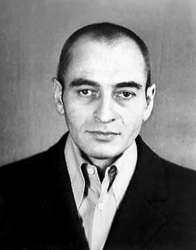
On 24 April 1979 Viktor Monblanov was sentenced in Kiev under Article 206, pt. 2 (UkSSR Criminal Code: ‘malicious hooliganism’) to four years in hard-regime camps.
*
V. Monblanov was arrested on 30 December 1978 on Kreshchatik Street in Kiev (CCE 52.4-2). According to the indictment Monblanov had gone into the street in ‘a white dressing-gown’ and collected a crowd around him, thus violating public order. In addition, he had shaken his fist at citizen A. G. Dil, wishing to strike him, and he had resisted arrest.
The Lenin district people’s court in Kiev examined the case of Monblanov. The judge was Kiba; the prosecutor, Ryndina. Monblanov refused a lawyer. Dil (the victim) and three police witnesses also took part in the proceedings.
Dil did not admit to being a victim. He informed the court that he had himself torn a placard from Monblanov’s chest; he, Dil, fought in the Patriotic War, he had helped to free prisoners from Hitler’s camps, and he did not believe that there were prisoners of conscience in the USSR; therefore the slogan on the placard — ‘Freedom for Prisoners of Conscience’ — had angered him. But Monblanov had not put up any resistance either to him or to police officials. (When sentence was passed Dil was indignant about its unfairness.)
When the evidence of the witness Duritsky was read (he was in hospital and did not appear at the trial), it became clear that he had testified incorrectly about the place where the event took place.
Neither did the remaining witnesses corroborate the fact that Monblanov had ‘put up resistance’. However, after the Procurator’s persistent questions one of them declared that when the policemen had taken Monblanov’s arm, he had put up resistance by ‘flinching’.
Procurator Ryndina repeated the indictment and asked for four years’ deprivation of freedom. In his final speech Monblanov talked about his impressions of the trials of A. Podrabinek, P. Vins, Yu. Orlov and A. Ginzburg. After these trials, Monblanov said, he had considered it his duty to express his objection and his solidarity with prisoners of conscience. ‘I wanted to appeal, not to people’s reason, but to their best feelings — to the heart, to their sense of honour; I wanted to appeal for mercy and sympathy,’ Finally, Monblanov expressed the hope that ‘justice will one day triumph’.
Sentence was passed by the court after a three-hour deliberation which was held, not in the consulting room attached to the courtroom, but on another floor of the building. During the deliberation, Judge Kiba held more than one long telephone conversation.
*
Until 1976 Viktor Vladimirovich Monblanov had worked as an assistant director at the Kiev Studio of Popular-Scientific films. In 1976 he received a legacy and left work to make an independent study of religion, history and literature.
*
Monblanov’s wife Alla Yakovleva has been refused a meeting with her husband, on the grounds that they are not legally married, Monblanov and Yakovleva have been living together for 13 years and have a ten-year-old son.
*
On 31 May the Kiev City Court rejected Monblanov’s appeal and ruled the sentence of the court of first instance to be correct.
==========================================
NOTES
In 1982 Vesti reported (USSR News Update, 1982, 6-1) that Monblanov had again been arrested, this time for a protest to mark the fifth anniversary of Yury Orlov’s conviction, and was sent to a psychiatric hospital for treatment. (He had been released early from the camps in 1981.)
ъъъъъъъъъъъъъъъъъъ
 A Chronicle of Current Events