Towards the end of 1978 some members of the USSR Writers Union (Vasily Aksyonov, Andrei Bitov, Viktor Yerofeyev, Fazil Iskander and Yevgeny Popov) compiled a literary almanac entitled Metropol.
It contained
- poems by Yevgeny Rein, Inna Lisnyanskaya, Semyon Lipkin, Andrei Voznesensky, Genrikh Sapgir, Yury Karabchiyevsky and Yury Kublanovsky;
- poems and songs by Vladimir Vysotsky and Yuzef Aleshkovsky;
- prose works by Bella Akhmadulina, Pyotr Kozhevnikov, Yevgeny Popov, Fridrikh Gorenshtein, Andrei Bitov, Fazil Iskander, Boris Bakhtin, Arkady Arkanov and Viktor Yerofeyev;
- an extract from a new novel by John Updike, a ‘guest of the almanac’;
- a play by Vasily Aksyonov; and
- essays by Mark Rozovsky, Vasily Rakitin, Viktor Trostnikov and Leonid Batkin on various aspects of culture.
A significant number of these works had been rejected by Soviet publishing-houses.
*
*
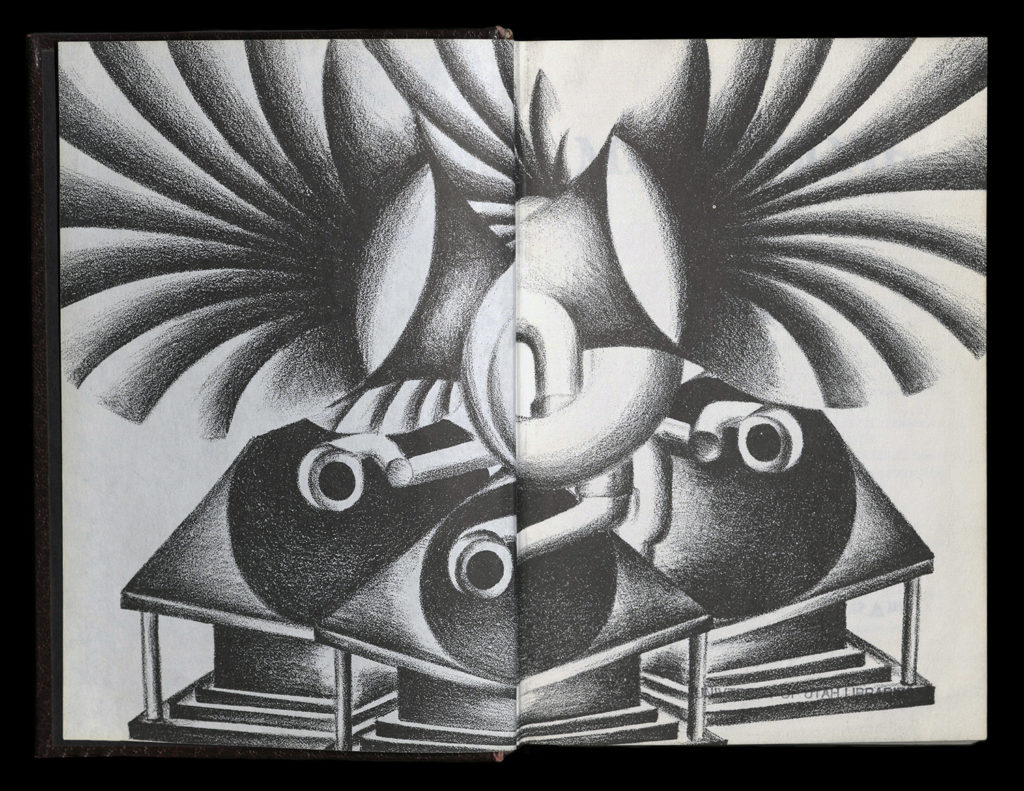
The first ‘edition’ of the almanac was prepared by the artists David Borovsky and Boris Messerer: each copy is a large file containing Whatman paper, each sheet of which has four sheets of ordinary typing paper fixed to it; there are altogether 500 sheets.
The literary material is preceded by a notice which states:
‘The Metropol almanac represents all its authors to an equal extent. All the authors represent the Metropol almanac to an equal extent.
“The Metropol almanac, which is issued in manuscript form, may be published in printed form only if the original composition is preserved. The works of each author may be published separately with the permission of the particular author, but no earlier than one year after the almanac is first issued. Reference to the almanac is obligatory.’
This notice is followed by a copyright symbol and ‘METROPOL 1979’.
A foreword states the principle of the authors’ personal responsibility for their own work.
The compilers decided to hold a ‘preview’ on 23 January 1979 in a Moscow cafe called ‘Metropol’, where the almanac would be ‘presented’ to specially invited guests: representatives of the press; well-known figures from literature (including Veniamin Kaverin, Georgy Vladimov, Vladimir Kornilov and Bulat Okudzhava); the theatre (A. Efros, O. Yefremov, Yury Lyubimov, Oleg Tabakov, M. Kozakov); and the scientific world (Academicians M. Leontovich, V. Engelgardt and others).
*
WARNINGS
On 12 January 1979, Victor Yerofeyev and Yevgeny Popov were summoned to the Secretariat of the Moscow Writers Organization to see Felix Kuznetsov, First Secretary of the Board of the RSFSR Writers Union Moscow Office. Together with Kobenko, the Secretary for Organizational Matters, Kuznetsov conducted a formal questioning (at first, they had tried to interrogate the two men individually, suggesting that the other ‘wait in the corridor’).
In the days which followed the compilers of the almanac were summoned one by one for similar treatment: questioning, threats, and attempts to persuade them “not to do anything foolish” and to set them against each other (Aksyonov, Bitov and Iskander were asked: ‘”Why do you, famous people, get yourselves mixed up with a load of drips?”; Yerofeyev and Popov were asked: “What are you doing running after them?! What has Aksyonov got to lose — he’s got half a million in American banks …”, etc).
*
On 22 January 1979, all five compilers were ‘slated’ for four hours at a joint session of the Secretariat and the Party Committee of the Moscow Writers Union presided over by Felix Kuznetsov. Those taking part included N. Gribachev. A. Sofronov, M. Alekseyev, Yu. Gribov, M. Prilezhayeva, S. Kunyayev and others — over 50 participants in all.
The beginning was relatively ‘calm’, but after only half an hour there was a loud chorus of ‘lack of ideological content’, ‘low level’, ‘unintelligibility’, and ‘pornography’ with regard to the almanac; and the ‘preview’ set for the following day was described as a ‘political provocation’ and an attempt to undermine detente designed — according to the compilers’ malicious aims — to incur millions upon millions of losses for the USSR:
“their scheme was that with all this we would have to expel a few people from the Union; that will arouse protests, followed by a malicious slander campaign; and the US Congress is just waiting for a pretext not to ratify the SALT 2 agreement”.
The compilers, who had five days earlier presented Kuznetsov with a copy of the almanac, insisted on the need for an objective analysis of it, on their right to freedom of publication, and on the absence of any covert political motivation whatsoever behind the almanac or the ‘preview’, to which all those present were invited.
By this time, however, the compilers had already decided to cancel the ‘preview’, as it might have served as a pretext for provocations against those involved in producing the almanac. Nonetheless, the cafe ‘Rhythm’ (on Gotvald Street), where a room had already been booked with the management, was closed ‘for a cleaning day’ just in case, and surrounded by reinforced squads of police.
*
SANCTIONS
After 22 January 1979, the almanac compilers received no more summonses.
All the writers were subjected to persistent, repeated threats, however, and to attempts to extract public repentance and renunciations from them. ‘Sanctions’ followed.
Contracts which have already been made are not being broken, but sources of income are being cut off.
The issue of a book by Vasily Aksyonov by the Soviet Writer publishers has been stopped; a film for which he had written the screenplay has been taken off release; and a publication in the Latvian SSR journal Daugava has been stopped.
A contract between Bella Akhmadulina and the Kishinyov publishing house has not been concluded and all her advertised performances in Minsk were cancelled: one did take place, nevertheless, because the chairman of a collective farm was very keen for a real poet to appear at his farm, and took the responsibility for the evening on himself.
Andrei Bitov’s screenplay for the film ‘On Thursday for the Last Time’, which was already being shown, was taken off general release (it has been shown in clubs); his seminar engagements in the Literary Institute have been cancelled; and his participation in the ‘Green Lamp’ association stopped.
The publication by the Soviet Writer publishers of a book by Fazil Iskander has been stopped and his publications in Country Youth suspended. The publication of a book by Yevgeny Popov by the Krasnoyarsk publishing house has been held up. Lipkin’s foreword to a translation of the ‘Shah-Name’ by Firdousi has been deleted, and his access to translation contracts cut off.
Translations which Lisnyanskaya had already prepared were not accepted (the work was reallocated to other translators). Arkanov’s screenplay for ‘Mosfilm’ has been ‘closed’, and his television broadcasts stopped. Rozovsky was taken off the production team at Mosfilm and his theatre shows stopped. All Messerer’s orders for book-illustrations and lay-outs have been cancelled. The publication of a book by Batkin for the Knowledge (Znanie) publishing house has been postponed (so far ‘for a year’) and all references to him in another writer’s book removed. The Writers Union has not reissued Yerofeyev and Popov with membership cards.
The single, very notable exception is that Andrei Voznesensky’s appearances in America, which had received extensive advance publicity, have not been cancelled.
*
PRESS
On 7 February 1979, Moscow Litterateur, the newspaper of the Board and Party Committee of the Moscow Writers Organization, published an article by Felix Kuznetsov. In it he accused those involved in the almanac of playing “a filthy political game that has nothing to do with literature”.
On 23 February Moscow Litterateur reported:
‘On 20 February a conference took place to which members of the Moscow Writers Organization who had studied the typewritten almanac Metropol talked about their impressions and conclusions. More than 1(X) writers had studied the almanac …
“In his summing-up remarks … Felix Kuznetsov thanked all the writers who had been forced to tear themselves away from their work and waste their time reading and discussing such artistically worthless, cheerless and tedious material as the collection contained. Not one of the writers who had read the almanac expressed the slightest doubt as to its very poor aesthetic and moral quality.
“They all agreed on one point: the extremely low artistic level of most of the collection pointed quite clearly to the fact that its organizers did not have literary aims. They had set themselves quite different tasks, far removed from those of literature, art and morality.“
The paper cited 30 excerpts from the ‘speeches and comments’:
“Representatives of national literatures whose epics used to be translated by Lipkin are now wondering whether to wait until another Lipkin is found” (Sergei Mikhalkov)
“What a betrayal of patriotic feeling, of feelings for our Motherland!” (Maria Prilezhayeva)
“The strategists of ideological warfare … will try to use this so-called ‘purely literary venture’ for provocative purposes” (Nikolai Shundik)
“ln my opinion, not even a microscope could succeed in detecting any literature in it. Political aims, on the other hand, are clearly visible” (Vladimir Karpov)
“The very idea of such a publication cannot but incur professional and moral censure” (Pyotr Nikolayev)
“Sexopathology … the literature of the small shopkeeper. We cannot allow this, you have to go to America for this” (Rimma Kazakova)
One phrase with a negative judgment was quoted from a review by Oleg Volkov, a Leningrad critic (Volkov protested about this). The critic Vladimir Gusev maintains that a quotation in the newspaper distorts the meaning of his speech [note 15].
*
The compilers of the almanac, and Bella Akhmadulina, as well, declared that if a single writer were excluded from the Writers Union they would leave it themselves.
After all the ‘slatings’ they wrote a number of letters:
- to Brezhnev and Zimyanin, a CPSU Central Committee secretary, enumerating the ensuing repressive actions (they received no reply);
- to the State Press Committee requesting the publication of the almanac in the USSR (the telephone reaction: “We don’t actually publish anything. Give it to the Soviet Writer publishers”); and
- to the All-Union Copyright Agency (VAAP), requesting that it defend the copyrights (oral reply: “If it’s published, then we will defend it.”)
Meanwhile Ardis Publishers in the USA is preparing the almanac for publication.
*
In a letter to Academician G. E. Clancier, President of the French PEN Club, Georgy Vladimov writes:
“This almanac … is a remarkable phenomenon of present-day social life and, in my opinion, merits a place in history on two counts: as the first instance of the large-scale exercise of uncensored literary freedom, and also as an example of rare unity by the participants in rebuffing all attempts to make them retreat.“
========================================
NOTES
 A Chronicle of Current Events