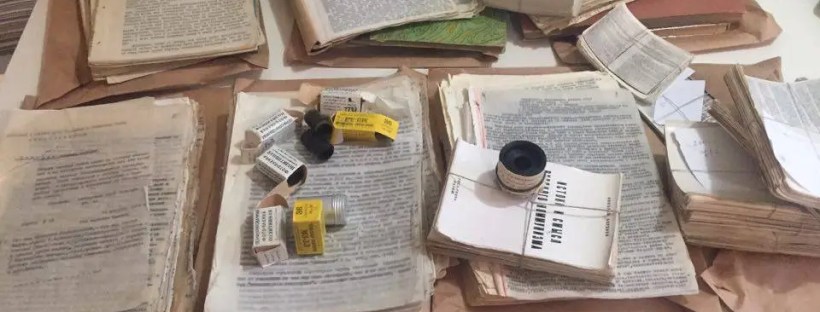
SIXTEEN ENTRIES
(Periodicals, 7-16)
[1]
Anon
“Defining ‘Security Risks’ in the USSR” (6 pp.)
In an examination of the restrictions on exit from the USSR applying to individuals who have access to secret information, the anonymous author notes that in our country information which on principle cannot be secret is often classified as secret.
If work is secret, this may be evidence of its topical nature or, conversely, of the backwardness of Soviet science in the study of a particular problem. Often a person who works in a ‘closed’ enterprise is actually doing ‘open’ work, but no heed is taken of this. Sometimes work is classified as secret simply as a device to give those involved access to (otherwise unobtainable) foreign publications, and this obviously cannot serve as grounds for refusing permission to emigrate from the USSR; and so on. view of the above it is proposed that the authorities should:
1. On refusal of an exit visa, report the period over which the refusal remains valid or the real date of the next reconsideration …
2. … Establish a procedure for examining the refusenik’s objections, similar to that for examining objections to the refusal of copyrights … It would be desirable to carry out this examination (or part of it) with the help of the refusenik himself;
3. Lay down the maximum period over which the refusal of an exit visa can remain valid.
*
[2]
Anon
“Third Open Letter to Academician Sakharov” (January 1979 11 pp.)
The anonymous writers appeal to Sakharov to investigate the essence of matters, and not to be distracted by the particular or secondary, such as, for example, the question of human rights violations. What, then, is of principal, primary importance? Above all, economics …
After a short historico-economic survey of the Soviet system the writers of the article comment on the unsuitability of the present ‘system of running the country and its economy’, They maintain that a new leadership will inevitably pursue policies which will lead to a revitalization of the system, to full democracy and to real socialism. The future belongs to socialism, to rule by the people, which will, of course, include all the positive elements of bourgeois democracy. The movement to defend human rights can be part of the struggle for a better future for our nation if it is part of the struggle for socialism, and does not merely involve the defence of human rights for their own sake.
*
[3]
M. Novikov
‘What’s Concealed in the New Law on USSR Citizenship’ (14 February 1979, 7 pp.)
The new Law has been devised as a means of regulating emigration. It is exactly this aspect of it … that makes it contrary to both the Spirit and the Letter of the Covenant on Civil and Political Rights.
Its basic meaning lies in its aim to preserve the total arbitrariness of the authorities with regard to emigration and, by using legislation, to strengthen the means, so rare in today’s world, of keeping people in a helpless position.
*
TERLECKAS (4-5)
[4]
Antanas Terleckas
‘Once More about Jews and Lithuanians’
(8 October 1978, 9 pp.) [1]
During the German occupation of Lithuania, a terrible tragedy took place: about 200,000 Jews were killed. The question is still with us today and will not let us rest: who was guilty?
In a polemic with an article by A. Zuvintas, published in Ausra No. 9 (CCE 48.24 [15]), the author writes:
“Only someone who is blind to the misfortunes and sufferings of defenceless people, someone who holds nothing sacred, can look for ‘objective’ arguments to justify the murderers.“
*
[5]
Antanas Terleckas
‘Open Letter to Viktor Kalnins’ (24 December 1978, 4 pp.)
“I recently discovered that you are travelling around the world, making public appearances and being received as a hero and martyr.“
Recalling Kalnins’s testimony in the Ginzburg case (CCE 46.5-1, CCE 50.3) and the Petkus case (CCE 47.5, CCE 48.4, CCE 50.5), the author concludes:
“You have brought shame not only on the Latvian people, but on all of us Balts. What is more, I am afraid that you may have imitators who intend to buy permission to emigrate with their treachery. May they know that our contempt and hatred will follow them, even abroad.“
*
[6]
Alexander Shutkin
“How I Became a Dissident” (February 1979, 10 pp.)
Alexander Fyodorovich SHUTKIN was born in 1926 in Gorky Region.
He worked as a photographer and correspondent on the newspaper Forwards of the Region’s Krasnobakovsky district. Seeing that local agriculture was in a state of collapse, that the chairman of the collective farm was a bully and hooligan and the judge a bribetaker, and seeing the rapacious mass-felling taking place in the local forest and the luxurious homes of agricultural administrators built at State expense, he tried to draw attention to shortcomings and have the leading criminals prosecuted. His efforts led only to his dismissal from the newspaper. Shutkin began writing complaints to Moscow.
In July 1975 a search was conducted at his home. Manuscripts of his own articles “Stand Up — the Trial is Beginning” (about how the district authorities are elected) and “Far from the Law”, two letters to the Minister of Agriculture and one letter to Kosygin, were taken. On 28 November 1975 the Gorky Regional Court, presided over by A. P. Bogatov, sentenced Shutkin to one and a half years in strict-regime camps. According to the judgment, the evidence incriminating Shutkin consisted of the three letters and ‘two short stories’.
In camp (Komi ASSR, Camps 231/36, 231-9/2 and 231-5/2) Shutkin encountered hunger, lice, bed-bugs, dysentery and exhausting labour. The guards used to joke: ‘Bring Lenin here — he’d soon renounce his ideas!‘
‘That is how I became a dissident. I accept this description,’ writes Shutkin at the end of his account.
*
PERIODICALS, 7-16
POISKI (7-8)
[7]
POISKI, 4
“Searches” No. 4 (10 December 1978), 361 pp.
A new member of the editorial board, Yury Grimm, appears on the list.
The 30th anniversary of the 1948 Universal Declaration of Human Rights is the subject of an editorial article and also of articles entitled “Thoughts on Citizenship” by Victor Nekipelov, “State Religion” by M. Baitalsky (in CCE 45.10 and 51.21 his name contains an error) [2] and “Trampled Springs” by M. Zotov.
The section headed ‘Doubt’ includes the articles “Minus the Past” by P. Yulin and “Apolitical Letters” by P. Rastiii.
A work entitled “The Poverty of the Peoples” by Adam Kuznetsov (CCE 51.21 [11]) and an interview with Aganbegyan, Corresponding Member of the USSR Academy of Sciences, given on 8 April 1965, deal with economic questions. The article “Twelve Years Later” comments on this interview. This section also includes an essay by M. Morskaya entitled “Once Again, about Queues”.
The journal contains poetry by Victor Nekipelov, Boris Chichibabin, Felix Serebrov and A. T., previously unpublished poems by N. Aseyev, stories by G. Rybak and Arkady Belinkov, the end of a novella by ‘G. Bezglasny’ (pseudonym) entitled The Mole of History, or Revolution in the Republic-S=F [3], an article by V. Gusarov entitled “In Defence of Faddei Bulgarin” (cf. CCE 12.10 [3]) and notes by L. Filonov entitled “From the Diary of a Reader”.
The chapter ‘Resistance’ contains G. Davydov’s appeal “I am against Terror” (CCE 51.20-1 [8]) and an article by P. Abovin-Yegides entitled “Paralogisms of Police Psychiatry”. This chapter also summarizes issues 1 and 2 of the collection Pamyat (Memory; CCE 42.12 [2], CCE 51.21 [17]).
A humorous section, “Ventilation Window” (fortochka), is introduced in this issue.
*
[8]
POISKI, 5
“Searches”, No. 5.
A new member of the editorial board, Victor Sokirko, is noted.
The publication of this issue was delayed through searches conducted on 25 January 1979 (CCE 52.4-2). It was not possible to recover all the confiscated material.
The issue contains accounts of these searches written by Victor Sorokin, Victor Sokirko and Gleb Pavlovsky.
*
ARTICLES
Pinkhos Podrabinek and Pyotr Abovin-Yegides, “Current Problems of the Democratic Movement” point out the vital need for unity between different opposition groups and currents.
“For the Sake of Russia” by Victor Sokirko polemicizes with authors published in Vestnik RKhD (Herald of the Russian Christian Movement; No. 125). Sokirko attempts to find a basis on which the positions of the supporters of State Orthodox Christianity and the Liberal Democratic Movement might be brought closer together.
Mikhail Gefter “Pro Domo Sua” (‘For one’s own home’).
*
ECONOMICS
The last part of Adam Kuznetsov’s book The Poverty of the Peoples.
An article by ‘Burzhuademov’ opening up discussion of the problems outlined by A. Kuznetsov.
Vsevolod Kuvakin publishes a survey of the social security situation in the USSR.
An excerpt from the Pole Stanislaw Lem’s book Dialogues:
“There has as yet been no serious study of the pathology of socialism. The mysticism of beliefs cannot interpret the exposition of this pathology as anything other than ‘attacks on socialism’.”
*
CROSSROADS
A excerpt from the Christmas Epistle of Pope John Paul II and the full text of the Czech dissenters’ document ‘Charter-77’. P. Pryzhov comments on the text of the ‘Charter’ in an article entitled “Instead of a Signature”.
*
LITERATURE
Poetry by G. Arsenyev and V. Nikolayevsky and stories by M. Liyatov [4], M. Yemtsev and Stanislaw Lem.
An excerpt from Lev Kopelev’s book Ease my Sorrow,“Solzhenitsyn in the Research Institute Prison [sharashka]”; Yulia Voznesenskaya’s “Notes from my Sleeve”; a story by L. Daniitsev entitled “In a War Tough even for Dogs”; and a lecture by Grigory Pomerants entitled “Tolstoy and the East”.
*EVENTS & FATES
Material on the Pushkin Square Demonstration of 10 December 1978 (CCE 52.15-1 [1]) and reactions to the death sentences imposed on Stepan Zatikyan, A. Stepanyan and Z. Bagdasaryan (Metro explosion case CCE 52.1).
***
[9]
PAMYAT, 3
“Memory”, No. 3 (1978) about 600 pp.
*
MEMOIRS
“One Political Trial”, the continuation of the Memoirs of Revolt Pimenov. In the published excerpt the author recounts his arrest and investigation. An editorial afterword explains that, because it was impossible to publish the memoirs in their entirety, the editors are limiting themselves to summarizing the final part, which deals with the 1957 trial of Pimenov and his co-defendants.
Memoirs of Ya. Meierov about the Prechistoye Workers’ Courses (1920-1923) and one of the teachers involved in these courses, the prominent social-democrat A. N. Potresov.
M. Velitsky’s notes “Sixty Days in a Condemned Cell!” which relate to the year 1942.
*
ARTICLES & ESSAYS
Extensive work by T.Til entitled “The Social-Democratic Youth Movement of the 1920s”.
Using personal recollections as a basis, the author gives an account of the underground youth organizations of the Social-Democratic Party and the fate of its members, and tries to give a retrospective appraisal of the activities of Socialists after the Civil War.
The appendix to the article is a biographical glossary compiled by N. Berlin, reconstructing the prison and war biographies of over 200 former Mensheviks, most of whom were members of the youth movement.
*
FROM THE HISTORY OF CULTURE
Memoirs of E. Shvarts and L. Panteleyev about Kornei I. Chukovsky.
“From the History of Social and Church Life”
An essay by K. Lazarev entitled “A. D. Samarin as recollected by his Daughter”.
*
VARIA
G. Maximov’s ‘The Trial of Ya. Blyumkin in 1919’ and ‘Money for the Party’ (a reference to the ‘Party of Revolutionary Communism’, 1918-1920 amongst the Central Committee members of which was the author);
‘From the Notes of a Trotskyite’ by N. N. Gavrilov;
a report by I. Garelin entitled “V. N. Figner and the Society of Political Convicts and Exiles”. Appended to this article is the text of a 1925 declaration by former revolutionaries to the Presidium of the Central Executive Committee, requesting the abolition of executions by firing squad without trial and an amnesty for all political prisoners;
‘On the Fall of Postyshev’. Based on the verbatim record of a plenum of the Central Committee, All-Union Communist Party (Bolsheviks), 1938); and
“The History of Pilot Shch” by P. P. Kuskov.
*
REVIEWS
An article by I. Voznesensky entitled ‘Only Orientalists …’ This is a critical analysis of the Bibliographical Glossary of Soviet Orientalists by S. D. Miliband (Moscow, ‘Knowledge’ Publishers, 1975; 2nd edition, 1977).
*
MY TESTIMONY
The tenth anniversary of the appearance of Anatoly Marchenko’s book My Testimony is marked by a collection of responses to the book, both laudatory and critical. Chapters from A. Marchenko’s latest book are also printed.
An article by Dm. Minin entitled ‘Once Again about the Political Red Cross’ appears in the chapter ‘Additions, Further Details, Letters to the Editors’. Minin disputes certain statements made by O. Markov in his article ‘E. P. Peshkova and her Aid to Political Prisoners’, published in the first issue of Memory, and adds his own comments to the article.
Most of the items in the collection are preceded by introductions by the editors and by detailed commentaries. Unique photographic documents are appended to some of the articles, and an index of names is given at the end.
*
At the time of writing, issue No. 1 of Memory has been published abroad in 1978 by Khronika Press (New York) and issue No. 2 in 1979 by YMCA-PRESS (Paris).
*
LITHUANIAN SAMIZDAT, 10-14
TERSPEDITIVOS (10-12)
All three issues are dated 16 February, Lithuanian Independence Day.
*
[10]
TERSPEDITIVOS, 5
Terspditivos, No. 5
The first five articles were received, as indicated by the editors, from the “League of Lithuanian Communists for the Secession of Lithuania from the USSR”.
The article ‘The Lessons of Prague’, signed M.B., analyses the events in Czechoslovakia of 1968 from a Eurocommunist point of view. In the article ‘Independence Granted’ Mindaugas Damelis puts forward the thesis that the domestic and foreign policies of the Soviet government are colonialist in character. Algis Danius analyses [1] the anti-Communist slogans of the supporters of Lithuanian independence (a reference to the proclamations scattered in Vilnius on 16 February 1978), [2] talks about the rigging of the trials against human-rights campaigners, and [3] analyses the view that ‘the West is interfering m the internal affairs of the USSR’.
This issue includes extracts from The Gulag Archipelago, an appeal by P. G. Grigorenko to the Norwegian public, a reply to attacks in the Lithuanian press on the New York productions by theatre director and emigre from the USSR Jonas Jurasas (CCE 39.8), and an article by A. Vientautas on the ideological pressure put on Lithuanian cultural figures.
*
[11]
TERSPEDITIVOS, 6
Terspditivos, No. 6
‘To All who are Worried about the Future’ is the title of a declaration by the ‘Movement for the Secession of Lithuania from the USSR’ included in this issue. It also contains a Lithuanian translation from Russian of three proclamations by the foreign-based People’s Labour Alliance [NTS].
*
[12]
TERSPEDITIVOS, 7
Terspditivos, No. 7
‘Appeal to Lithuanians throughout the World’ is an appeal by ‘The Action Group to Preserve the Lithuanian Language’. The issue also contains reports on the foundation of the Catholic Committee for the Defence of Believers’ Rights in the USSR (CCE 51.14) and documents of the Christian Committee for the Defence of Believers’ Rights in the USSR. There is also a translation of an interview with Possev given by Yevgeny A. Vagin (CCE 1.6).[5]
*
[13]
AUSRA, 14
“Dawn”, No. 14 (54), December 1978
This issue opens with a declaration by Lithuanian Helsinki Group member Father Karolis Garuckas to the First Secretary of the Lithuanian Communist Party Central Committee, P. Griskevicius. Garuckas points out that B Baltrunas’s article “On the Road of Lies and Crime” (CCE 50.5), about the trial of Petkus, is full of lies and slander.
K. Garuckas insists that the author of the article be brought to justice.
An editorial note reports on the repressive actions against B. Jaugelis (this issue CCE 52.12) and Zinaida Dapšiene (CCE 51.14). Criminal charges were preferred against Dapšiene, and she was sentenced on 17 November 1978 to four years’ imprisonment. The real reason for Dapšiene’s arrest, according to Ausra, is her role in the distribution of underground publications.
This issue also contains material from the trial of R. Ragaisis (CCE 52.10) and a letter by Ju. Sasnauskas to the Lithuanian Party Central Committee about All Souls’ Day.
The article ‘Trading in Peoples’ sets out the history of how Stalin divided spheres of influence between them in 1939 and 1940, and examines Western policies towards the ‘sold peoples’.
The issue ends with an article entitled ‘A Look into the Future of Lithuania’, signed by ‘Medvegalis’. The author outlines his blueprint for the construction of a future independent Lithuania. The most important points in this blueprint are:
- the deportation of Russians from Lithuanian territory;
- the formation of an army;
- the making of certain territorial claims with respect to Belorussia (the Gerve£iai and Petesa localities) and Poland (the so-called ‘Suwalkai triangle’);
- the desirability of uniting Lithuania, Latvia and Estonia in a federal State;
- the neutrality of Lithuania;
- separation of church from State, and school from church;
- an agriculturally-based economy; the development of industrial sectors which do not require enormous reserves of raw materials.
*
[14]
LCC CHRONICLE, 36 & 37
“Chronicle of the Lithuanian Catholic Church”
Nos. 36 (6 Jan 1979) & 37 (4 March 1979).
*
ESTONIAN SAMIZDAT, 15-16
[15]
POOLPAEVAPEKHT, 4-7
“Saturday Newspaper”, Nos. 4-7
This newspaper is published fortnightly in Tartu and is largely composed of material relating to Estonian history, social and cultural life, and also emigre life.
In each issue, under the heading ‘Liberation’ in the section ‘A Look into the Past’, material is published about the war with Soviet Russia which began on 28 November 1918 and ended with the signing of the Tartu Peace Treaty on 2 February 1920. In this treaty Russia agreed to withdraw forever all claims on Estonia.
Articles entitled ‘Russian philology at Tartu State University’ and ‘Tartu Autumn’ (on the decline of the democratic movement in Estonia), and a bibliographical index headed ‘The Most Important Samizdat Works of 1978 ’are also included.
*
[16]
SUPPLEMENTS, 1 & 2
“Supplements to the Free Dissemination of Opinions and News in Estonia”
Collections 1 and 2 (in Estonian)
Collection I
An account of the trial of Aare Prints, suspected of raising the national Estonian flag over the ‘Vanemuine’ theatre in Tartu on 24 February 1977.
A section of the collection is devoted to the events in Lithuania connected with the Petkus case (CCE 50.5). It also contains letters by Estonian defenders of the rule of law, broadcast by Radio Liberty.
*
Collection 2
An account of the demonstration of schoolchildren which took place on 30 September 1978.
Approximately 150 children from senior classes gathered outside the building of the Komsomol and Party town committees. They smashed the town committee’s signboards, shouting: “Slavs, go home!”, “Long live the Estonian Republic!”, “More education — less politics!” The demonstration was broken up by police, who took the ring-leaders to the police station for a ‘chat’.
*
The publication of material about the case of Viktoras Petkus continues.
This collection contains letters and declarations by Estonian dissidents, and reports on violations of freedom of conscience.
======================================
NOTES
- Published in Russian in Kontinent, 1979, No. 21 (pp. 213-226).
↩︎ - For an obituary of Baitalsky (1903-1978) see CHR, 1979, No. 33.
↩︎ - This work was published in book form in Russian in 1979: Krot istorii iii revolyutsiya v respublike S=F (YMCA Press: Paris). The real name of its author is revealed to be Vladimir Kormer oF Moscow (b. 1939). For more about the author, see CCE No. 56 (Searches, Letters & Statements).
↩︎ - ‘Liyatov’ was the nom de plume of Yakovlev.
↩︎ - The Vagin interview was published in Possev No. 10, 1976.
↩︎
=====================
 A Chronicle of Current Events