ELEVEN ENTRIES
(Periodicals, 1-2, 4-7)
[1]
AUšRA, 3
“Dawn”, No. 3: June 1976.
The first two issues of this Lithuanian journal were briefly summarized in CCE 39.8 and CCE 40.10.
*
The third issue includes eight articles.
1. Kestutis Daugirdas: “How Lithuania lost its independence” (28 pp.)
A description of the events of 1939-1940.
After the secret agreement between Germany and the USSR dividing Eastern Europe into their respective State spheres of influence, the three Baltic States were invaded in the autumn of 1939 by Red Army units, in accordance with the “agreements on mutual aid”. An imaginary story about some Red Army men disappearing in Vilnius was the pretext for the ultimatum of 14 June 1940, the entry of larger army units and the formation of the ‘People’s government’ of J. Paleckis.
On the night of 11-12 July 1940 mass arrests took place in Lithuania.
On 14 July 1940 elections to the Seimas (Parliament) took place, which resulted in the so-called ‘Union of Working People’ taking power. According to official data, 90 per cent of the votes were in its favour. In the author’s view, based on a number of sources, the votes in favour were 15-16 per cent of the total.
On 21 July the Seimas [parliament] asked the Supreme Soviet of the USSR to accept Lithuania into the Union of Soviet Socialist Republics.
*
2. V. L.: “Polonization or Russification?” (6 pp.)
The author gives facts about the growing number of Polish schools in Vilnius and its surroundings. He refers to Polonization as an interim stage in the Russification of these districts.
*
3. J. A.: “Alcoholism, a national disaster” (3 pp.)
The authorities’ attempt (in 1972) to halt this problem has come to nothing.
The author quotes many statistics. In 1972 the consumption of alcohol in Lithuania amounted to 116 roubles’ worth (per person); in 1974 it reached 156 roubles. In 1974 a total sum of 17,000 million roubles was spent on buying spirits in the USSR.
*
4. Letter to a camp. From Lithuania to Mordovia, 12 December 1975 (3 pp.)
The author of the letter, Senelis (Grandfather), writes to the prisoners Nijole (Sadunaite) and Liudas (Simutis) in the Mordovian camps. He read of their fate [1] in the Chronicle of the Lithuanian Catholic Church (LCC Chronicle), and he also found their addresses there.
The author himself spent time in “that island of the Gulag Archipelago”. Senelis swears to do all he can to assist the return of Nijole and Liudas to Lithuania.
*
5. V. P.: “How are traditions born?” (6 pp.)
The author of this article expresses his deep regret at the neglect of ancient church rituals and national traditions, etc. He feels sorry that the celebration of ‘socialist festivities’ is usually accompanied by plentiful boozing, which assists the excessive trade in alcoholic spirits and snacks from temporary stands.
Speaking of attempts to introduce new rituals, the author of the article refers to the well-known ‘Remembrance Day’ in Lithuania. Official propaganda prides itself on the idea of commemorating this day, but, as the author reports, we remember and know quite well how ‘widely’ the anniversary of Romas Kalanta’s death (CCE 26.11) is commemorated in our country: on the anniversary of his death no one is usually allowed to approach his grave.
*
6. A letter to Virgiliius Noreika, director of the Lithuanian Opera and Ballet Theatre.
On 10 April 1976 the official newspaper Tiesa published an article (“Whom are the slanderers serving?”) mainly about Mr and Mrs Jurasas, describing their emigration from Lithuania and their activities abroad.
The authors of the letter ask the well-known Lithuanian singer, who appeared in the above-mentioned article in the role of ‘chief accuser’ of J. Jurašas (formerly chief producer at the Kaunas Drama Theatre), if he is really ignorant of Jurašas’s motives for leaving his homeland.
As is well known, Jurašas, who was responsible for many talented productions, could not stand the pressure put on him by the censors and, in August 1972, he sent a letter [2] to the Ministry of Culture and other institutions, declaring that he no longer wanted to mutilate productions at the behest of the censorship and would not compromise. He was immediately sacked from his job, could not find any other work in his field, and finally, in despair, he emigrated.
The authors of the letter remind the venerable singer that, contrary to his assurances, normal conditions for artistic creation have not been realized in Lithuania: in the Lithuanian Opera Theatre directed by Noreika not a single national opera is being performed, and Noreika himself appears on stage more and more rarely.
The authors accuse Noreika of premeditated lying, careerism and cowardice. They sign themselves: ‘the Vilnius intelligentsia’.
*
7. “How the Soviet authorities are restoring national historical monuments.”
The article describes how ancient monuments, especially church buildings, are being destroyed in Soviet Lithuania. The story of the Church of the Resurrection in Kaunas, a Lithuanian national shrine, is an example.
Left empty for a long while, this building was finally reconstructed at great expense as a radio factory. The article includes information how, immediately after the war ended in 1945, the Tomb of the Unknown Warrior was desecrated, the Eternal Flame in the garden by the War Museum was extinguished, and the Liberty Monument was destroyed.
The author’s signature is ‘Tautonis’ (approximate translation, ‘man of the people’).
*
8. “Antanas Poskus is not an ethnographer!”
The article describes how officials of the Vilnius Museum of Atheism obtain exhibits for their stands.
They travel round villages in Lithuania under assumed names, entreating peasants and priests to give them church valuables: these objects, they say, will grace the Museum of Ethnography. A certain Antanas Poskus has distinguished himself by his especial zeal. There are grounds for believing this is a pseudonym used by the museum’s director.
*
[2]
PAMYAT, 1
“Memory”, An Historical Almanac
No. 1, Moscow 1976 [3]
In the introductory article the editors announce that the magazine will contain material on the (largely post-revolutionary) history of our country.
The editors intend to publish the almanac at least once or twice a year and call on readers to give their active support. Natalya Gorbanevskaya, a member of the editorial board, is named the representative of Pamyat abroad.
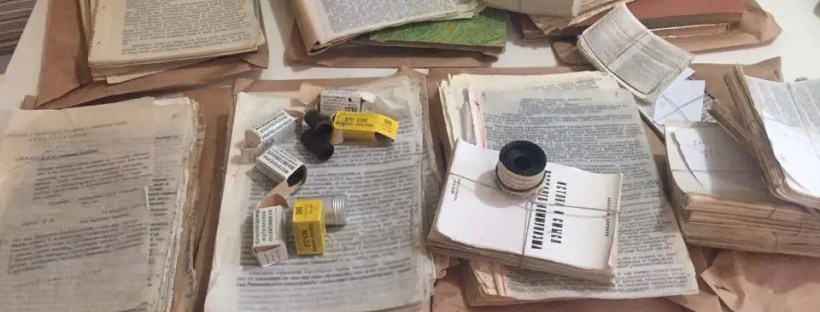
The first issue (about 650 typewritten pages) includes the memoirs of former political prisoners, essays on the ‘cases’ of the 1940s-1960s, published documents, fragments of evidence, and reviews.
Much of the material is accompanied by editorial comment.
*
[A] MEMOIRS
(1) M. L. Shapiro, “Harbin 1945”.
Excerpts from the voluminous memoirs of an émigrée journalist, arrested for an article she wrote in the 1930s after the invasion of Manchuria by Soviet troops.
After ten years in the camps, she died a in an invalid home in Mordovia where she wrote her memoirs.
(2) O. I. Yasevich, “From my Memoirs”.
Three chapters from the notebooks of a woman prisoner on Solovki at the end of the 1920s, imprisoned on a ‘religious’ charge.
(3) G. D. Zalmanovskaya, “Prisoners’ Transport to the War”.
Record of an oral description of the evacuation of prisoners in the summer of 1941, after the German invasion.
(4) M. B. Shulman, “My Life in Letters and Stories”.
The author, who remained a convinced communist after 15 years in the camps, describes his sufferings after rehabilitation.
*
[B] ARTICLES & ESSAYS
- an article on a student ‘terrorist’ case of 1944, cooked up by the KGB (the case of V. Sulimov, E. Bubnova, V. Frid, Yu. Dunsky, M. Levin, N. Yermakova and others);
- the story of a group of young people arrested in 1945 (Nikolai Vilyams [4], Leopold Medvedsky, Yury Tsizin, Lev Malkin and Yury Gastev, who is the narrator), with many digressions on life in those years and the preceding ones;
- a historical sketch about the so-called ‘Union of Communards’ in Leningrad (1963-1965), better known as the ‘Kolokol’ [Bell] group [5];
- the article “In memory of Anna Petrovna Skripnikova”, which tells of the help given by A. P. Skripnikova to her former comrades in the Mordovian camps (Skripnikova’s life story is told in the Gulag Archipelago).
*
[C] THE HISTORY OF CULTURE
Three “Letters to the Leaders”:
- Maximilian A. Voloshin to Kamenev (1924),
- Nadezhda Khazina-Mandelshtam to Molotov (1930)
- Lilya Yuryevna Brik to Stalin (1935).
It was after Stalin’s decision on the last letter, addressed to Nikolai Yezhov, then a secretary of the Central Committee, that Stalin uttered the phrase about “our best, most talented poet”[6], which was quoted the next day in Izvestiya [7].
*
[D] MISCELLANEOUS
“Yekaterina Pavlovna Peshkova [8] and her aid to political prisoners”, “V. O. Levitsky’s letters from exile”, “An incident from the history of Solovki”, “Three letters to an old revolutionary”, “The camp on Nazino Island [9]”, “The girl in the sailor-suit: commentary on a photograph”, “Victors are not brought to trial”, “Party rehabilitation”.
Three reviews follow:
- “Names and Fates”, by I. Voznesensky. The fruit of research on the history of the Academy of Sciences (reduced to journal article length), the starting point of discussion being the jubilee edition of the reference-book The USSR Academy of Sciences: Personnel (Nauka publishers: Moscow, 1974).
- “An Unfinished Portrait”, by P. Nadvoitsky. A sarcastic examination of the ‘complete’ collection of photographic documentation on Lenin, published in 1970-1972 by the Institute of Marxism-Leninism.
- “Remarks on the book The Fourth Dimension” [10] by Revolt Pimenov. A critical analysis of camp memoirs by A. Shifrin published in 1974 by Possev as a historical document.
*
[E] DOCUMENTS
A. P. Babich’s complaint to an appeal court (1947, see the Gulag Archipelago for Babich’s fate), the sentence in the ‘Kolokol’ case [11], and some other texts.
*
[F] The issue ends with a BIBLIOGRAPHY listing prison literature from 1921 to 1935, accompanied by a wide-ranging article investigating the question of prison publications as a source for study of the Gulag Archipelago.
The editors state that they do not intend to limit themselves to ‘camp’ themes in the future. The whole volume has a markedly non-Party character.
***
NINE NOTES, ARTICLES & BOOKS
[3]
V. F. Turchin
The Inertia of Fear: Socialism and Totalitarianism (250 pp., Moscow 1976).
In the introduction the author writes:
“In Autumn 1968 I wrote a pamphlet called ‘The Inertia of Fear’, which was then quite widely circulated in samizdat [12]. This edition has been rewritten and is thus a new work, although it is based on the same ideas as the first version.
“I want to list the most important of these ideas:
- positivism in the realm of philosophy, and socialism (but not Marxism) in the field of social thought;
- a belief in the leading role of world-views in social movements;
- basic democratic freedoms and individual rights as the essential condition for a normal development of society;
- gradualism [step-by-step changes, CHRONICLE] in politics;
- my discernment of a strength in the intelligentsia which could, in principle, and therefore should, achieve democratic changes;
- my extremely critical opinion of the intelligentsia as it at present exists;
- My call for the inertia of fear to be overcome. It is rooted in Stalinist times and fetters the initiative of society.’
*
GEORGIA (4-7)
[4]
Zviad Gamsakhurdia
An Undelivered Speech (24 April 1976, 19 pp.)
Open Letter to the Presidium of the 8th Congress of Georgian writers
Z. Gamsakhurdia, a delegate to the Congress, “considered it humiliating to ask for permission to speak from persons who, according to the law, should not have had anything to do with controlling the speeches of a writers’ congress” (i.e., from officials of the Georgian Communist Party Central Committee).
In the author’s own words, Georgian official literature is deaf to the suffering of its own nation. None of the delegates said a word about this at the congress, except Revaz Dzhaparidze [13]. He received friendly applause from the auditorium, but it was Eduard Shevardnadze, secretary of the Central Committee, not the officials on the platform, who in his closing address referred to Dzhaparidze’s speech as “breaking down an open door”.
Zviad Gamsakhurdia says
“The guiding line of Georgian literature always has been and will be service to high spiritual ideals. Its aim is to deepen national consciousness … Literature certainly must educate people in international sentiment, but that internationalism to which our people is now being called is not true internationalism, but a mask for the egoistic interests of one nation, known to everyone, which is trying in this way to swallow up the interests of the other nations.”
The author protests that they must fight for the primacy of the Georgian language, and that demands for a reasonably comprehensive and objective teaching of Georgian history are declared to be “manifestations of nationalism”. In the course of his argument the author quotes in detail the well-known letter of 1922 by Lenin “On the question of nationalities or autonomization”, published after the Twentieth Congress of the CPSU [1956]. Gamsakhurdia also quotes the favourable words of Andrei Bely, Boris Pasternak and other representatives of Russian culture about the Georgian nation and Georgian culture. He recalls the misfortunes suffered by Georgia in the years of the Soviet regime.
Gamsakhurdia criticizes the methods used in the present campaign against corruption: the correcting of a serious economic situation is being replaced by repressive measures which are virtually not touching the speculators and bribetakers from the ‘privileged caste’, while the press carries on a campaign of libel to convince its readers that nowhere else but Georgia is the centre of the moral corruption now so prevalent. Gamsakhurdia considers that his moral corruption is made worse by the so-called fight against harmful customs and traditions, which is “a mask for a fight against religion and national identity”. He says:
“In general, we must remember that the fight against religion leads only to the moral degradation of society, an increase in crime, and the reinforcement of anti-cultural tendencies among the people.,” he says and concludes: “The most negative phenomenon in our country must be considered the fact that Russification in Georgia has now become the basis of State policy.”
*
IN SVANETIA
“Behind the mask of ‘the fight against harmful customs’ … (5-6)
[5]
Zviad Gamsakhurdia and Valentina Pailodze (Paliani)
… the government is robbing the church” (10 September 1976).
The authors report that in Svanetia the overwhelming majority of the population are religious believers, but no church services are held in any churches.
Patriarch David V has refused to send the Svanetians a priest; the Abkhazian priest David (Pipiya), who christens children secretly in Svanetia, has heard him say “I cannot go against the government.”
The article also describes (this is the main theme) the threat posed to icons, which include very old and revered works, and to other church treasures. Many of these have been carried off by the State authorities; some are lying in safes in closed churches, but recently there have been a number of mysterious robberies.
The Svanetians are resisting attempts to carry away their icons.
*
[6]
Teimuraz Dzhanelidze
… the government is forbidding religious festivals” (9 September 1976, 4 pp.)
The author of the article, a teacher, and three other Georgian intellectuals were present at the festival of St. Kvirike on 29 July in the village of Kala (Svanetia). They found it very difficult to get to the festival, as police had closed the roads leading to Kala.
The secretary of the district Party committee, to whom they appealed for help (they wanted to record folk songs and customs), explained that these measures were part of ‘the fight against superstition’ and tried to scare them by saying that there were knife-fights and drunkenness at the festival. However, he was ready to excuse the driver, who agreed to take them to Kala.
The author describes the atmosphere at the festival, which went off beautifully in an orderly way, and the custom of general reconciliation which is linked with it. He is annoyed at the campaign against Christianity, as the latter ‘has deeply permeated the worthy sons of Georgia’.
Dzhanelidze writes:
“The fight against religion is also a fight against the culture in which it is rooted; it is likewise a fight against the past …”
*
[7]
Zviad Gamsakhurdia
Anti-government protests in Georgia in 1976 (17 September 1976, 5 pp.)
This concerns the fires and explosions which have occurred recently in Georgia: over 300 incidents in 1975-1976, of which about 50 were in Tbilisi.
The article describes (giving places, dates, the amount of damage, the nature of the sabotage) 15 cases which occurred in 1976 and mentions a number of the larger fires and explosions in 1975. Some details are given of the government authorities’ fight against these diversions.
The author is of the opinion that:
“The fires and explosions can be divided into two kinds. The first, most widespread kind are the fires started by employees of one institution or another, to save themselves from the claws of the Department for Combating the Pilfering of Socialist Property and Speculation.
“The second kind are protest fires and explosions, like, for example, the explosion at the aviation factory, the explosion at the government building, the fires at bus stations, factories, and so on.”
*
NEKIPELOV (8-9)
[8]
Viktor Nekipelov
Anaesthesia.
A collection of verse written mostly in 1974-1975 (CCE 32.4), while Nekipelov was in the camps.
*
[9]
Viktor Nekipelov
The Institute of Fools (Notes on the Serbsky Institute), 194 pp. [14]
The author describes his stay at the Serbsky Institute in January-March 1974, while being diagnosed.
He clearly outlines the characters of the medical personnel and of his companions in misfortune. At first he refused to talk to the doctors, but finally he suddenly began to speak. This may have been caused, Nekipelov suggests, by drugs mixed into his food.
*
[10]
M. S. Bernstam
What do the events of the past week mean? (21 September 1976, 4 pp.)
In his comments on the repressive measures and threats directed against Pyotr Starchik, VIadimir Borisov (CCE 42.1, CCE 42.3 [2]), Yevgeny Barabanov and Lev Regelson (on 15 September he was threatened with arrest), the author concludes that these events signify a change in the policy of the authorities, demonstrating their scorn for agreements on human rights.
He considers Borisov’s position to be especially dangerous, as is that of Barabanov (CCE 30.7 [1]), who “is being hunted .. . with the aim of forcing him to undergo examination in a psychiatric clinic”. Bernstam calls for “an active and principled attitude to be taken by public opinion in Russia and the world”.
*
[11]
Anna Gerts
The Forbidden Roads to Free Will … (Moscow 1972).
This novel ‘on dissident life’ has circulated quite widely in samizdat. Roman Gul, editor of the New York journal Novy Zhurnal, which has published the novel [15], prophesies that it will become a bestseller in 1976.
*
[12]
Larissa Bogoraz
“Petty Demons”
On Anna Gerts’s novel The Forbidden Roads to Free Will (July-August 1976, 14 pp.) [16]
Bogoraz assigns this work to the genre of “ladies’ novels”. Other examples, she refers to are novels by Antonina Koptyayeva and Vsevolod Kochetov, and the memoirs of Natalya Reshetovskaya.
As for the specifically dissident and samizdat background to the novel, Bogoraz is of the opinion that it serves to transform “an ordinary story of immorality” into a case against a group of people charged with “lack of feeling and lack of responsibility towards society”.
What article does the prosecution use?
‘Since the time of Dostoevsky, it has been a tradition in Russia to call any social movement ‘demon-possession’. In the late 1960s and early 1970s this definition became very fashionable …
“Alas, we are used to arguing by analogy and bowing to authority: petty feelings and lazy thoughts take their toll. The salon critics do not even try to analyse the essential characteristics, good or bad, of the new social movement, which is many-sided and diverse, with an unresearched origin and an unknown structure. Instead, they isolate its real and imaginary defects, spitefully bringing the scum and rubbish up to the surface …
“For these critics Anna Gerts’s novel will be an agreeable present, the more so because the novel contains transparently photographic portraits.“
Because Anna Gerts does not have the courage to condemn the phenomenon as a whole, this also results “in mediocrity, pitiful attempts to understand all and forgive all, feeble hatred and contrived reconciliation”.
*
Bogoraz writes very sharply about the literary manners of the novel’s author and the characteristics of the real people she has turned into characters in the book.
In the end, no matter what the author intended, “these people have been slandered by Anna Gerts, and as she has changed their names, they cannot sue her”. “Amazingly” the author “contrives to see in people and events all that is empty, superficial, inferior and irrelevant”.
In conclusion, Larisa Bogoraz suggests that the novel should be published by Novosti Press Agency as a work “which is as valuable in the ideological duel” as, for example, A Quarrel with Time by Natalia Reshetovskaya, recently printed by the same publishers.
=================================
NOTES
- They were, respectively, in two Mordovian camps: Nijole Sadunaite in Camp 3, and Liudvikas Simutis, a Twenty-Fiver, in Camp 19 (CCE 41.6-1, August 1976).
↩︎ - Full Russian and English texts in Reports of Helsinki-Accord Monitors in the Soviet Union, (Commission on Security and Cooperation in Europe, US Congress: Vol. 1, 24 February 1977); and in Russian in Sbornik dokumentov Obshchestvennoi gruppy sodeistvya vypolneniyu Khelsinkskikh soglashenii (Khronika Press, New York, Vol. 1, 1977).
↩︎ - Published by Khronika Press, New York, in 1978.
↩︎ - Future husband of Ludmila Alexeyeva, Vilyams was then innocently engaged as a member of the “Lower Sybarites”, a university gang, with Yury Gustev and others.
↩︎ - See Joffe Foundation summary, The Bell Affair, 1965 to the present (2015).
↩︎ - A reference to the deceased Vladimir Mayakovsky (1893-1930), reported in Pravda, 5 December 1935 (see Emma Gerstein, Moscow Memoirs, 2004, p. 427).
↩︎ - This relieved Boris Pasternak of the brief and uncertain privilege of being the Soviet Union’s outstanding poet (Gerstein, 2004, pp. 347-348). Better for everyone to have a hero who was safely deceased and silenced.
↩︎ - In the 1920s Yekaterina Peshkova, former wife of Maxim Gorky, set up an organisation to aid (leftist) political prisoners, the “Political Red Cross”, which survived until 1937.
↩︎ - See report in the Map of Memory (70-12) and the book by Nicolas Werth and others, Cannibal Island: Death in a Siberian Gulag, 2007.
↩︎ - “Fourth Dimension” reviewed by Revolt Pimenov. On the book’s author and his friendship with Yevhen Hritsyak, see CCE 43.13 [1].
↩︎ - See Note 3.
↩︎ - The first version of the “Inertia of Fear” was described in the February 1969 issue of the Chronicle (CCE 6.8 [5]). The new version was published in Russian in 1977 by the Khronika Press.
↩︎ - See the text of Dzhaparidze’s speech, protesting about discrimination against the Georgian language, in Index on Censorship, 1976 (No. 4).
↩︎ - Summarized in Bloch and Reddaway, 1977 (pbk, pp. 147-151). Nekipelov’s Institute of Fools was published in English in 1980 by Victor Gollancz in London.
↩︎ - Gerts’s novel was serialised in Nos. 120 (1975) to 124 (1976) of Novy zhurnal.
↩︎ - Published in Kontinent, 1977, No. 12.
↩︎
========================
 A Chronicle of Current Events