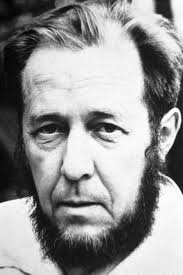
- 20-1. “Letter to the Soviet Leaders” (Solzhenitsyn, 1973).
- 20-2. From Under the Rubble (1974)
*
LETTER & RESPONSES (2-18)
from Sakharov, Roy Medvedev, Mikhail Agursky, Vladimir Osipov, Raissa Lert, Leonid Borodin, Alexander Yanov and nine others
*
[1]
Solzhenitsyn: “A Letter to the Soviet Leaders” (27 pages)
The “Letter” is dated 5 September 1973.
In March 1974, after he had been sent into exile (CCE 32.1), Solzhenitsyn had the “Letter” published. In his foreword to its March edition, he writes:
“I wrote this letter, with all its suggestions, before the confiscation of The Gulag Archipelago by the KGB and sent it to those to whom it is addressed six months ago.
“Since then, I have received no response or reply, nor any sign of a move towards one … I have no choice now but to make the letter public … The letter came into being and developed from a single thought: how can the national catastrophe which threatens us be avoided?”
*
In the opening section of the “Letter” Solzhenitsyn writes:
“I try here to express briefly what I consider most important: what I consider will benefit and save the nation to which you — and I — all belong by birth. I wish all nations well … But I am primarily concerned with the fate of the Russian and Ukrainian nations …
“And I write this letter on the assumption that you also feel this particular concern … If I am wrong about this, then it will be a waste of time for you to read any further.”
Solzhenitsyn points to two dangers which “over the next 10 to 30 years” threaten our country: war with China
“and the mutual destruction of Western civilization and ourselves in the thick smoke of a burnt-out Earth”.
Two factors, in Solzhenitsyn’s opinion, ‘point to’ war with China. They are the ‘ideological’ (“who understands, expounds and continues the work of the Fathers of the Progressive World View more truly?”) and the “dynamic pressure of the Chinese millions on our Siberian lands that we have not yet properly mastered”. The author proposes one way of avoiding war with China — or at least of postponing it for a long while: “Surrender this ideology to them”.
Solzhenitsyn lists the following reasons for the second ‘danger’: the shortage of land resources; the unchecked striving for ‘economic growth’; “the modern technology of gigantism — in industry, and in agriculture, and in population growth”; and the irremediable pollution of the environment.
As a way out of this he suggests “the transfer of the centre of attention and the focus of efforts … from outer tasks to inner ones”. The utilization — “within the basic principles of a stable, non-dynamic economy” — of the Russian north-east (the north-east of our European area, the north of the Asian and main massif of Siberia”) [1] and, again, the renunciation of Marxist ideology.
“This ideology” writes Solzhenitsyn
“… even in its best ten years, was wrong in all its predictions. Nowadays in this country nothing constructive is based on that ideology … Everything in this country has long since been based on material calculations and the obedience of its subjects, and not on any constructive inspiration.
“Today this ideology only weakens and enchains you. It cripples social life, the mind, speech, radio, the press — by lies, lies, lies … This all-pervading obligatory and compulsory resort to lying has become the most tormenting aspect of people’s existence in our country.”
The author does not suggest that “Marxism should be persecuted or forbidden.”
But only this:
“Marxism should be deprived of its powerful government support; let anyone who wishes to propagandise, defend and inculcate Marxism do so unhindered — but not during their working hours and not on State pay”.
*
The latter part of the “Letter” is more reflective. Discussing the advantages and drawbacks of democracy and authoritarian systems, Solzhenitsyn writes:
“Yes, of course, freedom is moral. But only up to a certain point, until it spills over into licence and selfishness. Likewise there is nothing immoral in order, in a stable and peaceful system. Again — up to a certain point, until it slides into oppression and tyranny …
“So, maybe we should admit that in Russia this road [Chronicle then explained which “road” 2] was not right and came before its time? Perhaps for the foreseeable future, whether we wish it or not, regardless of our own plans, Russia is bound to have an authoritarian system? Perhaps Russia is only sufficiently mature for such a system?
“Everything depends on what kind of authoritarian system awaits us in the future. It is not authoritarianism itself that is unbearable, but the wretched everyday ideological lie. It is not so much authoritarianism that is unbearable as tyranny and lawlessness.”
The writer suggests: “So that our country and people may not suffocate, so that they may be able to develop and enrich even you with their ideas, allow us the freedom to compete — not for power, but for truth! Allow freedom for all ideological and ethical currents, and in particular for all religions.”
Solzhenitsyn writes in conclusion:
“By writing this letter I also assume a heavy responsibility before Russian history. Not to take upon myself the search for a way out, to do nothing, however, would be an even greater responsibility.”
*
“What Awaits the Soviet Union?”
A collection of articles (Moscow, 1974) on the theme of Solzhenitsyn’s “Letter to the Soviet Leaders”
The collection consists of 14 articles and an appendix giving some information about 11 of the authors.
The compiler Mikhail Agursky tells us in his foreword, dated 17 June, that
“the aim in compiling this volume was to reflect a wide range of existing contemporary views and avoid any tendency to look for common factors … The authors of these essays include Marxists, liberal democrats and nationalists of various kinds …”
The compiler believes that “the weight of any particular opinions as quantitatively represented in this collection, may not correspond at all to their real weight in Soviet society as a whole.”
A short survey of all 14 articles in the collection follows [3].
*
RESPONSES TO THE LETTER (2-18)
[2]
Andrei Sakharov
“On Alexander Solzhenitsyn’s ‘Letter to the Soviet Leaders’,” (3 April 1974, 9 pages)
Sakharov notes that the “Letter to the Soviet Leaders” includes an implicit argument with some of his own “earlier public statements”.
He speaks of his own conception of the role of ideology in Soviet society — a conception that] differs from that of Solzhenitsyn; he does not agree with Solzhenitsyn’s assessment of Marxism “as an allegedly ‘Western’, anti-religious ideology, which distorted the healthy Russian line of development”. In Sakharov’s opinion Solzhenitsyn exaggerates the role of the ideological factor in Sino-Soviet relations.
Sakharov sets out “Solzhenitsyn’s positive programme” in the form of 10 points. Three of them are:
- the development of the north east of the country as a buttress against China] and a heartland or ‘reservoir’ for the Russian nation;
- economic isolationism;
- the preservation of the Party and basic authoritarian aspects of the system, together with a strengthening of the role of the Soviets, of legality and the rule of law under conditions of freedom of conscience.
Sakharov criticises as follows:
“Solzhenitsyn’s programme for the future is more of a myth-creation than a real project. But the creation of myths is not always harmless, especially’ in the 20th century, which longs for them. The myth of a “reservoir” for the Russian nation could be transformed into a tragedy.’ And further on: “A significant proportion of the Russian people and of the country’s leaders are inclined to Great Russian nationalism, which is bound up with a fear of becoming dependent on the West and of democratic reconstruction. By falling on such fertile ground Solzhenitsyn’s errors could become dangerous.”
Sakharov concludes his article thus: “In spite of the fact that some aspects of Solzhenitsyn’s view of the world seem mistaken to me, he is a giant in the struggle for human rights in today’s tragic world.”
*
[3]
Roy Medvedev
“What awaits us in the Future?” (20 May, 17 pages)
Roy Alexandrovich MEDVEDEV (b. 1925), a Marxist, a historian, and holder of a doctorate in education; author of Let History Judge, On Socialist Democracy and other works published in samizdat and abroad. He was expelled from the Party for writing Let History Judge.
In his article Medvedev criticises “Solzhenitsyn’s nationalism and isolationism”, and finds unacceptable “the preservation and development of the Russian nation’s distinctive nature” by means of transferring the centre of national activity to the north-east of the country, but he shares Solzhenitsyn’s concern “regarding the Church’s position in the USSR”.
In the opinion of Roy Medvedev, Solzhenitsyn exaggerates the threat of war with China, “especially war, … resulting from any ideological differences”.
The author considers that “Solzhenitsyn rejects any democracy at all as unsuited to the USSR”; in disagreeing with him, he puts forward the concept of “socialism with a human face”. The author writes: “Socialist democracy is the only reasonable alternative and the only possible path to a positive framework of life for all the nations of our country”.
Medvedev insists that Solzhenitsyn “understands Marxism badly” and “tries to blame all shortcomings and defects in the Soviet Union on Marxism-Leninism”.
In conclusion Medvedev expresses the hope that “democratic movements of different hues” will be strengthened, and envisages the possibility of “the emergence of a party” which
“would form a loyal and legal opposition to the existing leadership and by this would indirectly contribute to a renewal and revival of the CPSU”.
*
[4]
Mikhail Agursky
“The International Significance of the ‘Letter’” (9 June, 8 pages)
Mikhail Samuilovich AGURSKY (b. 1933), a Doctor of Technological Science in the field of technical cybernetics, has published in samizdat and abroad as a historian and journalist. He is an activist in the Jewish emigration movement. Since 1972, he has been refused an exit visa to Israel.
In his article, he writes:
The credo of the majority of modern intellectuals includes the following ‘self-evident’ dogmas:
(1) It is essential to work untiringly towards the removal of State and national boundaries, and to counter any forms of isolationism.
(2) The growth of per capita production and consumption is an indisputable blessing.
(3) The modern parliamentary systems which have developed in the Western countries are an ideal towards which all nations should strive.
The author welcomes Solzhenitsyn’s criticism of these ‘dogmas’. He also supports the criticism of Marxism in the “Letter to the Soviet Leaders”: “In demanding that the authorities should renounce their totalitarian Marxist ideology Solzhenitsyn is totally correct, for it is precisely this worn-out Marxism that has developed into the real barrier to any true progress.”
The article states that the “purified Marxist ideology” of R. Medvedev is also a “theoretical justification of totalitarianism”.
Disagreeing with A. Sakharov, the author again recalls the danger of introducing unlimited democratic freedoms “without any preparation”.
A great deal of attention is devoted to the problem of “national and State isolationism”.
In conclusion M. Agursky writes: “If the programme outlined by Solzhenitsyn were to be carried out, it would be a victory not only for the peoples inhabiting the USSR but for all the peoples of the world”.
*
[5]
Vladimir Osipov
“Five Disagreements with Sakharov” (April, 5 pages)
Vladimir Nikolayevich OSIPOV (b. 1933) graduated from a teachers’ training institute.
In 1961 he was sentenced to seven years imprisonment under Article 70 (RSFSR Criminal Code). In 1971 he founded the journal Veche and openly edited it. In 1974 he left the editorial board (CCE 32.16). On 27 November 1974 he was arrested (see CCE 34.7 [11]).
The author accepts ‘Solzhenitsyn’s programme’ unconditionally and defends it against the criticism of Sakharov, whose article he heard on the radio.
He does not agree that Solzhenitsyn has greatly exaggerated the risk of war with China. “The Chinese People’s Republic is the quintessence of arrogant, aggressive godlessness and Marxism.”
His second disagreement concerns Sakharov’s assessment of technical progress. Here Osipov accuses Sakharov of making science into a cult.
Osipov disagrees with Sakharov on the question of “democracy as opposed to authoritarianism”.
“To a Russian, the distrust which lies at the base of the election system is agonizing; so is the calculation and rationalism of democracy. A Russian feels the need for a whole truth and he cannot conceive of truth as being made up of Social-Christian, Social-Democratic, Liberal, Communist and other ‘truths’ stuck together.
“My fourth objection is to the world view expressed by Sakharov. However sad it may be, Academician Sakharov loses all impartiality when discussing Slavophile philosophy.
“It is awkward to speak about my last disagreement with Sakharov. Is Solzhenitsyn right in emphasizing the particular sufferings and victims of the Russian nation?”
*
[6]
A. Skuratov
“On the Polemic between Sakharov and Solzhenitsyn”
(from Veche, No. 10, dated 19 April, 10 pages)
A. Skuratov (b. 1935) is a historian. He has been arrested twice—in 1959 and in 1961.
The author’s position is stated at the very beginning of the article: “In this argument we wholly share and support most of A, I. Solzhenitsyn’s conclusions and we express, at the least, surprise at the arguments put forward by Academician A. D. Sakharov”. The tone of the article is very sharp.
The article concludes with these words:
“Solzhenitsyn, even when forcibly torn from his native soil, has preserved the faculty of thinking as a Russian. Academician Sakharov, on the other hand, does not think as a Russian.
“Sakharov’s views are mistaken because, while he claims universal significance for them, they do not take into account the national characteristics of the Russian people or of other peoples.
“His views will not be popular in Russia (thank God!), but might be in the USA, where, in Solzhenitsyn’s words, there exists ‘a very weak, unexpressed, national consciousness’ which will inevitably bring defeat to that country and any imitators in an era when, as Solzhenitsyn has rightly remarked, there is no force stronger than nationalism.”
*
[7]
Anatoly Krasnov
Extract from his book The World Upside Down (6 pages)
Anatoly Emmanuilovich KRASNOV-LEVITIN (b. 1915) is a religious writer. He is a graduate of a teachers’ training institute and has taught literature. From his youth he has participated in church life. He was secretary to the Metropolitan A. Vvedensky of the “Living Church”.
Krasnov has been arrested four times and has spent a total of 10 years in imprisonment (the last time from 1971 to 1973). In September 1974 he emigrated. Until his departure he was a member of the Action Group for the Defence of Human Rights in the USSR. After hearing on the radio ‘last week’ the text of the “Letter to the Soviet leaders”, A. Krasnov criticizes Solzhenitsyn’s positive programme. He writes: “Your programme for the future can (alas!) arouse only laughter.” The author states in particular that one of Solzhenitsyn’s main propositions — the conquest of the north east — can be accomplished only by ‘Stalinist’ methods.
Krasnov writes about Marxism:
“Of course it is true that Marxism has a very primitive view of man and that its anthropology is simply absurd. It is also true that history has not confirmed many of the prophecies of Marx and Engels … But all this cannot conceal the great truths of Marxism.”
Disagreeing with Solzhenitsyn, Krasnov writes of democracy:
“Only this system is a guarantee against illegality and repression … Only this system is natural and corresponds to human nature … So there can be no people which is not mature enough for democracy.”
Krasnov agrees with Solzhenitsyn that “Christianity is Russia’s only salvation”.
*
[8]
Gennady Shimanov
“How Can We Understand Our History and What in It Should We Strive for?” (2 June, 15 pages)
Gennady Mikhailovich SHIMANOV (b. 1937) is a manual worker. Since the early 1960s he has been active in religious life and in the democratic movement. In 1969 he was forcibly incarcerated in a psychiatric hospital but was released after 20 days. He described his impressions in the article “Notes from the Red House”.
G. Shimanov poses the question:
“Has Solzhenitsyn, in his vision of history, been able to rise to those heights from which great spiritual horizons are visible?”
The author’s negative answer can be discerned through his view of Russia’s history as the evolution of Christianity, and shows in a number of reproaches to Solzhenitsyn. Among these are reproaches about Solzhenitsyn’s “democratic frame of mind”, his call for a “free flow of thought”, his recognition of border nations’ right to secession, and the tone of an ultimatum in the “Letter”.
The author bestows on the Soviet government the mission “to begin the great transformation of the world” into “an ascetic and spiritual civilization”. In a post-script he calls for “the recognition of the spiritual legitimacy of Soviet authority, a loyal attitude to it … and hard work to achieve a renewed Russian Orthodox World”.
*
[9]
F. Petrov and Y. Gurevich
“By What Should We Live?” (34 pages)
The main part of this article is dated 5 March. It is written in the form of a personal appeal by the authors to A. Solzhenitsyn.
The nature of the authors’ detailed criticism of the “Letter” is defined in the following theses postulated by them: “Genuine democracy in Russia as the basis of real socialism—this is the only solution to all global and local problems, the panacea for the catastrophe threatening mankind”.
“The absence of socialism in Russia is a threat to the democratic world, to European civilization.”
The authors suggest that the pride and distinctive character of the Russian people lies “not in outworn Orthodox Christianity but in the idea of socialism”, which is essential to ‘its humanistic spirit’; they reproach A. Solzhenitsyn for following in the footsteps of ‘Western technophobes’.
The authors insistently call on Solzhenitsyn to found a new Kolokol, in order to conduct at once an unremitting campaign for ‘genuine’ socialism.
In a post-script, written after the appearance of A. Sakharov’s article, the authors explain more precisely their position. They demand recognition of “Russia”s distinctive path”, oppose the ‘concept of convergence’, the concept of ascent ‘to socialism’, and note that “the West must use its achievements not for capitalism but to further the democracy which has developed there”.
The post-script ends with an analysis of the positions of ‘liberals’ and ‘radicals’ and a call for them to unite in the struggle for the victory of democracy.
*
[10]
Valentina Mashkova
“Who is to Judge?” (17 June, 13 pages)
Valentina Yefimovna MASHKOVA (b. 1938) was sentenced to six years in labour camps for her participation in a small oppositionist student group. Soon after her release she was again sentenced for political reasons. She is a supporter of “the Russian national movement” and is the wife of Vladimir Osipov.
The article is a discussion on the subject of ‘violence and non-violence’. The author considers that ‘repulsion for violence’, a great and splendid impulse, but negative and unproductive, is the motive force of today’s ‘dissent’ and unites both Sakharov and Solzhenitsyn. In forecasting the appearance of ‘a new ideology’ based on the creative principle of ‘love for Non-violence’, the author does not consider the disagreement between Sakharov and Solzhenitsyn very important, and sees its solution in the “solution suggested long ago by the early Slavophiles”, the spirit of “Orthodox community”.
*
[11]
V. Sinitsky
“On A. I. Solzhenitsyn’s “Letter”
Thoughts of a Communist of the Leninist Type (27 pages)
In the Soviet press the “Letter to the Soviet Leaders” is veiled in silence — “Stalinists cannot answer it in any way.” But “Leninists … are obliged to reply”.
While expressing great respect for A. L Solzhenitsyn and the ‘factual criticism’ in this message, the author also describes the contents of the ‘Letter” as “a mixture of reason and prejudice” and sees in it a reflection of “the very deep contradictions of our country, always ending in an impasse (after being led into it!)”
The “reasons for the facts” described by Solzhenitsyn lie not in “the slavish subservience of Soviet leaders to Marxist ideology” but in their repudiation of it. Solzhenitsyn’s suggestions for the future are a reactionary political programme aimed at restoration of the ‘undeveloped’ Russian capitalism of the late 19th and early 20th centuries. Solzhenitsyn “is a mirror of the degeneration of the Russian revolution”, his political programme reflects the aspirations of “the average Soviet man”, who no longer sees any ‘reality or idealism’ in Marxism, replaced as it has been by Stalinism. But in this way his programme “skims over Stalinism and aims a direct blow at the October revolution”.
‘Marxist-Leninists’ should put forward their own alternative to both Stalinism and Solzhenitsyn’s programme — the renewal of the movement of the Soviet Union towards socialism.
Solzhenitsyn’s ‘anti-Marxism’ is explained by the fact that the writer is a “product of the Stalinist epoch and Stalinist education” who “uncritically accepts the official lie” that the ruling ideology in the Soviet Union “really is the ideology of Marxism-Leninism”. But it cannot be ruled out that this ‘great man’ may still ‘turn to Marxism’, the “only ideology that really shows a love of humanity and truth”, from which turn the Russian people, whose happiness he truly desires, would only gain.
*
[12]
Leonid Borodin
“Against Reality in the Name of Truth” (4 pages)
Leonid Ivanovich BORODIN (b. 1938) is a historian. He used to be the headmaster of a village school.
In 1967 he was sentenced to six years’ imprisonment for his membership of the All-Russian Social-Christian Union (CCE 1.6). Since his release he has worked as a labourer. He took part in Veche. He lives in Kaluga Region.
Solzhenitsyn’s “extremely deep conviction that the revolution was senseless and destructive and a natural filial love for Russia — these were the reasons which impelled Solzhenitsyn to write to ‘the leaders’. Belief in the possibility of a positive reply and confidence in the practicability of the suggestions he made were of secondary importance.
“Repudiation of the ‘progressive world-view’ — but in the name of what? There is only one equally eminent and powerful alternative to Marxism — Christianity.”
The author is convinced that the Soviet government will not agree with Solzhenitsyn’s programme.
“However, all this in no way means that his appeal has been useless or in vain. To invite your enemy to lay down his arms is not only always legally and morally right but also sensible in its aim … Man should serve not historical necessity and reality but the truth, even when it is impracticable. This is why Solzhenitsyn’s “Letter to the Soviet Leaders” will always live in history as testimony to a moral feat. A feat directed against reality in the name of truth.”
*
[13]
M. Chernyshev
Notes on the ‘Letter to the Soviet Leaders’ (6 pages)
In the author’s opinion A. Solzhenitsyn is being disrespectful to “the leaders of the (Russian) people” and, as he does not consider the Russian people sufficiently mature for democracy, he also does not respect the Russian people.
On the other hand, Chernyshev agrees with Solzhenitsyn in repudiating the idea of Western democracy for Russia.
M. Chernyshev believes in the “general development of the country for the better” and advocates ‘positive conservatism’ in thinking and caution in publicizing ‘paradoxical and bold ideas’.
*
[14]
Raissa Lert
“Do We Want to Return to the 16th Century?” (14 pages)
Raisa Borisovna LERT (b. 1905) is a journalist and pensioner; she has been a member of the Party since 1926.
The author admits “with sorrow — while Solzhenitsyn seems to derive satisfaction from the fact — that at the present stage of history internationalism has suffered a serious setback; Solzhenitsyn regards this as one of the symptoms of “the crisis in modern society”
“Solzhenitsyn’s Russian nationalism … like the utopian nationalism of some imaginary Moravian kingdom”, could be transformed into a more aggressive form. In this sense, his programme is “ideologically close to Stalinism”, Similarly, she criticizes the practical and moral aspects of “a policy of national egoism”, A. Solzhenitsyn’s point of view is contrasted to those of A. Sakharov and P. Grigorenko.
Lert considers that the “Letter” contains “a call for the revival of former values …, an apologia for the old Tsarist Russia”, This provokes a sharp protest from her.
Raissa Lert advocates democratic socialism and free elections, in which “they (the individuals of whom the people is composed) would not choose either capitalism or bureaucratic quasi-socialism or Orthodox monarchy”.
“Let us go on reading Solzhenitsyn’s books. Let us imbibe from the life- giving fountain of his art “the deepest feeling of responsibility for social injustice” (R. Luxemburg). And let us not follow his socio-political recommendations.”
*
[15]
O. Merts
“Farewell, Russia” (17 pages)
In the opinion of the compiler, “This pamphlet reflects the attitudes of certain groups of intellectuals who are seeking to emigrate from the country.”
In contrast to the other articles in the volume, the author of this one is indifferent to the country’s fate. He writes in a scathing, journalistic style. The author attacks everyone: the Soviet authorities, Solzhenitsyn, and ‘the dissidents’.
*
[16]
Alexander Yanov
“The Third Way” (45 pages)
Aleksandr Lvovich YANOV (b. 1930) is a historian and sociologist, a Candidate of Philosophical Science. He is the author of numerous articles in various Soviet newspapers and journals. In October 1974 Yanov emigrated (this issue “News in Brief” CCE 34.18).
Working from his own theoretical constructions and from historical analogy, the author criticizes two tendencies among the Soviet opposition of today: that of Solzhenitsyn, which calls on the authorities to renounce the ideology of Marxism-Leninism, and that of Sakharov, which proposes an immediate democratization of the internal life of the country. Yanov asserts that both are unrealistic and impossible to achieve by peaceful means, since they have no support either from society as a whole or from the ruling elite, Moreover the low level of the people’s spiritual and political culture means that one set of fetishes can be replaced only by another, one authoritarian system by another authoritarian system. And this will inevitably be accompanied by a new blood- soaked terror, by new Archipelagos of death.
Yanov considers that a third way is possible — the way of the gradual democratization of absolutism. The authorities — at least “the positive faction of the ruling elite” — must place limitations on themselves in matters of the economy, awareness that otherwise they are doomed to physical extinction. A large part of society — the ‘latent opposition’ — would willingly follow this third way. The function of an active opposition is to consolidate all progressive forces in society and to confront its own isolationist and extremist elements. Yarov presents a “sketch of a constructive mechanism” which would ensure the country’s development along the third way.
*
[17]
Andrei Grigorenko
“Today for Today” (11 pages)
In connection with the “Letter to the Soviet Leaders” Andrei Grigorievich GRIGORENKO analyses the contemporary social situation in our country. He is critical of the authoritarian trend of social thinking, in particular the ‘messianic’ variation which hopes for a Russian Orthodox State. He also rejects ‘true socialism’, although he concerns himself not with the essence of this ideology but with its secondary aspects.
The author considers the democratic tendency to be the most fruitful. Its main defect is its unfounded faith in the possibility of rapid democratization of the country, whereas it is necessary first to educate society in democratic views, to develop legal consciousness and respect for the law and for humanist values. Any other road would lead to violence, to the replacement of one authoritarian system by another.
Andrei Grigorenko warns the activists of the democratic movement against extremism and actions outside the limits laid down by the law”. At the same time, socially-active groups should make fuller use of their legal democratic rights. The opposition must convince the authorities that democratization of the country is necessary, if only for the stability of the system. The evolutionary progress of society “will be all the more rapid as the opposition grows more active and the authorities more realistic”.
*
[18]
Georgy Dudarev
“Let Us Be Realistic!” (5 pages)
The polemic surrounding the “Letter to the Soviet Leaders” is assessed by the author as symptomatic of important changes occurring in the USSR.
Dudarev calls on ‘the entire opposition’ to unite around the ‘Marxist revisionists’, as the path they suggest is “the most realistic for us today”.
=======================================
NOTES
- This refers in present administrative and military terms to Russia’s two easterly Federal Districts (Siberia and the Far East) and to Northwest Russia: see Map One.
↩︎ - Solzhenitsyn means “the road of democracy” which (as the Chronicle commented) “lasted eight months altogether — from February to October 1917”.
↩︎ - The following 16 excerpts evidently include two more comments on the “Letter”.
↩︎
========================
 A Chronicle of Current Events