A criminal case against Valentina Pailodze was set in motion, as indicated in the indictment, on 23 March 1974, “… on the basis of materials received from the Georgian KGB”.
On 23 March 1974 Pailodze was summoned to the local police ’on a matter concerning accommodation’ and taken from there to Remand Prison No. 1 in Tbilisi, even though she was ill and had a temperature of 38°.
She was charged under Articles 206 pt. 1 (= 190-1, RSFSR Code) and 233 pt. 2 (= 227 pt 2, RSFSR Code) of the Georgian SSR Criminal Code.
*
Valentina Serapionovna PAILODZE was choir director of the churches of Svetitskhoveli (in Mtskheta) and St Dodo (in Sagaredzho) and at the Church of the Trinity (in Tbilisi).
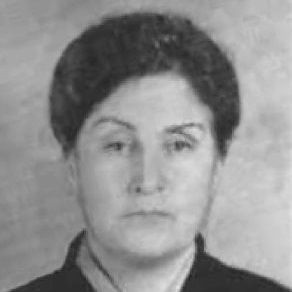
Valentina Pailodze
*
INDICTMENT
The indictment, signed by the procurator of the Zavodsky district in Tbilisi, counsellor of justice O. Dzhaparidze, asserts that between 1970 and 1974 Pailodze wrote and circulated 136 anonymous letters.
She sent them to various organizations in Georgia: to the Central Committee, the Council of Ministers, the Ministry of Internal Affairs, the Academy of Sciences, the Union of Writers, courts, military enlistment offices, district Party committees, district soviets, educational institutions, the television and also to a number of cultural figures.
In the letters, claimed the indictment, she ‘insults’ the founder of the Soviet communist Party and the State [Lenin] and leading Party and Soviet officials; she urges Party and Komsomol members to tear up their Party and Komsomol cards; urges top officials to resign from their jobs, threatening them otherwise with destruction (another passage in the indictment says: “… otherwise she threatened them with perdition in God’s name …”, Chronicle);
She proposes to teachers that they give up educating students, give up their studies, refuse to take part in demonstrations on 7 November and to carry portraits of V. I, Lenin and other leaders at the victory parade… .
“The same anonymous letters” … libelled the Soviet social system and people, urged society to adopt passive resistance, and “urged young people not to serve in the Red Army …” It is also asserted that “… she urged leading scientists to abandon their creative work … .”
In addition,
“… V. S. Pailodze systematically infringed the personal freedom and rights of citizens [Article 233, Georgian Criminal Code, Chronicle], in that, she systematically conducted religious propaganda for the performance of religious rites …”
There is only one reference in the text of the indictment to the evidence of witnesses. It is asserted that “… Pailodze circulated two anonymous letters on 5 and 6 November 1973 …” in the Tbilisi polytechnic institute. These letters were discovered by students Gulnara Kharbedia (5 November) and Omar Beriashvili (6 November).
In asserting that Pailodze was the author of the incriminating letters, the indictment refers only to the results of an examination by handwriting expert.
A document signed by Procurator Dzhaparidze and attached to the indictment says: “There is no material evidence.”
*
TRIAL
The judge at the trial was G. Kukhaleishvili.
The trial was twice postponed — on 12 and 18 June.
The first time in connection with a protest by Pailodze concerning procedural violations (in particular, the pressure exerted on her by O. Dzhaparidze), the inhuman conditions in which she was being kept in prison, and the fact that the lawyer she had chosen, D. Bakradze, was not being admitted to see her.
The second time in connection with Pailodze’s illness (she fainted in court). The trial eventually took place on 26 June. .
V. S. Pailodze pleaded not guilty. Just as she had at the pre-trial investigation, she denied that she had written any anonymous letters or circulated false information.
The witnesses mentioned above were students who did not know Pailodze and had never seen her; they merely testified that they had found the letter in the institute.
Not one handwriting expert was summoned to court and the conclusions of the examination could not be verified by the judicial investigation.
Despite the document attached to the indictment, the State prosecutor presented one piece of material evidence to the court — a letter which he alleged had been signed by Pailodze and confiscated from her during a search. Pailodze did not agree that the signature was genuine. It should be noted that the letter is not listed in the search record.
Pailodze declared to the court that illegal methods of interrogation had been employed: she had repeatedly been placed in a punishment cell and threatened with beatings, and attempts had been made to use denunciations by her cell-mates, who were ‘plants’.
Pailodze also stated that the real reason for her arrest was the KGB’s desire to discredit her, as she was a dangerous witness. She regarded her trial as a consequence of the fact that she had often denounced the KGB employees and churchmen in their pay who had taken part in the robbery at the Patriarchate in 1972 and in other violations of the law. (Many people name Pailodze as a possible witness in the investigation being conducted by the Procuracy into the state of affairs in the Georgian Patriarchate.)
The defence attorney, Bakradze, was simply not allowed to appear in court; the defence was conducted by Kikvidze.
The court sentenced V. S. Pailodze to 1 ½ years in ordinary-regime camps.
*
Several texts about the condition of the Orthodox Church in Georgia — its evolution and decline, the specific forms of pressure exerted on it by the local authorities and the organs of State security, and the crimes committed in the Georgian Patriarchate — have circulated in samizdat.
V. S. Pailodze is named among the witnesses who exposed these events [1].
==========================================
NOTES
- See an article (with documents) on this complex matter: “The Georgian Orthodox Church: Corruption and Renewal” by Peter Reddaway, in Religion in Communist Lands, 1975 (Nos. 4-5 and 6). See also CCE 34.13, CCE 34.18 [23], CCE 35.12 [5] and this issue CCE 32.20 [17].
It is clear from this material that Mrs Pailodze’s case played an important role in the emergence and development of human rights activity in Georgia.
↩︎
==========================
 A Chronicle of Current Events