JOSYP TERELYA
At the end of December 1976 Josyp Terelya (CCE 43.8) sent the KGB Chairman Yu.V. Andropov, an Open Letter (17 pages [1]) in which he described his life.
Born in 1943, he had spent 14 years in camps, prisons and the Sychyovka Special Psychiatric Hospital (SPH), and the torment he has had to endure from officials of the Ministry of Internal Affairs (MVD), the KGB and the SPH. The letter says in part:
“In Kirovograd [central Ukraine] …Regional Procurator Dyatlov, in the presence of the head of the investigations department of the KGB, Snesarenko, and of an investigator, Senior Lieutenant Medvedev, read me a ‘Resolution on Methods of Physical Persuasion’, and explained that all this was applicable in cases where there was reliable material on a suspect’s criminal activities, where these were not without danger for the State system, and where he refused to give evidence. [This took place in 1967, Chronicle].”
The letter ends thus:
“After all that I have endured in camps and prisons, and knowing what awaits me in the future, I say — no! It is a crime to be a citizen of the USSR. It means that I am at one with you, with that union that calls itself the KGB. I am forced to leave my native land only because it has been deformed by alien suffocators. There is no place for me in it: I am not such as the KGB would have me be. But I believe that we will return to the Ukraine — to a free Ukraine which welcomes all who wish her to be happy and flourish.”
In March 1977, when Terelya was staying with friends in Kiev, he was seized on the street and taken to the KGB. There they talked to him about his letter to Andropov and about the Ukrainian Helsinki Group.
*
On 28 April 1977 a policeman and three men in plain clothes came to his home and invited him to come to the police station “in connection with questions of registration and work”. There they informed him that the Mukachevo court ruling of April 1976, which had released him from compulsory treatment, had been set aside and that a Beregovo court had reimposed compulsory treatment.
Terelya was put in the Regional psychiatric hospital in Beregovo.
*
LEV KONIN
In Leningrad on 27 April 1977 Orthodox priest Lev Stepanovich KONIN (b. 1945) was taken from a police station to Psychiatric Hospital No. 6.
In 1962 Lev Konin was expelled from a technical school in the Urals (Shadrinsk, Kurgan Region), for organizing a discussion club. Konin took his secondary school exams externally and in 1963 entered the physics and mathematics faculty of the Shadrinsk teacher training college. A year later, for organizing a campaign against the deprivation of a group of students of their stipends, Konin was placed in the Shadrinsk Psychiatric Hospital for a month and a half with a diagnosis of “paranoid tendencies syndrome” and expelled from the institute.
In February 1965 Konin sent a statement to the Sverdlovsk City Visa & Registration Department (OVIR) asking to be allowed to leave the USSR. He was at once put in a Sverdlovsk psychiatric hospital, where he was subjected to forcible treatment. When he came out of the hospital a Work Fitness Commission gave him Group II invalid status. In 1968 he was transferred to Group III status. In 1972 his invalid status was taken away.
*
In 1966 Konin entered the Leningrad seminary. In 1969 he finished the course and was ordained. In 1973 Father Lev Konin graduated from the Spiritual Academy and received the degree of Candidate of Theology. In May 1973, after the authorities had ‘charged’ Konin with duplicating and circulating religious literature, Metropolitan Nikodim deprived him of his parish. From 1973 to 1977 Father Lev sang in a church choir.
In April 1977 an article, “Servants of Slander”, was published in the Evening Leningrad newspaper, in which Konin was accused of sending slanderous information to the West. The article also said that Konin was suffering from schizophrenia, and that “his illness is getting worse”.
On 27 April Konin was invited to a police station and it was demanded that he explain his ‘idleness’. An hour later a psychiatric ambulance drove up and took Konin to Psychiatric Hospital No. 6.
The head of section 1 where Konin was placed, Pavel Mikhailovich Tsvetkov, and the doctor in charge said that Konin had been brought in for diagnosis; if he was healthy, he would be let out in two or three weeks; if sick, he would be treated. The doctor in attendance, Olga Mikhailovna Bobrova, said that Konin had been brought to the hospital on orders from above and that his illness had a social character. “You know as well as we do,” she told one of the visitors, “what he was grabbed for.”
27 citizens of Leningrad have published “A Word in Defence of Father Lev Konin”, which ends with the demand “Freedom for Lev Konin!” [2]
*
YURY BELOV
In the Krasnoyarsk Region Psychiatric Hospital (663831, Krasnoyarsk Region (Krai), Nizhneingashsky district, Poimo-Tiny) Yury Sergeyevich BELOV has been undergoing forcible treatment since 3 September 1976; he was transferred there from the Sychyovka SPH (CCE 42.5).
Yury Belov (b. 1941) entered the philological faculty of Leningrad university in 1958. In 1960 he was expelled from the university “for participating in the anti-Soviet group of V. Sosnovsky”, In 1961 Belov was called up into the army. There he was indicted on a criminal charge in connection with the “Shlyauters case” (a group escape by military personnel through Finland to Sweden). After a forensic psychiatric examination had established a diagnosis of “psychopathic personality”, the case against him was dropped and he was demobilized. In 1962 Belov was deprived of his Leningrad registration as an ‘anti-social element’ and banished from Leningrad.
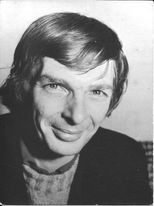
Yury Belov (b. 1940)
Belov entered the history and philology faculty of the Kaliningrad teachers training institute.
[In 1963 he took part in an Esperanto congress in Cracow. There he received a transit visa to West Germany and gave a speech at an Esperanto conference in Munich in which he criticized the Soviet leadership. In 1964 he was expelled from the institute and arrested. Under Article 70 (RSFSR Criminal Code) he was sentenced to three years in the camps (he served them in Mordovia), and two years in exile.
While serving his term of exile Belov compiled and sent to the UN Commission on Human Rights a report by Soviet political prisoners. In addition, his “Report from the Gloom” was published in West Germany under a pseudonym. (A few years previously Radio Liberty broadcast several of his reports under a pseudonym.)
In 1968 an employee of the West German Deutsche radio station, Herman Fuchs, disclosed the pseudonym of the author of “Report from the Gloom” to a KGB agency [3].
Yury Belov was again arrested. Under Article 70, pt. 2 (RSFSR Criminal Code) he was sentenced to five years in a camp, which he served in the Mordovian camps and in Vladimir Prison.
In prison a new case was instigated against Belov, under Articles 70 (pt. 2), 72 & 64. A diagnostic team at the Serbsky Institute (the experts were Ilynsky, Taltse and Turova) ruled him not responsible (the diagnosis was “pathological development in a psychopathic personality”).
*
From 30 May 1972 Belov underwent compulsory treatment in the Sychyovka SPH. He was intensively ‘treated’ with neuroleptics. In 1976 Belov was transferred to a general psychiatric hospital. Since 3 September 1976 he has been in the Krasnoyarsk Psychiatric Hospital.
There he was at first given no medicines. At the beginning of January 1977 Belov was visited in hospital by a member of the “Working Commission to Investigate the Use of Psychiatry for Political Purposes” (CCE 44.10), Alexander Podrabinek, who gave him provisions, warm clothing and a transistor radio. The doctor in attendance on Belov, Vladimir Vasilevich Myasnikov, told Podrabinek that Belov did not at that time constitute a social danger and did not require further compulsory internment. He also said that he would give Belov a recommendation for discharge from hospital, and that the case would be sent to the Nizhneingashsky district people’s court.
However, on 19 January 1977 Belov was transferred to a strict-isolation regime and forcible treatment was started. He was given haloperidol, triftazin and motiden-depo. Writing materials and the transistor radio were taken a wav from him.
*
On 1 February 1977 Alexander Podrabinek sent an open letter about this to the chief medical officer of the Krasnoyarsk territorial psychiatric hospital, Boris Spiridonovich Gladkikh. Podrabinek writes:
“… It has also become known to me that these actions are motivated by the fact that on 7 and 8 January Belov met me, that he has not renounced his beliefs and that in general ‘he has to be put in prison’…
“What are you counting on? To crush the will and intellect of Belov with the help of neuroleptics, and to bring him nearer to the image in which you yourselves are created? Or are you simply — forgetting the duty and honour of your profession — following orders from above? …
“I demand an end to the hounding and mockery of Yu.S. Belov. Stop them giving him triftazin. End the murderous ‘treatment’ with haloperidol and motiden*depo: after forcible administration of these drugs Belov has started to suffer attacks of cardiac pain. Recommend him for discharge, as you were about to do before I came to see him.
“I emphasize: my visit to Belov was of a private nature…
“You have taken a first step on the road to the physical destruction of Yury Belov. You know that he cannot take a new course of ‘treatment’ with neuroleptics.
“I shall appeal to public opinion in our country and abroad to speak up in defence of Yury Belov.
“I shall appeal to all people of good will to strive for the release of Belov, to save him from an inevitable death in your psychiatric hospital.”
Podrabinek received no reply to his letter. Then on 15 February the Working Commission issued an “Appeal to the World Public”.
“The Commission considers that the meeting and also the giving to Yury Belov of warm clothing, food products and a transistor radio cannot be a basis for applying such measures.
“The hospital administration replies neither to our telephone calls asking about Belov’s situation, nor to the open letter of Alexander Podrabinek to the chief medical officer of the hospital, Boris Spiridonovich Gladkikh. Since all applications to the hospital administration have gone without result, the Commission appeals to all people of good will to raise their voice in defence of Belov.”
On 10 March the hospital sent the local court a recommendation by a medical commission that compulsory treatment should be ended. The recommendation was returned to the hospital and then sent a second time — to the Krasnoyarsk territory court.
On 11 March the transistor radio was returned to Belov.
*
VLADIMIR TITOV
In May 1976 Vladimir Grigorevich Titov (b. 1938) was transferred from the Sychovka Special Psychiatric Hospital to the Kaluga Psychiatric Hospital No. 1. (There are some minor inaccuracies in the information given about him in CCE 41.7.)
This is the same hospital in which in May-June 1970 Zhores Medvedev was held; the chief medical officer there is now, as formerly, Alexander Yefimovich Lifshits. The doctor in attendance on Titov, Valentin Sergeyevich Yakovlev, told him: “I’ll cure you all right, you anti-Sovietist. I’ll make a real lunatic out of you.” Titov was forcibly given haloperidol, aminazin and motiden-depo. He was tied to his bed for a week for refusing to take medicines voluntarily.
On 22 December 1976 Titov was discharged from the hospital. The convulsive twitching which he began to suffer in the hospital as a result of the medicines is still continuing.
*
PYOTR LYSAK
Pyotr Alexeyevich Lysak is also in Kaluga Psychiatric Hospital No. 1. He was arrested 15 [in fact 21 (in 1956)] years ago under Article 70 (RSFSR Criminal Code) [4].
*
VICTOR BOROVSKY
At the beginning of May the police took Victor Borovsky from the gangway of an aeroplane in Kharkov airport as he was about to fly to Kiev, and interned him in a psychiatric hospital.
In the police station it was explained to his relatives that this had been done on orders from the Regional health department. V. Borovsky had already spent three months in a psychiatric hospital when he tried to find out in Moscow how to emigrate. V. Borovsky (b. 1952) lives in Slavyansk (Donetsk Region). He studied at a teacher training college but was forced to leave due to summonses from the KGB.
After this he was unable to find a job. Following the arrest of Rudenko and Tykhy, Borovsky travelled to visit Tikhy’s mother and Rudenko’s wife.
=======================================
NOTES
- Terelya’s account was published in full in English as Notes from a Mad-House, Smoloskyp Publishers, Maryland (USA]), 1977 (21 pp).
↩︎ - Konin was soon released (CCE 46.13). In 1978 he emigrated.
↩︎ - This account of Belov’s early life contains some substantial errors.
It is not clear whether these are due mainly to misunderstandings which occurred when Podrabinek met him, or to a faulty memory on Belov’s part, or to some fantasizing on his part, or to some other cause. In any case, it seems that he did not in fact visit Poland or Germany, and his works were not apparently published in the West.
↩︎ - There is a summary of Lysak’s case, and the sources on it, in Bloch and Reddaway (1977, Psychiatric Hospitals), note 29 (pp 217 & 373).
↩︎
================================
 A Chronicle of Current Events