CCE 43.7 [11] reported the ‘psychiatric arrest’ of Vladimir Borisov, which took place on 25 December 1976.
On 5 January 1977 a medical commission led by Professor D.S. Ozeretskovsky, head of the psychiatry department at the 1st Leningrad Medical Institute, came to the conclusion, after examining Borisov, that in his present psychiatric condition he did not need hospitalization. The commission explained the forcible hospitalization of Borisov by the fact that Borisov had not been attending the psycho-neurological clinic. Besides Ozeretskovsky and the hospital doctors, the commission also included psychiatrist A.E. Lichko, deputy director of the Bekhterev Institute.
After the commission met, Borisov’s wife Irina Kaplun was told that her husband was being held in hospital in order to appear before a Work-Fitness Commission.
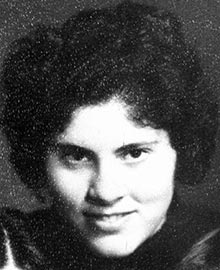
Irina Kaplun, 1950-1980
Meanwhile a special regime was established for Borisov: his writing materials were taken from him — they were given to him only for as long as it took to write a letter, and only in the presence of a doctor; he was deprived of meetings; he was forbidden to associate with certain patients (for example, with Anatoly Ponomaryov, CCE 38.10) or, even, to approach the window.
On 10 January 1977 after he approached the window Borisov was tied to his bed for an hour and a half.
*
On 13 January 1977 Borisov was examined by an inter-district Work Fitness Commission, but no decision was taken.
The commission chairman Matochkin gave contradictory answers to Borisov’s mother and his wife: first he stated that the commission had found Borisov capable of work, then he said that it had prescribed for Borisov a prolonged in-patient examination; finally, he stated that the commission would not examine Borisov and his relatives should refer not to him but to the hospital. From the hospital the head doctor M.P. Isakov sent them back to Matochkin.
On 15 January 1977 the ‘Working Commission to Investigate the Use of Psychiatry for Political Purposes’ (see “Activities of Helsinki Groups”, this issue CCE 44.10) published a report ending with this conclusion:
“The case of Vladimir Borisov is directly related to the persecution of dissidents in the Ukraine, Leningrad and Moscow, which started at the end of 1976. This is a clear example of political repression through the use of psychiatry.”
*
APPEAL
On 23 January Irina Kaplun appealed to international psychiatric organizations:
“The third forcible internment of my husband Vladimir Borisov has already lasted more than a month.
“And once again the executors of this illegal action were, as has often been the case before, Soviet psychiatrists … ‘He will be in hospital as long as we consider it necessary,’ this is the only answer of head doctor Isakov to my demand that he free my husband. ‘We tied him down, and I will tie him down again — this is the punishment for going up to the window,’ this was the reply of the doctor treating him, Tobak, when I demanded that he stop persecuting Borisov.
“I did not expect any other answer from psychiatrists who have already more than once proved to the whole world their professional dishonesty. I ask international psychiatric organizations to take up the case of my husband: only the intervention of public opinion can save Borisov from the tyranny of Soviet psychiatry.”
On 29 January 1977 friends of Borisov declared in an open letter (63 signatures), after describing his placement in a hospital and the regime created for him:
“Everything indicates that the placing of Vladimir Borisov in a psychiatric hospital is an action which bears no relation to his mental health.
“The psychiatric hospital is being used as a prison, and perhaps as a cell in a detention centre or an investigation prison.
“We demand that Vladimir Borisov be released from the psychiatric hospital. We call on everyone who holds human and civil rights dear to support our demand.”
In a “Report” of 31 January the Working Commission stated:
“The Working Commission considers that publicity is the basic method of averting and fighting the abuse of psychiatry. It intends to continue to collect and transmit information on the forcible imprisonment of Vladimir Borisov in a psychiatric hospital, and also on the underlying factors which make such lawlessness possible.”
*
At the beginning of February 1977 the Working Commission Issued a “Report on Activities” (7 pp). The report said, in particular:
“Private individuals reporting this or that information to the Commission do not want any mention of their names, fearing reprisals. Regarding their fears as realistic, the commission cannot indicate its sources of information.
“Thus, for example, it was reported by one of these persons to the commission that the psychiatric institutions received a directive on the forcible hospitalization of Borisov from the Kalinin district KGB office in Leningrad. Not finding it possible to refer to the source of this information, the commission cannot confirm that such a directive was issued. However, as is evident from what follows, there were no other grounds for the forced hospitalization of Borisov.”
The report ends with the following conclusions:
“1. The forcible placement of Borisov in the Skvortsov-Stepanov Psychiatric Hospital No. 3 in Leningrad, using the procedure of emergency psychiatric help, clearly had no justification and was carried out in crude violation of the current Directives of the USSR Ministry of Health of 26 August 1971, which were approved by the USSR Procurator’s Office and the USSR Ministry of Internal Affairs [MVD] (they have not been published in the general press).
“2. The forcible detention of Borisov in hospital to go before a Work-Fitness Commission is not grounded in law.
“3. The knowingly illegal restrictions of Borisov’s rights during the period of his stay in hospital are clearly inadmissible. To tie him to a bed, not as a medical measure but as a punishment for attempting to approach the window, is criminal.
“4. The facts established by the Commission are grounds for regarding the forcible placement of Borisov in a psychiatric hospital and his compulsory detention in hospital up to the present time as a new act of abuse of psychiatry for the repressive purpose of suppressing dissent.”
The following document of the Working Commission reports that:
“Not only are letters from Borisov’s relatives and friends being censored, as a result of which their greater part is erased (and after he has read the remainder they are taken away by the doctor and added to his ‘medical history’): Borisov’s own letters, which are not numerous, are also being assiduously censored by the ‘doctor’ treating him, A.I. Tobak.”
*
On 16 February 1977 Borisov was visited by a member of the British section of Amnesty International, Peter Luff, and by the famous English playwright Tom Stoppard, a member of the Campaign Against Psychiatric Abuse. They managed to see Borisov through a window.
On 22 February 1977 the Chief Psychiatrist of Leningrad, V.P. Belyayev, told Irina Kaplun that her husband would be home at the beginning of March. The same day TASS broadcast abroad that Borisov would be kept in a psychiatric hospital for a lengthy period in view of a deterioration in his condition. On 23 February the Working Commission circulated a ‘Refutation’:
“… The Commission to Investigate the Use of Psychiatry for Political Purposes declares that the TASS report on the deterioration of Borisov’s state of health does not correspond to reality …
“Moreover, it has been stated repeatedly that Borisov will be discharged from hospital in the next few days. This was officially confirmed by the Chief Psychiatrist for Leningrad to two members of the commission, Irina Kaplun and Dzhemma Babich, as well as to a member of Amnesty International, Ilya Levin, on the day of the TASS report.
“The false invention of TASS indicates an intention to prolong the persecution of Borisov for an indefinite period, and also the broadening of the front of reprisals against dissenters in the USSR.”
*
On 28 February 1977 a new commission examined Borisov.
On 2 March Belyayev chatted with Borisov. During this conversation, which took place in the office of the head doctor, a bulb lit up on the switchboard and a voice reported: “His mother is coming.” Through the window Borisov saw his mother approaching.
Belyayev tried to persuade Borisov and his mother that Borisov should agree to enter the Bekhterev Psychiatric Institute to occupy a bed of the Work Fitness Commission. Borisov refused categorically. His mother agreed with her son.
On 3 March 1977 Belyayev sent Irina Kaplun a written answer to her statement:
“To your statement on the hospitalization of Borisov, Vladimir Yevgenyevich, I report that he was examined four times by commissions made up of highly-qualified specialists, who found the hospitalization correct and confirmed the presence of an illness. The restrictions in his regime were connected with the incorrect behaviour of friends of the sick man on the territory of the medical institution.
“The doctors have persistently recommended to the sick man that he undergo additional examinations in an institution specialized in testing work fitness (using a Work-Fitness Commission bed at the Bekhterev Research Institute), and the mother of the sick man agreed, but could not persuade her son.
“I ask you to help the doctors in every way to keep the state of health of Borisov V.E. under review and to get him a job as soon as possible.”
On 4 March 1977 Borisov was released.
=========================================
 A Chronicle of Current Events