- 26-1. Registration and Exchange of Flats; Trial of Pyotr Naritsa (1-15).
- 26-2. Sakharov: Exchange of letters (with President J. Carter); Six media interviews (16-22).
*
16.
Correspondence with US President
On 21 January 1977 Sakharov sent this letter to President Carter.
“Dear Mr Carter,
“It is very important to defend those who suffer for their non-violent struggle for openness, for justice, for the trampled rights of other people. Our duty and yours is to struggle for them. I think that very much depends on this struggle — trust between people, trust in high-flown promises, and, ultimately, international security.
“Here we have a difficult, almost intolerable situation — not only in the USSR, but in all the countries of Eastern Europe. Now, on the eve of the Belgrade conference and with an upsurge in the struggle for human rights in Eastern Europe and the USSR, the authorities, not wanting to make any concessions regarding the human rights most essential for society (freedom of belief and information, freedom of conscience, freedom to choose one’s country of residence, and others), not being capable of an honest competition in ideas, are intensifying oppression and making attempts to discredit dissenters; the persecution of members of the Groups to Assist the Helsinki Agreement in Moscow and the Ukraine, and especially the provocation in the Moscow underground railway, which must be seriously rebuffed.
“Do you know the truth about the position of religion in the USSR: the humiliating position of the official churches and the merciless persecution (arrests, fines, removal of children from believing parents) of those churches which seek independence from the State — Baptists, Uniates, Pentecostalists, the True Orthodox Church and others? The uninvestigated murder of Baptist Biblenko may be one example of all this.
“It is very important that the President of the USA continue his efforts for the release of those people whom the American public already know about, and that these efforts do not remain fruitless. It is very important to continue the struggle for those who are seriously ill, and for women political prisoners.
“Here is a list of those who need urgent release [1], but it is very important to remember that many others are in an equally serious position: [Sergei] Kovalyov, Romanyuk, [Mustafa] Dzhemilev, Svetlichny, Gluzman, Ruban, Shtern, Yury [Ivanovich] Fyodorov, Makarenko, Sergiyenko, Pronyuk, Maria Semenova, [Georgy] Vins, [Valentyn] Moroz, Fedorenko, Superfin.
“Detailed information about each of them is available from Khronika Press (Ed Kline knows everything!)”
(Replying on 2 February 1977 to a question from a Newsweek correspondent about this letter, Sakharov said:
“… It was not an appeal which I intended to make public.
“I do not know how it came to be printed in the newspaper New York Times newspaper [2], but if its publication helps even one of the 16 people it lists I shall be deeply satisfied”.)
*
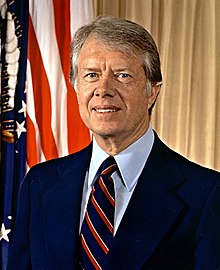
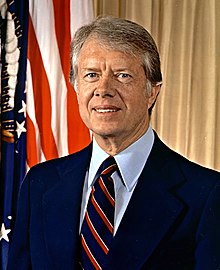
Jimmy Carter (US President 1977-1981)
On 5 February 1977 Carter sent a letter in reply [3].
Dear Professor Sakharov,
I received your letter of 21 January, and I want to express my appreciation to you for bringing your thoughts to my personal attention.
Human rights is a central concern of my administration. In my inaugural address I stated: “Because we are free, we can never be indifferent to the fate of freedom elsewhere”. You may rest assured that the American people and our government will continue our firm commitment to promote respect for human rights not only in our own country but also abroad.
We shall use our good offices to seek the release of prisoners of conscience, and we will continue our efforts to shape a world responsive to human aspirations, in which nations of differing cultures and histories can live side by side in peace and justice.
I am always glad to hear from you, and I wish you well.
*
On 17 February 1977 Andrei Sakharov replied.
Much esteemed Mr President,
“Your letter of 5 February, which I received today, is a great honour for me and a support for the unified movement for human rights in the USSR and the countries of Eastern Europe, a part of which we all here consider ourselves …
“I have repeatedly written and said that defence of basic human rights is not interference in the internal affairs of other countries, but one of the most important international affairs, inseparable from basic problems of peace and progress. Today, having received your letter, the exceptional character of which I clearly understand, I can only repeat this once again.
“I shall use the occasion to remind you of some specific matters …
“From foreign radio broadcasts I have learned that you expressed a desire to meet me if I came to the USA. I am very grateful for this invitation. For me there is no doubt that such a trip and personal contacts would be extremely significant. Unfortunately, at the present time I do not envisage the possibility of such a trip for myself.
“I want to express the hope that the efforts of people of good will, and your personal efforts, Mr President, will help the implementation of those lofty goals about which you write in your letter to me.”
*
17-22.
SIX INTERVIEWS (Excerpts)
[17]
A NORWEGIAN CORRESPONDENT (30 October 1976)
1. Did your situation improve after you received the Nobel Peace Prize?
… Unfortunately, I cannot say anything comforting about a change of position by the authorities towards me personally, my friends and relatives, or my public activities and the conditions in which they take place.
I, as well as my friends, are still not being allowed into the court-rooms where political trials are held. Nor are the authorities showing greater respect towards my appeals and letters — they simply don’t reply to them. My telephone and postal links with the West are still completely blocked (telephone conversations are cut off after the first few words, which testifies to the constant eavesdropping of the KGB; my post is not just opened by the same organs, but often simply seized) …
2. What has happened in the movement for human rights in the last year? Which internal events particularly trouble you?
…Recently the initiatives of unorthodox artists, the organization of unofficial scientific seminars, musical evenings, etc. have attracted attention. But especially important, I am convinced, is the movement which may be called the “general democratic movement” or, to be more precise, the “movement for human rights”. The spirit of this movement has been reflected most fully, in my opinion, in the samizdat journal A Chronicle of Current Events which is cruelly persecuted by the KGB …
In a totalitarian, closed society imbued with fear of the State and with dependence on it, imbued with tyranny and egoism, the appearance of such a movement, despite its small numbers and material weakness, is a phenomenon of historical significance. The movement for human rights in the USSR is important for the whole world, because totalitarianism and closed societies are, in fact, the greatest threat for the future of mankind.
It is precisely in this direction that strong blows were inflicted recently. The arrest and conviction of Kovalyov and Tverdokhlebov, the fabrication of a case against Dzhemilev and his conviction, which is almost equivalent to a death sentence, the intensification of repressions in the camps …
Ever stronger are dark rumours (unproven, but also not disproven) that in individual cases the KGB is resorting to political murders and bandit-like attacks to intimidate this or that category of people: for example, believers who do not accept the intervention of the authorities in the affairs of their church, or non-conformist cultural figures. I know of a few tragic events which have taken place in the last year and which demand careful, dispassionate investigation in this context: the deaths of the Baptist Biblenko, the Lithuanian Catholic engineer Tamonis, the Lithuanian Catholic kindergarten worker Lukšaite, and the poet-translator Bogatyryov; the beating up of the young dissident Kryuchkov, and the beating up of Academician Likhachev.
A year ago, the unemployed lawyer Yevgeny Brunov [4] died a few hours after visiting me and asking me to help him meet foreign correspondents. There are testimonies that Brunov was thrown off a moving electric train at night. To my repeated enquiries to the Ministry of Internal Affairs (MVD) about the circumstances of his death I have received no answer.
Both I and many other dissidents constantly encounter threats of physical violence, particularly in relation to their relatives.
Here are typical examples. The pregnant wife of the Georgian dissident Zviad Gamsakhurdia was repeatedly called on the telephone with the threat: “Prepare two coffins, one for yourself and one for the child.”
The 80-year-old mother of the poet Alexander Galich, who is hated by the KGB (he left for the West two years ago), was sent a typewritten note through the post for New Year 1976 with the words: “A decision has been taken to kill your son Alexander” [5].
There are many similar examples. The very form of these threats and the means of informing the ‘addressee’ effectively preclude the lack of involvement in them of official bodies: who else, for example, could intercept a letter sent to me from abroad and insert in the same envelope a new letter containing threats to my wife? …
[Q. 3]
4. The Soviet government says that the dissenters Sergei Kovalyov and Andrei Tverdokhlebov were convicted because they broke Soviet law. What can you say about Soviet legality?
Juridical culture, impartiality and Independence of courts, and a commitment to justice are in short supply in the whole of the Soviet judicial system, and not only in relation to dissenters.
I receive hundreds of desperate letters from people convicted in ordinary criminal (not political) cases, and from their relatives. While taking fully into account the commitment and partiality of my correspondents, I nevertheless cannot but shrink in horror from the picture which opens up of judicial tyranny and corruption, of cruelty and a lack of desire by those in power to put right the mistakes and injustices committed. Without troubling themselves with the collection of proof, investigators frequently (themselves or with the help of prisoners) beat up people under investigation, thus acquiring the needed evidence — I read of this in almost all my letters. A 19-year-old boy Igor Brusnikin died in this way. In political cases, fortunately, there are at present no reports of this. Even such serious cases as those where the death penalty is available — for example, premeditated murder — are examined by some courts with extraordinary superficiality, with no attention paid to contradictions in the case and the demands of the defence.
The case of the Tatar worker Rafkat Shaimukhamedov, shot in January 1976 after almost two years in a death cell, is a terrifying example [6] of how mercilessly and unjustly our judicial machine sometimes works (the prosecutor and, evidently, the ‘author’ of the case was Bekboyev).
And so a court of this sort is given a political case, in which the desired sentence has been determined in advance by top officials of the KGB and the participants in the trial know precisely that any ‘liberty’ they take will harm their careers. Plain-clothes agents of the same organization vigilantly protect the court-room to prevent any undesirable audience from penetrating and watching the judicial spectacle. Can one expect a justly grounded sentence in these conditions?
Kovalyov and Tverdokhlebov, like many before them, were convicted under Articles 70 and 190-1 of the Russian Criminal Code. The notions contained in these articles: anti-Soviet agitation and propaganda, slanderous fabrications, the presence of an aim to undermine or weaken the Soviet political and social system — are in no way defined juridically …
5. The Soviet Union has said time and again that it will fulfil all the obligations of the Helsinki Final Act. Do you think that it is fulfilling all the humanitarian obligations?
Insistence on freedom to exchange information and freedom of movement for people (trips abroad, emigration) constitute an inalienable part of the Helsinki Act. The very fact that in the Act the indissoluble link between these demands and international security is emphasized makes it an important historic document. Up till now the Soviet side has changed almost nothing in its practice regarding free exchange of information and movement of people. Individual concessions, for the most part in relation to emigration or trips, are important, but they are not such as to produce a radical change in the picture as a whole …
6. Can you explain why you have almost no support from your colleagues in Soviet science?
I do not think I have the right to reproach my colleagues in the USSR for insufficient support. The life of everyone who decides to speak out freely on social questions quickly becomes unbelievably difficult, moreover not just for the dissident himself, but also for those close to him. It is completely natural that only a few individuals decide on this. In addition, for a man who has a calling to science, inevitably his fears of being removed from it are very relevant and completely real.
I very much value the support given to me by such well-known scientists as Turchin, Orlov and Melchuk, but I cannot at the same time forget that they all lost their jobs. Since 1971 Tatyana Khodorovich has been without work, mathematician Yury Gastev is without work, and so are others. Returning to my colleagues in the Academy of Sciences, I would like to add that I do not feel alone amongst them and constantly feel the silent support and sympathy of some of them …
[Q. 7]
8. What plans do you have now? Do you envisage circumstances in which you will be forced to ask for a trip abroad or even to emigrate?
Up till now my situation, as well as the situation of those near to me, has progressively deteriorated each year. It is possible that it will continue to deteriorate in the future. I hope that international public opinion will find effective methods of pressure and will prevent further such developments, I do not regard emigration or a temporary trip abroad as a possible way out for me personally.
*
[18]
ITALIAN NEWSPAPER “CORRIERE DELLA SERA” (26 January 1977)
[Qs. 1-6] …
7. Has pressure on dissidents increased recently?
I think so, yes. One of the reasons is the strengthening of the struggle for human rights, which the authorities cannot deal with by means of honest debate. The other reason is the approach of the Belgrade conference. To suppress and compromise dissidents at this time is a tempting goal for the organs of repression …
It would appear that the authorities want to destroy the Groups to Assist the Implementation of the Helsinki Agreements in the USSR (in Moscow, Kiev, Vilnius) …
After the explosion in the Moscow underground the fear arose that it would be used to intensify repressions and, possibly, it was the work of the KGB, The bloodstained past of the agencies of State Security aids the rise of such fears. The article of Victor Louis greatly strengthens them …
The deputy Procurator-General announced an official warning to me … Such a warning is often the precursor to arrest. However, regarding those near to me and also myself I am more afraid of mafia-like actions …
*
[19]
AMERICAN MAGAZINE “NEWSWEEK” (2 February 1977)
[Q. 1] …
2. Do you look with optimism at the possibility of the Carter administration rendering help? Or have you been made uneasy by the fact that it has given more attention to the SALT agreement than to human rights in the USSR?
I regard the juxtaposition expressed in your question as erroneous. Negotiations on disarmament and the defence of basic human rights are two indissoluble component parts of the struggle for the future of mankind, for international security and trust. The indissoluble link between these two aspects of the basic problem of mankind has in fact already been recognized in the Final Act of the Helsinki conference on international security.
*
[20]
AMERICAN TELEVISION COMPANY CBS (10 February 1977)
1. What is your opinion on the current human rights situation and the treatment of dissidents in the USSR? Why are the authorities intensifying pressure on dissidents as Belgrade approaches?
The most important civil and political rights have traditionally been violated in the USSR. I have in mind freedom of conscience and freedom to exchange information, freedom of movement and freedom of religion. Also unjust trials, psychiatric repression, the arbitrariness and torture regime in the camps (not only those for political prisoners, but also those for the millions of criminals), the constant persecution of believers who do not acknowledge the diktat of the state, the persecution of the Crimean Tatars, Meskhetians and Germans, and the growing anti-Semitism.
One example. Yesterday I received a letter from a group of Germans who came to Lithuania to live and work. State and Collective Farms provided them with work and a place to live, but the authorities are refusing to register them. Reduced to despair by threats to expel them by 1 April, they are now demanding to leave for West Germany and repudiating Soviet citizenship. There are 48 signatures under this letter, I am handing on the letter as a document for the Belgrade conference.
This is the background against which today we are observing a new wave of repression against active dissidents. We’ve had a big series of searches, accompanied by forgeries and illegal confiscation of money; a whole army of KGB agents has been mobilized; and there is a stream of slander in the Soviet press. In the course of a week four members of the Group to Assist the Implementation of Helsinki have been arrested in Moscow and the Ukraine. The authorities are trying to disperse the ranks of dissidents, to compromise and intimidate them. It is quite obvious that the goal of the authorities is to achieve a situation before the Belgrade conference in which not a single voice within the country will be able to make itself heard on the violations of the humanitarian articles of the Helsinki Act …
2. How do you regard the attitude of the new Carter administration towards you and other dissidents? Is the policy of Washington effective in these matters? What should the Carter administration say or do?
The moral and bold position of the new Carter administration arouses respect and hopes in me. To conduct a policy of firmly, consistently defending human rights throughout the world as a matter of principle is not interference in the internal affairs of other countries, but means the salvation of the moral democratic values of the American people and of the whole of humanity, the salvation of a free future for the USA and the whole world …
[Q. 3]
4. What is your personal situation since you were summoned for an official warning?
During the last few years persecution has been directed against those near to me…
My wife has become the object of a new form of slander — in the name of some (non-existent) man, letters containing the most odious insinuations have been sent to hundreds of addressees. Academicians, writers and artists are receiving these letters. Some of them bring them to us, and they are piling up in our house like waste paper. A stream of letters with intimidating cuttings has been coming from Norway — about car accidents, brain operations, murders — you cannot enumerate them all. The mind cannot grasp how many people are engaged in this so-called work.
The recent refusal to allow us an exchange of flats is very aggravating for our family. This exchange would not have touched the housing fund of the State and would have provided desirable living conditions for another five families besides us. The district soviet executive committee, doubtless on KGB instructions and in direct contravention of the law, would not allow this exchange. Exchanges of flats constitute a special page in the life of our country, one which illustrates in bold colours the complete lack of rights of our citizens …
[See “Registration and Exchange” in this issue CCE 44.26-1, Chronicle.]
[Q.5]
6. What do you expect from world opinion at the present moment?
As always, I expect an understanding of the situation in the USSR and the countries of Eastern Europe — this understanding is necessary for the whole world. As always, I expect active and open interventions. Today I call on world opinion:
1. To obtain the immediate transfer of Sergei Kovalyov to the Leningrad prison hospital.
2. To seek the immediate release on bail or against personal guarantees of the sick Alexander Ginzburg and Mykola Rudenko.
3. To seek the release of all four arrested members of the Groups to Assist Helsinki in Moscow and the Ukraine — Alexander Ginzburg, Mykola Rudenko, Oleksa Tikhy and the leader of the [Moscow] Group, Yury Orlov.
4. Addressing citizens of the USA, I call on them to seek a review of the sentence on Pyotr Ruban, sentenced to eight years of camps and five years of exile for carving a congratulatory message to the American people (in the form of a wooden book) for the 200th anniversary of the Independence of the USA.
*
[21]
FRENCH NEWSPAPER “FRANCE SOIR” (23 February 1977)
[Q. 1]
2. What dangers do you think there are for you and those near to you?
It is difficult for me to envisage what dangers await me personally, I don’t think about it, although the warning given to me by USSR Deputy Procurator-General Gusev does not augur anything good for me …
All the persecutions of recent years have most of all affected the family of my wife’s daughter Tanya [Semyonova]. They threatened me that they would kill her husband and one-year-old son (the letter came from the central committee of the Russian Christian Party — which clearly doesn’t exist), and this threat was reported to her husband [Efrem Yankelevich]. She was driven out of the university, and her husband is unemployed and has no hope of obtaining any sort of work.
There was an attempt to fabricate a criminal case against him. A few days ago he was summoned to an interrogation and threatened with the institution of a criminal case — perhaps it has already been instituted. Tanya herself is now threatened with a criminal case in connection with the fact that she was registered as a laboratory assistant at an enterprise where they make a medical-diagnostic serum. She was receiving 20 roubles a month and did translations from English at home for her work-shop, whilst the remainder of her salary was shared amongst themselves by the laboratory assistants who washed dishes in the shop. This is done in the majority of Soviet enterprises, but in the given instance the Procuracy has shown an uncharacteristic interest, reckoning that a loss has been inflicted on the State, although the work was being performed.
Tanya transferred her own loss — 280 roubles — to the enterprise. At an interrogation the Procurator threatened her that she would be arrested at once, despite the fact that at home two young children — aged three and one — and a sick grandmother were waiting for her. How this will end, we do not know. I often think that all the burdens and persecution which should have hit me personally are falling on Tanya and Efrem, because Western public opinion reacts very sensitively to any word addressed to me, but does not understand that the persecution of them is for me incomparably more tragic than anything else. This family, with two small children, which long ago became a hostage in the hands of our repressive organs, lives in an unending nightmare, having totally sacrificed its home, its peace and its work, and helping me so that I can continue my social activities.
*
[22]
AMERICAN MAGAZINE “NEWSWEEK” (24 February 1977)
1. How many political prisoners are there now in the Soviet Union? And how did you reach the figure you give?
I think that there are now 2,000-2,500 political prisoners in the Soviet Union, but some Western sources and some Soviet citizens indicate a much higher figure — 20,000 people. I adhere to the former figure which I arrive at simply by adding up the populations of all the camps I know about where political prisoners are held and adding, also very approximately, a certain percentage of those in other camps and psychiatric prisons. Unfortunately, statistics of this type are not published in our country …
[Qs. 2-6]
7. Is there a danger that public pressure from the West will lead to a counterproductive result — an increase in the number of arrests and an even greater violation of fundamental human rights?
Inconsistency in the defence of human rights, weakness, even a hint of weakness, or compliance with blackmail can lead to tragic consequences. A decisive, calm, steadily growing pressure from public opinion and official bodies in the West (including from the very top), the defence of principles and the defence of specific people, can have only a positive effect. Every instance of the violation of human rights must become a political problem for the leaders of the countries which are the violators.
8. Does the danger exist that by a policy of arrests, exile and intimidation the Soviet authorities will be able to decrease the effectiveness of, and then reduce to nothing, the so-called movement of dissenters? Do the recent arrests of Yury Orlov, Alexander Ginzburg and others mean that the authorities have now embarked on this course? Can they be successful, or will there always be others who will speak out in defence of human rights in the Soviet Union?
The arrests of members of the Helsinki group — Ginzburg, Rudenko, Tikhy and the leader of the group, Orlov — evidently signify a real attempt to inflict a strong blow on the movement for the defence of human rights. However, at the same time, this is a challenge to world public opinion, to all the countries which participated in Helsinki. I think that this is understood in the West and that this attempt by the Soviet authorities will meet strong resistance. In any event, it is certain that as long as the underlying causes exist which give rise to the movement for human rights in the USSR and the countries of Eastern Europe, it will continue …
[Q. 9]
10. Is pressure by the West on human rights an interference in the internal affairs of the USSR? How can this charge be refuted?
No, it is not. The international character of the defence of human rights is laid down in the Universal Declaration of Human Rights, in the Covenants on Rights and in the Helsinki Final Act. To affirm that defence of human rights is an interference in the internal affairs of any country means to reject these documents …
=============================================
NOTES
- Two of the prisoners named by Sakharov (Valentyn Moroz, Georgy Vins) were released early in 1979 and forced to leave the country with their immediate family (CCE 53.1).
The fate of the others varied (see Name Index); both Valery Marchenko and Anatoly Marchenko (no relation) died in prison, in 1984 and 1986, respectively.
↩︎ - A slightly edited and abridge version appeared in the New York Times on 29 January 1977 (in a different translation from that given here).
↩︎ - Carter’s original text is given here, not a back-translation. Sakharov was given the letter in the US Embassy on 17 February 1977.
↩︎ - See this issue CCE 44.16 (note 4) for more about Brunov; and CCE 42.13 about Bogatyrev.
↩︎ - “Galich was electrocuted in his Paris flat in 1977, aged 59” (AI edition, January 1979). Most probably an accident, not a deliberate assassination.
↩︎ - See September 1977 statement by Sakharov (CCE 48.23-2 [1]).
↩︎
=============================
 A Chronicle of Current Events