THE RIGHT TO LEAVE
- 8-1 Introduction
- 8-2 Pentecostalists
- 8-3 Those who have left
- 8-4 The Jewish Movement
*
EXIT VISAS. BABY YAR. LETTER & VYTREZVITEL …
*
The Jewish Movement
(1)
EXIT VISAS
On 21 September 1977 Igor and Yanella Gudz were received by Colonel Danilov, head of reception at the USSR Ministry of Internal Affairs (MVD).
They tried to find out why they had been refused an exit visa, Danilov said to them:
“… The question of leaving for Israel is alien to us. We are on different sides of the barricade. … We do not intend to tell you why you have been refused an exit visa or for what period. We have secret laws and instructions by which we are guided.”
The Gudz couple, on the same matter, visited Lieutenant-Colonel Zolotukhin, deputy director of Moscow City Department of Visas & Registration (OVIR). He told them:
“The reason for refusal will never be known to you …. Not one Jew who has been in my office has yet been satisfied. That is the distinguishing feature of your nation.”
*
Leonid Slepak, youngest son of Vladimir Slepak, has left his institute. He fears that lessons in military affairs would make him liable for ‘secrecy’ restrictions.
In October he received a summons to the military enlistment office. On 19 October 1977 he sent a statement to the Ministry of Defence in which he wrote that being a citizen of Israel (the government of Israel long ago gave the members of the Slepak family Israeli citizenship) he did not consider it possible for him to serve in the Soviet army.
*
MOSCOW. On 2 November 1977 Valery Sorin (25) was arrested in his own home. He was not shown the warrant for his arrest. Sorin was placed in the cells at Police Station 51.
On 5 November 1977 he was transferred to the MVD Investigation Prison on Matrosskaya Tishina Street. The inquiry in his case is being conducted by First Lieutenant S.Ya. Knysh, an officer at Police Station 125. Evidently Sorin is charged with “leading a parasitical way of life for a lengthy period” (Article 209, RSFSR Criminal Code) [1].
In August of last year Sorin was dismissed from his job and submitted his documents for an exit visa to Israel. Half a year later he was refused because of his army service. (Boris Mendel who served together with him left for Israel three months after demobilization.)
In March 1977, after receiving two warnings under Article 209, Sorin found himself a job. On 10 October he was dismissed for absenteeism during the period of his house arrest from 3 to 7 October (on house arrests of Moscow refuseniks, see below).
*
On 29 September 1977 after several warnings under Article 209 (RSFSR Criminal Code) E.M. Akselrod was detained by the police.
He was held for three days in the cells; then he was released after he had signed an undertaking that he would not leave the city. For a month Akselrod tried without success to find work in his profession (psychiatrist, candidate of medical sciences). In the end he went to work as a postman.
Now Akselrod’s case has been returned from the procurator’s office to the police for further investigation.
*
At the end of September 1977 P. Abramovich, V. Lazaris and Shakhnovsky received warnings under Article 209 (RSFSR Criminal Code).
Abramovich and Shakhnovsky found work soon afterwards. Lazaris was detained on 31 October 1977: he spent three hours in the police station until they satisfied themselves that his exit visa had already been authorized (CCE 47.8-3).
*
KISLIK’S ARTICLE
KIEV. An article by Kiev refusenik Vladimir Kislik (CCE 45.18 [9]) on nuclear physics, reports Izvestiya (11 June 1977), was confiscated this summer from US citizen Harold Greenberg.
An American tourist, Greenberg was stopped at the customs in Sheremetyevo Airport (Moscow). Kiev’s Institute of Nuclear Physics, where Kislik worked before, gave permission at one time for the article’s open publication. The institute has now replied to an inquiry by the investigative bodies that the article contains confidential information.
Sometime later Kislik intended to go to Moscow. He was detained near the train and taken home to a search. A work by Kislik “Thoughts on the Emigration of Jews from the USSR” was confiscated.
A criminal case has been instituted against Kislik under two Articles of the RSFSR Criminal Code: “Disclosure of a State Secret” and Article 190-1 (“Circulation of knowingly false fabrications …”). He is being interrogated regularly at the Kiev City Procurator’s Office.
On 27 September 1977 the newspaper Evening Kiev mentioned Kislik several times in an article on Zionists under the title “The Intrigues of Anti-Sovietism”.
*
JEWISH SEMINAR
KHARKOV. Refuseniks here number more than twenty families. In 1977 they organized a seminar on Jewish culture.
On 1 November 1977 one of the active participants of the seminar, Alexander Paritsky, was invited to Kharkov OVIR, supposedly for resolution of the question of his exit visa.
KGB official G.G. Mandrik was there, waiting for Paritsky and took him off for a ‘chat’ at Kharkov KGB. Mandrik said that the seminar of Kharkov refuseniks and their other joint actions enabled the enemies of the USSR to throw dirt at the Soviet Union. As an example, Mandrik named the visits paid by foreigners to Paritsky’s flat and the laying of wreaths by a group of refuseniks at the place where Jews shot by the fascists in 1943 had been buried.
At the end of their chat, it was suggested to Paritsky that he stop participating in the work of the seminar.
*
(2)
BABY YAR (Kiev)
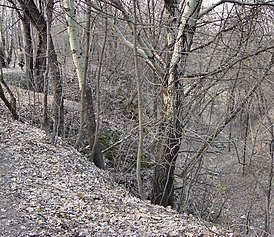
29 September 1977 is the anniversary of the 1941 mass executions at Baby Yar.
*
In this connection 44 Jews awaiting permission to leave the USSR have addressed a letter to the Supreme Soviet. They expressed the hope that this year the authorities would not prevent them from revering the memory of the victims of Baby Yar.
On 26 September 1977 five Kiev citizens Tsitverblit, Kharib, Lebed, Gertsberg and Mizrukhina, arrived at the city soviet with a request to hold a mourning ceremony at Baby Yar on the 29th: to read prayers of remembrance and to lay wreaths with inscriptions in the Jewish language.
Officials of the executive committee V.Kh. Degtyar and S. Zimenko refused to grant permission.
They could lay wreaths, they were told, but the word ‘Jew’ must not be on the ribbons. The petitioners sent a complaint to the Central Committee of the Ukrainian Communist Party and the Kiev City soviet. As a sign of protest, they wrote, they were declaring a one-day hunger strike on the 29th.
*
On 28 September 1977 six Moscow activists of the Movement for Jewish Emigration (among them, Vladimir Slepak, M. Kremen and Victor Yelistratov) were detained at 7 pm at the Kiev railway station in Moscow. They were held at the police station until 3 a.m. on 29 September, preventing them from leaving for Kiev to join the commemoration at Baby Yar.
B. Chernobylsky was detained at the exit of his house and held at a police station.
*
In Kiev on 29 September 1977 Tsitverblit was summoned to the MVD for a conversation about his finding a job. He was held there until 8 o’clock in the evening.
Lebed was summoned to the procurator’s office, Presman to OVIR.
Pargamanik [2] was seized on the street, taken to the KGB, and held at an interrogation in the Shcharansky case until evening.
A few days before 29 September 1977 Kiev citizen Elbert was arrested at the airport, when leaving for Moscow, and given 10 days for ‘hooliganism’. When his wife tried to clarify where her husband was, she was told nothing.
*
This year there was no official service of mourning at Baby Yar on 29 September 1977; only a few organizations laid wreaths at the foot of the monument.
*
(3)
A LETTER & THE SOBERING-UP STATION
On 26 September 1977 Moscow Jewish refuseniks in Moscow again (CCE 43.12) addressed a letter to the Presidium of the USSR Supreme Soviet.
As before, they are demanding that a review of the authorization for an exit visa should take place with the participation of the refusenik and that “legally substantiated” reasons and the duration of the refusal be reported. This time the letter was addressed to L.I. Brezhnev as chairman of the Presidium of the Supreme Soviet. There were 53 signatures under the letter.
No reply to this letter was forthcoming.
*
On 3 October 1977, a number of the Jews who had signed the letter were intending to gather in the reception room of the Presidium to hand in a complaint addressed to Brezhnev. None of them succeeded in getting into the reception.
The majority were detained at home or near home. They were ordered to return to their flats and to remain there. Only four of them were seized at the approaches to the Presidium reception: Dina Beilina, S. Inditsky, B. Chernobylsky and Dmitry Shchiglik were taken to a sobering-up station [vytrezvitel]. Chernobylsky was beaten up in detention.
*
In the sobering-up station, 65-year-old Inditsky began to feel ill with the onset of a serious attack of hypertonia. The staff would not call a doctor, despite Inditsky’s demands and the protests of the others detained.
Dmitry Shchiglik was tied to an iron bedstead with towels.
A loud conversation was started up near the door of Dina Beilina’s cell. They said, for example: “Hitler didn’t finish you off — he left us the trouble”. They fell silent only when Beilina broke the feeding hole in the door and threatened to break down the door.
Those detained were not given anything to eat all day.
In the evening, the police escorted Beilina, Inditsky and Shchiglik to their homes. Chernobylsky was given 15 days in jail for “a breach of public order”.
Thus began the house arrest of 28 refusenik families. Police shifts guarded these families from 3 to 10 October 1977 with a break on Saturday, Sunday and the festival of Simhat-Tora (evening, 5 October).
*
On 4 October 1977 Andrei Sakharov, Pyotr Grigorenko and Naum Meiman addressed the participants of the Belgrade Conference, calling on them to direct their attention to this lawlessness.
*
(4)
APPEAL TO BREZHNEV & HOUSE ARREST
During the same period women from families of Jewish refuseniks wrote a statement addressed to L.I. Brezhnev.
They described the grievous situation of their families: the reasons for refusal and the dates of exit were unknown; they and their husbands were effectively deprived of the possibility of working. The women requested Brezhnev to receive them personally and to investigate “the illegal situation which has been created on the matter of emigration”.
The letter was signed by 16 Moscow refuseniks: Khana Elinson, Dina Beilina, Yanella Gudz, Yelena Seidel, Faina Kogan, Ida Nudel, Natalya Khasina, Lydia //Likhtecrova, Larisa Vilenskaya, Natalya Rozenshtein, Elena Dubyanskaya, Irina Gildengorn, Yevgeniya Nepomnyashchaya, Gitageniya Redker, Galina Shmeleva-Tsitovskaya and Batsheva Yelistratova.
On the morning of 6 October 1977, they were intending to go to the reception of the Presidium of the Supreme Soviet and hand in their statement. From the evening of 5 October, however, persons in civilian dress and uniformed police would not let them out of their flats. On 6, 7 and 10 October 1977 they were all kept under house arrest.
- Ida Nudel was not allowed out to shop for three days and neighbours were stopped from bringing food products to her.
- Natalya Khasina was at first not allowed to go for a walk with her infant in arms; then she was let out, but an escort accompanied her and the pram with the baby in it.
- Yelena Seidel went to a clinic with her daughter on the morning of the 10th. She was ordered to return home. When she refused, force was applied.
- A policeman and civilians accompanied Galina Tsitovskaya to a clinic. Children invited to the birthday party of their 11-year-old daughter were not allowed into the Tsitovskys’ flat.
The same authors describe these events in a complaint addressed to Brezhnev. They conclude with the words:
“Despite everything that has happened, we have not given up hope of obtaining an appointment with you.”
This case is distinguished from preceding cases of the house arrest of refuseniks by the participation of uniformed police; previously it was only people in civilian clothes. The guard was of considerable size: police and men in civilian clothes crowded in the entrances and on the stairways near the doors of those being detained.
(Soviet legislation does not provide for house arrest as a measure of restraint.)
See also “Letters and Statements” (CCE 47.15 [5, 6]).
===========================================
NOTES
- On 1975 amendments to Article 209, see CCE 37.15.
↩︎ - On Pargamanik, see CCE 48.12 and CCE 51.16 [29].
↩︎
============================
 A Chronicle of Current Events