9 ENTRIES
[1]
Vladimir SKVIRSKY (trial, CCE 53.9) was first exiled to the Soviet Far East, to Ust-Nera (Yakut ASSR).
After he was there about a month, Skvirsky was transferred to Central Asia, to the Baikadam settlement in Sarysusky district (Dzhambul Region, Kazakhstan).
*
YAKUTIA (Soviet Far East)
[2]
UST-NERA (Yakut ASSR). Lately, Alexander PODRABINEK has been refused telephone communication with Moscow.
Deputy Head of Telephone Communications Levchenko informed Podrabinek this had been done on his instructions: Podrabinek was using his telephone calls to Moscow ‘for anti-State purposes’.
***
A letter from Mustafa DZHEMILEV, 30 January 1980 (excerpt)
[3]
ZYRYANKA (Yakut ASSR).
“Since the end of December [1979], I have been virtually deprived of the opportunity to telephone my friends and relations in other towns. And if there’s a word in my telegrams THEY don’t understand, they order me to ‘decode’ it or replace it with a word they can understand.
“I tried to quote the relevant Article of the Constitution guaranteeing privacy of telephone conversations. the people in the Telegraph Office just shrugged and said these orders regarding me came from ‘their superiors’ ….
“‘You’d better shut up’, another one said, ‘and just be thankful you’re allowed to send telegrams at all. After all, you know WHAT sort you are… ’
“My trunk calls have often been interrupted by operator’s exclamations:
” ‘I’m warning you! If you say anything else about trials and arrests I’ll break the connection …’
“‘Stop talking about self-immolation … ’
(we were talking of putting up a monument on the grave of Musa Mamut,
who set fire to himself on 23 June 1978 [CCE 51.13]).
“Well, now it looks as if there are to be no more conversations at all.
“Not only do the KGB make no attempt to hide the fact that trunk calls are tape-recorded, they even boast about it — either to discourage me in advance from expressing myself freely, or to show that they’re busy and not earning a salary for nothing. I shall speak to the procurator on this subject.”
*
On 5 November 1979, T.I. Timchenko, who lives in the same hostel as Dzhemilev, sent a ‘report’ to V.Ya. Ivanov, commander of the Zyryanka River Port; the hostel belongs to the Port.
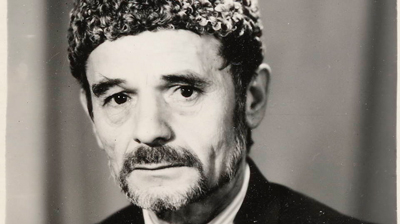
Mustafa Dzhemilev (b. 1943)
She accused Dzhemilev of breaking the regulations for use of the communal telephone: when he was going to call New York, Dzhemilev attached a tape-recorder to the telephone in order to record his conversation.
Timchenko requested that measures be taken against Dzhemilev.
*
On 20 [?] December 1979, the hostel superintendent R. Kozy sent Ivanov a ‘report’ about a conversation of Dzhemilev’s which she had overheard:
“This is what I understood from the conversation: they were talking about some trial which apparently didn’t finish the way they would have liked …
“At the end of the conversation, Mustafa asked him to write down the address of someone called Davydov. The latter was supposed to pass all this on to political exiles and political prisoners in the camps.
“I consider that such conversations should not be held over the telephone and request that measures be taken.”
*
On 29 December 1979, Ivanov sent a ‘report’ to Major V.S. Shirobokov, head of the Upper Kolyma district internal affairs department.
Dzhemilev was breaking the regulations for use of the telephone, writes Ivanov, and, in his long-distance trunk calls, uttered “statements which are politically harmful to the Soviet State”.
Ivanov also requested that measures be taken against Dzhemilev.
*
On 28 December 1979, a post-office employee informed Dzhemilev that on the orders of M.A. Lyapunov, Zyryanka head of communications, he would no longer be sold coupons for making trunk calls, i.e., Dzhemilev could now make calls only from the post-office.
Lyapunov also complained to the police that Dzhemilev was breaking trunk-call regulations.
Dzhemilev “accuses us, i.e. the communications office, of eavesdropping on his conversations …”, writes Lyapunov: “Please make it clear to Dzhemilev that his actions are offensive, and such allegations are slanderous”.
As the basis for his complaint Lyapunov enclosed a ‘report’ by telephone operator N.V. Penyagina, which includes summaries of Dzhemilev’s conversations.
*
On 7 February 1980, Dzhemilev was told at the Zyryanka post office that the postmaster had ordered that no insured letters would be accepted from him. Dzhemilev tried to learn the reasons and legal grounds for these orders from Lyapunov.
The reason for the ban on selling coupons to Dzhemilev, said Lyapunov, were the ‘reports’ by Timchenko, Kozy and Ivanov, of which he had copies. (The ban was imposed on 28 December 1979; Ivanov’s report was dated 28 December.) As grounds for the ban on insured letters he cited post-office regulations:
“You want to send photographs. The regulations say ‘snapshots’. Not the same thing. Snapshots, for instance, are tastefully photographed landscapes …
“And what if your letter should get wet somewhere, or get lost — you’d hold us responsible, wouldn’t you?”
*
On 29 February 1980, Dzhemilev sent Shirobokov a statement requesting him to thoroughly inform the district procurator, “so that active measures may be taken to put a stop to the illegal restrictions on my rights.”
Literature which Dzhemilev had ordered by inter-library loan has stopped reaching Zyryanka. Anyone with anything to do with Dzhemilev is summoned for a chat with the local KGB official.
*
From Dzhemilev’s letter of 22 March 1980
[4]
“After persistent asking for permission I somehow managed to get to his birthday party.
A couple of days later they started pestering the poor fellow, trying to make him do what they wanted — if he ‘really was a Soviet citizen’, that is.”
*
Some students at the Tashkent Teacher Training Institute’s Faculty of the Crimean Language & Literature in Uzbekistan signed a letter demanding Mustafa Dzhemilev’s release. They were summoned for a chat in October 1979.
The signatories were urged to renounce their letter; to agree with Kruzhilin’s article about Dzhemilev in the Evening Tashkent newspaper (“Profession, Sponger”, CCE 53.2 & CCE 54.14); and to condemn him.
Those who refused were threatened with expulsion from the institute.
*
[5]
NYURBA (Yakut ASSR). In the middle of January 1980, Viacheslav CHORNOVIL was no longer allowed to make trunk (long-distance) calls, and his mail, which until then had been profuse, dwindled almost to nothing.
On 17 January 1980, Chomovil’s wife Atena Pashko arrived from Ukraine to visit him.
*
From Chomovil’s letter (19 February 1980)
“… On 19 January, KGB agents sneaked into our locked flat to install or remove something or other.
“My wife and I had gone to spend a long time with a geologist friend of ours, and had talked about our intention before going out; but we forgot something and returned home a few minutes later, by a different street. The surveilllance vehicle — for some reason it was bright orange, the only one of its kind — noticed us too late. It sped past us and warned the intruders right under our noses.
“We spotted one agent leaping over the fence into the neighbouring yard, and another on the porch, locking my door with his key. He too tore past us, muttering something under his breath. Of course, we reported the break-in to the police, but the burglars (who took nothing, but possibly left something behind) still haven’t been caught.”
*
On 7 April 1980, Chornovil went with his employer to the town of Mirny (pop, 30,462; 1979) on a business trip. That evening he rang Moscow from Mirny.
On 8 April, Chornovil was arrested in Mirny and charged with attempted rape.
On 16 April, his wife Atena Pashko received a telegram from Nyurba, signed with her husband’s name, saying that everything was fine. The next day Chornovil’s employer said on the telephone that Chornovil was not in Nyurba:
“ ‘He was drinking and got a bit rowdy, nothing serious’,” he told her. “Chornovil is being held in Markha,” (a small town near Yakutsk).
***
KRASNOYARSK REGION (central Siberia)
[6]
Romen KOSTERIN was sentenced to four years’ exile (CCE 52.15-2).
In letters from his place of exile he wrote that the belongings of his fellow-workers were beginning to disappear. In March 1980 his wife received an official notice:
“Your husband R.F. Kosterin arrived on 3 March [1980] to serve his sentence in institution UP-288/28 at the following address: 663850, Krasnoyarsk Region (Krai), Ilansky district, Khairyuzovka post office, V. Tugusha settlement …”
This ‘institution’ is an ordinary-regime corrective-labour amp.
*
BURYATIA (east Siberia)
[7]
BAGDARIN (Buryat ASSR). At the end of winter, Yevhen SVERSTYUK was not permitted to travel to see his dying mother (CCE 55.4), although he was already entitled to leave.
*
KOMI REPUBLIC (NW Russia)
[8]
MIKUN (Komi ASSR). On 7 January 1980, Vadim KONOVALIKHIN (CCE 54.14) again requested permission from Captain Chegleyev, head of the Ust-Vym district internal affairs office, for early leave to visit his parents, who are seriously ill.
“I am unable to show you a medical certificate to prove my parents’ serious condition, as the medical officials in Sovetsk (Kaliningrad Region) where my parents live, refuses to testify to the serious condition of my parents’ health because of my present situation.”
On 22 January, Chegleyev refused his request.
On 20 February 1980, Konovalikhin requested permission from the local police, on the advice of a doctor, for a quick visit to the Komi capital Syktyvkar to have his heart trouble diagnosed. At police headquarters he was first questioned:
“How many radio receivers have you got at home?”
“What do you think of Academician Sakharov’s exile?”
(“That’s my business!’’ he replied.)
“Do you listen to Western radio broadcasts?”
“Are you going to vote in the [February 1980] elections?”
(“I am not!’’ he replied).
His request was turned down.
*
MOSCOW-VORKUTA
[9]
In March 1980, the wife of Mark MOROZOV (trial, CCE 53.14), who is in exile above the Arctic Circle in Vorkuta (Komi Republic), received a telephone call from an unknown woman.
She told Morozov’s wife that her husband had been arrested under Article 70 (RSFSR Criminal Code).
==========================================
 A Chronicle of Current Events