<< Issue 61 : 16 March 1981 >>
On 8-9 January 1981, the Lipetsk Region Court, presided over by Judge F.F. Borisenko, heard the case of Kirill Pinkhosovich PODRABINEK (b. 1952).
He was charged under Article 190-1 (RSFSR Criminal Code) in Yelets Prison on 24 June 1980 [1], four days before his previous sentence ended (//CCE 57).
The prosecutor was Procurator A.S. Nuzhnov. The defence counsel, lawyer L.V. Bobryasheva, was appointed by the court.
(A day before the investigation closed, Moscow lawyer Yury Pozdeyev, hired by Kirill’s father Pinkhos, declined to take part in the case , cce 60.18.)
*
While in a Siberian camp (penal institution YaTs-34/16, Tobolsk Region) and in Yelets Prison (penal institution YuU-323/st-2), the charge sheet states, Kirill Podrabinek
“systematically circulated among the convicts, in oral form, deliberately false fabrications defaming the Soviet political and social system.”
Podrabinek pleaded not guilty and challenged the court’s composition. In the absence of guaranteed legal norms, he explained, he did not trust a single Soviet court: his petition was turned down “for lack of grounds”.
*
Family
The Judge forbade Kirill’s father Pinkhos A. Podrabinek to take notes during the court proceedings.
Subsequently Judge Borisenko granted the prosecutor’s petition to remove Pinkhos Podrabinek and Kirill’s sister S. Klochikhina from the courtroom so that they could be questioned later as witnesses. Notwithstanding the objections of the defence lawyer, no relatives were present in court on the first day of the trial.
On 9 January 1981, the session began with the questioning of the relatives.
Pinkhos Podrabinek petitioned the court to attach a medical certificate to the case file. In the camp Kirill had contracted tuberculosis, diagnosed after a year’s delay as “a spreading tubercular inflammation of the right lung” (CCE 56.21). Such a diagnosis required constant intensive treatment over the course of a year. A new sentence of imprisonment, said his father, would threaten Kirill with loss of health, if not of life. The certificate was attached to the case file.
Kirill’s father, followed by his sister, refused to give any other evidence.
*
Prison, camp and penal administration witnesses
The court questioned fifteen witnesses:
- Rudnev, Krasilnikov, Malykh, Nikitin, Revnivykh (prison or camp staff);
- Katayev, Larin, Aleksandrov, Avstrievskikh, Konnov, Sokolov, Malyavin, Murashkintsev, Filimonov and Ovchinnikov (convicted felons who met Kirill Podrabinek while they were imprisoned);
- Four other witnesses (Ananyev, Tomilov, Pestov and Glukhikh) did not appear in court. Their testimony was read out by the Judge.
*
The representatives of the administration spoke about the ‘fabrications’ uttered by Podrabinek in private conversations with them.
Podrabinek: Witness Malykh, did you and I have conversations in private?
Malykh: We had conversations in private.
Podrabinek: What did I say to you?
Malykh: That the Jews and Cossacks are oppressed; that there are no free elections here, but there are abroad.
Podrabinek: And you told me that Brezhnev is an old ape.
Malykh: I didn’t say that!
Podrabinek: And I say you did. I have no more questions for the witness: he has revealed himself sufficiently as a witness.
From the questioning of the witness Krasilnikov, a Major in the Ministry of Internal Affairs, Deputy Head of Yelets Prison (political matters):
Krasilnikov: Podrabinek … said that our country is a colonial power, that civic freedoms are not observed here, our Constitution is a fiction, the people are exploited by the CPSU. I personally talked to Podrabinek, but he obstinately persisted in his error.
Podrabinek: …Witness Krasilnikov, did you and I have talks in private?
Krasilnikov: Yes, we talked in private.
Podrabinek: You told me that Brezhnev is an old ape.
Krasilnikov: It’s not true. That’s slander, it never happened.
Podrabinek: And I say it did.
Judge: Accused, I am warning you, stop using this approach.
*
The convicts called as witnesses were for the most part unable to answer the Judge’s question as to what they knew about the present case, and remained silent until the Judge read out to them their written evidence given in the pre-trial investigation, which they merely confirmed.
In addition, it transpired that the witnesses Konnov and Avstrievskikh had given ‘evidence’ in the pre-trial investigation only after Frolov, the Yelets Deputy Procurator supervising the case, had shown them similar evidence as a model.
*
The “punch chamber” (witness Filimonov)
A dramatic situation arose when convict Filimonov was questioned.
From Leningrad, Filimonov (b. 1956) had already completed his three-year sentence. For unknown reasons he was still being held (‘for a little while’) in Yelets prison.
Judge: Witness Filimonov, tell us what you know of the criminal acts committed by the accused, Podrabinek.
But first sign this sheet, which says you’ll be liable if you give false evidence.
Filimonov: I’m not going to give any evidence.
Judge: But you know Podrabinek.
Filimonov: I know him.
Judge: Then why won’t you testify?
Filimonov: Guarantee my personal safety, then I’ll testify.
Judge: This is news. No one and nothing are threatening you here! What are you afraid of?
Filimonov: Nothing here. Guarantee my safety, then I’ll tell you everything.
Judge: You gave evidence during the investigation?
Filimonov: I renounce the written evidence I gave during the investigation.
Judge: Why?
Filimonov: It was false.
Judge: Why did you give false evidence in the pre-trial investigation?
Filimonov: I was under threat.
Judge: threat of what?
Filimonov (hesitates. He is silent for a while): Threat of the press-chamber [note 2].
Judge: What kind of chamber is that? I’ve never heard of it.
Filimonov: All prisoners know about it.
The ‘press-chamber‘ (or ‘press-hut’) is where people are beaten and maimed on the orders of the administration.
Judge: Who beats them and, as you put it, maims them?
Filimonov: Selected prisoners.
Judge: Have you been beaten?
Filimonov: No.
Judge: Then how do you know about the beatings?
Filimonov: From my cell-mates Abdulayev and Moshkin, who were beaten.
Judge: Did you see them being beaten?
Filimonov: Moshkin was beaten up before he came to our cell, and the beatings continued when he tried to complain about it to the Lipetsk Administration for Corrective-Labour Institutions (ACLI).
Abdulayev was seriously injured while I was in the cell. This was a Soviet prison, remember, not the Chilean Junta.
(What Filimonov says is not the first report of such practices in Soviet prisons.
A similar episode took place during the trial of Mustafa Dzhemilev in 1979 (CCE 40.3) and A. Soldatov was beaten up in a ‘press-hut’ in Tallinn Prison (CCE 48.10-2 [2].)
Judge: Accused, do you have any questions for the witness?
Podrabinek: I do.
Witness Filimonov — Tolik [affectionate, diminutive form of Anatoly] — do you know if anyone in the administration was removed from their post in connection with denunciations of the ‘press-chamber’?
Judge: Question overruled.
Filimonov: I know that three people were removed.
Podrabinek: No further questions; the administration, course, always knew what was going on.
*
After a delay of 7-10 minutes, the next witness, prisoner A.E. Murashkintsev, entered the courtroom.
Murashkintsev gave his testimony against Podrabinek without any prompting from the Judge.
Kirill had spoken ill of Lenin. “Leave Vladimir Ilich alone, we told him: he’s someone we greatly respect.” But Podrabinek had continued to defame him. He had also defamed Brezhnev, using obscene language.
Podrabinek was beaten up for speaking ill of Lenin.
Murashkintsev also testified that he had seen Kirill shake his fist at Filimonov before the trial, urging him to withdraw the evidence he had given during the investigation, and giving him cigarettes. According to Murashkintsev, all this had happened at a chance meeting lasting two minutes in the investigations prison, before the prisoners were led to separate cells.
Questioned a second time, Filimonov confirmed the fact that he and Podrabinek had met, but denied there had been any conversation then, and again renounced the evidence he had given in the pre-trial investigation.
Podrabinek said that prisoner Ovchinnikov had taken part in the beatings of other prisoners.
Podrabinek: Witness Murashkintsev, you worked in Camp 16 as a manager for the administration. Tell me, when did you take up this post?
Murashkintsev: I can’t remember.
Podrabinek: Let me remind you. You took it up three weeks after you were called to the camp Commandant and persuaded, together with some other prisoners, to beat me up when I arrived in the punishment cells. There was a deliberately provoked fight. You didn’t beat me, but you were the instigator.
From the questioning of Ovchinnikov:
Ovchinnikov: Podrabinek said he was a dissident, he insulted our ways…He has raised his son in the same spirit.
Judge: In the same pernicious spirit .. that he himself was raised by his father.
Ovchinnikov: He said he had friends in Moscow and abroad who would defend him.
Judge: They have not defended him, however.
Ovchinnikov: The father knows Sakharov, they meet at Sakharov’s place and have conversations.
Judge: You know, Ovchinnikov, Sakharov isn’t in Moscow anymore; he doesn’t have conversations there anymore.
Ovchinnikov: Thank God for that; let’s hope it lasts forever. (Cheerful animation in the courtroom.)
*
Closing Speeches
Before the summing-up began, Podrabinek submitted a petition for about twenty other witnesses to be summoned to court. They had known him for a long time as a prisoner; they could testify to the beatings of prisoners and refute the false evidence against him.
The petition, supported by defence counsel, was turned down by the Judge for “the hollowness of the reasons”.
*
Procurator Nuzhnov’s speech opened with a depiction of the flowering of Soviet democracy and the unity of the whole nation (People).
Only an insignificant bunch of renegades, he said, a fraction of one per cent, numbering fewer than a hundred — Podrabineks of various kinds — oppose the People, the State and the Party. Of course no one fears this pathetic bunch of people, but they live among us and leave their stinking mark. They must be isolated from society.
Nuzhnov went on to declaim Sergei Mikhalkov’s fable “But they say, Eat Russian Fat” and Krylov’s fable “The Elephant and the Pug-Dog” , and listed the criminal opinions of the accused Podrabinek:
- fabrications about the absence of democracy in the USSR;
- the Soviet Constitution was a fiction;
- the People were exploited by the CPSU;
- there were no free elections in the USSR;
- Jews are oppressed in the Soviet Union (“we mustn’t forget”, commented Nuzhnov, “that Yakob Sverdlov, first Chairman of the Central Executive Committee of the Soviets, was a Jew… And everybody loves [comedian] Arkady Raikin”) [note 3 (92)];
- the USSR is a colonial power;
- “libellous attacks on our brilliant leader V.I. Lenin, to the effect that he should be thrown out of the Mausoleum.”
“As for his shameful libel on the leader of our Party and State, L.I. Brezhnev, a man of profound humaneness, the accused had the gall to say that Brezhnev is an old man and a dictator.”
The Procurator categorically rejected Filimonov’s evidence about the ‘press-chamber’ (“It’s obvious that there was collusion on this point”) and, citing Kirill Podrabinek’s previous conviction, asked that he be given the maximum sanction under Article 190-1, three years of strict-regime camp.
*
DEFENCE
Lawyer Bobryasheva built her defence on an analysis of the confusion and contradictions in the witnesses’ evidence, drawing attention in particular to the fact that the indictment was based on written evidence which had not been proved in court.
“The witnesses were unable to give any oral accounts: they could not remember anything or even explain why they could not remember. Whereas they had given detailed accounts in their evidence taken during the investigation.”
The evidence was abstract, general and doubtful. This applied in particular to Murashkintsev’s evidence on collusion between Podrabinek and Filimonov, and this cast doubt on other evidence given by Murashkintsev. In two cases the lawyer admitted that anti-Soviet statements had been proved.
“These are, first, when he was beaten up by Yurov because he didn’t want to work for the communists, and secondly, when he told Malyavin he was a dissident.”
Concerning his statements on Lenin and Brezhnev, Bobryasheva reminded the court that they are not covered by Article 190-1 (RSFSR Criminal Code). She asked that Podrabinek be acquitted, the charges not having been proved.
*
“I am not going to defend myself, I am going to attack,” said Kirill Podrabinek in his final speech. He reminded the court that it was Filimonov who now needed to be defended.
“The ‘press-chamber’ is a branch of Hell on earth. I know a prisoner who was beaten in the kidneys and died soon after release. Filimonov made the right choice in giving false evidence in the pre-trial investigation in order to have the chance to confirm and denounce this appalling act of lawlessness.”
Podrabinek said that the witnesses’ evidence had been falsified, as it had been obtained under threat of physical violence:
“The fact that Murashkintsev and Ovchinnikov committed acts of violence became clear here in court. The other witnesses were blackmailed and bought off with reduced sentences, improved conditions, etc. Katayev was a stoolpigeon: He told me so himself and sought my advice on what to report to the authorities.”
As one of the basic motives for the trial, Kirill mentioned his essay “The Unfortunates” (CCE 47), which denounced the degradation of human dignity in the ranks of the Soviet Army, and also other denunciations by him of the forms and methods of repression used by the administration against …Podrabinek stated in blatantly distorted and tendentious form that there is no democracy in the Soviet Union, no freedom of speech or the press or association.
After the accused went on to list specific facts known to him of tyranny on the part of the prison and camp administration, the Judge began to interrupt him.
Podrabinek then broke off his final speech with a stanza by Pasternak:
I know you won’t shudder
As you sweep a man away,
Why, you’re martyrs of dogma,
You’re also victims of the age.
*
SENTENCE
The judgment was practically a paraphrase of all the of the indictment.
“… Podrabinek stated in blatantly distorted and tendentious form that there is no democracy in the Soviet Union, no freedom of speech or the press or association.
“He called the USSR Constitution a fiction; he asserted that members of the Communist Party of the Soviet Union are exploiters of the people; that elections to State bodies are not free; that the rights of Jews in the USSR are violated; and that the USSR is a colonial power in which Jews, Cossacks and other peoples are oppressed and deprived of rights. Podrabinek spoke offensively and libellously about the founder of the CPSU and the Soviet State, V.I. Lenin, and about one of the leaders of our State.
“The witness A.E. Murashkintsev testified that he was serving a sentence with the accused Podrabinek in 1978 in penal institution YaTs-34/16 [a camp in the Tobolsk Region of Siberia (CCE 51.9-2)]. Podrabinek told him and other prisoners that in the USSR there is no freedom of speech or of the press, that the peoples of the USSR have no rights and there is no democracy; he called the Soviet Union a colonial power in which Jews, Cossacks and other nations are oppressed and deprived of rights. He spoke offensively of V.I. Lenin and made incorrect observations about his activities, and made the same statements about one of the leaders of the Soviet State. In addition, Podrabinek threatened the witness Filimonov into denying his evidence, in which the latter had unmasked the accused.
“The witness Pestov stated that he had heard, with other convicts, statements by Podrabinek in which he defamed the Soviet State system, spoke offensively about state leaders, and said that the party exploits the citizens of the USSR.
“The witnesses Nikitin, Revnivykh, and, in the pre-trial investigation, the witnesses Tomilov, Sokolov and Clukhikh gave evidence proving Podrabinek’s circulation of deliberately false fabrications which defamed the Soviet political and social system.
“The witness S.N. Ovchinnikov testified that from November 1978 to April 1979 he had served his sentence in penal institution YuU-323/st.2 [Yelets Prison] together with Podrabinek. In a room of seven prisoners Podrabinek systematically told all of them that there was no freedom of speech in the USSR, gave an incorrect, libellous evaluation of the activities of the Soviet government, asserted that the Jews were repressed in the USSR and circulated other fabrications of a libellous nature.
“Witnesses Konnov, Avstrievskikh, Rudnev, Krasilnikov, Malykh, Katayev, Larin, Malyavin and Aleksandrov gave evidence at the pre-trial investigation from which it follows that in Yelets Prison (penal institution YuU-323/st.2), from autumn 1978 to June 1980, Podrabinek systematically circulated among persons serving sentences various kinds of information describing the Soviet political and social system in a blatantly distorted and tendentious way.
“The witness Filimonov gave evidence at the pre-trial investigation corroborating Podrabinek’s guilt of the charges against him. In court Filimonov denied his original evidence and stated that he had given this evidence under the influence of the administration of penal institution YuU-323/st.2 (Yelets Prison). He gave no specific names.
“The court, having evaluated both of Filimonov’s testimonies in the context of all the case materials, finds the evidence given at the pre-trial investigation authentic (pp. 54-55 of the case file). He altered his evidence in favour of Podrabinek under the latter’s influence.
“This circumstance was corroborated by the evidence of witness Murashkintsev.
“The accused Podrabinek also tried to persuade other witnesses to alter their evidence in his favour. From the letters filed with the case as material evidence, it is obvious that the accused suggested to Katayev that he deny his earlier evidence in court. Results of a graphological examination show that the handwritten texts addressed to Katayev were written by Podrabinek.
“The witness Larin testified that unidentified persons twice summoned him for an international telephone conversation. An unidentified person told him not to give any evidence concerning Podrabinek at the trial, and threatened him if he did not comply. He did not have a conversation with him. He did not go to answer the second call.”An unidentified person told him not to give any evidence concerning Podrabinek at the trial, and threatened him if he did not comply. He did not have a conversation with him. He did not go to answer the second call.
“Podrabinek’s assertions that the witnesses who served sentences with him in Yelets Prison (penal institution YuU-323/st.2) gave false evidence were not corroborated in court. The court finds that this assertion of his is aimed at evading responsibility for the actions committed by him and is of a defensive nature.”
*
Sentence
The court sentenced Kirill Podrabinek to three years in strict-regime camps.
*
In January 1980, Pinkhos A. Podrabinek sent a letter to the Head of the Central Administration for Corrective Labour Institutions [ACLI] at the USSR Ministry of Internal Affairs. In it he recounted in detail Filimonov’s denunciations of the ‘press-chamber’ in Yelets Prison.
He received replies from the Lipetsk Procurator’s Office and the Lipetsk ACLI:
“The convicts Filimonov, Abdulayev and others testified in their explanations that they knew nothing about the ‘press-chamber’: they had never been in it, there was no pressurizing by convicts or by the administration of the institution, nobody beat them up. Filimonov further explained that he had refused to give evidence in court at the request of your son, K.P. Podrabinek.”
On 17 February 1980, Pinkhos Podrabinek was summoned to the KGB district department in Elektrostal, where he was cautioned “in accordance with the Decree” [note 4 (83)]. In addition to his articles in the journal Poiski [Searches] (CCE 52, 56, 57) and the article “Reciprocal relationships under Socialism”, the manuscript of which was confiscated during a search of his home, the list of reasons for issuing the warning also includes his letter to the Central ACLI with an excerpt from the trial.
*
On 29 January 1981, the Moscow Helsinki Croup adopted Document No. 155, ‘Second Convictions for the Brothers Alexander and Kirill Podrabinek’ (see CCE 61.2-1).
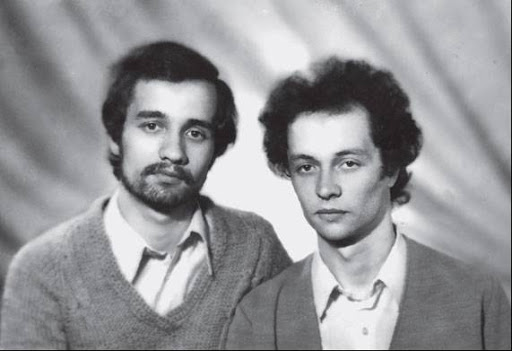
Alexander and Kirill Podrabinek (1970s)
*
On 19 February 1981, the RSFSR Supreme Court heard an appeal against the judgement; the sentence was left unchanged. The defence lawyer did not inform Podrabinek’s relatives of the date of the appeal hearing.
=================
NOTES
In mid-August 1983, Vesti USSR News Update (15-22) reported that Kirill Podrabinek was released on 29 June 1983 [actually 28 June, ed.] and had returned home to his father in Elektrostal (Moscow Region). His state of health was “very poor” and he was admitted for treatment to a specialist TB hospital.
*
[3] The Jewish nationality of Yakov Sverdlov (1885-1919) was a two-edged sword in Soviet times and subsequently.
Sverdlov has often been identified, incorrectly, as the leading Bolshevik in Moscow who gave the order for Nikolai II and his family, then in the Urals, to be killed. Post-Soviet research has revealed that other, more senior Bolsheviks (e.g., Vladimir Lenin) also took part in the decision to murder the last Tsar.
Arkady Raikin was a popular Jewish stand-up comedian who often appeared on Soviet television in the 1970s and 1980s (Lapin’s anti-Semitic comments).
[4] A reference to the unpublished decree 25 December 1972 (see original text of decree in Bukovsky Archive) whereby formal warnings were issued and recorded by the KGB before charges were brought against an individual.
====================
- In March-April 1980 , suffering from tuberculosis, Kirill Podrabinek was transferred from Yelets Prison to a prison hospital in Usman (both Lipetsk Region, south-central Russia).
On 28 June 1980, his father Pinkhos Podrabinek was told by an official at Yelets Prison that Kirill had been charged under Article 190-1 (RSFSR Criminal Code). “Two days ago he received and counter-signed the warrant for his own arrest” said the official (during the investigation of his previous case KiriII Podrabinek had not signed a single piece of paper). When asked what KiriII had done, the man replied: “He refuses to admit his errors.” (see CCE 57.19 ?4).
↩︎ - Two cells set aside as ‘press-chambers’ in Tallinn Prison (58 and 108) were called ‘gorbachevkas’, after Gorbachev, the prison’s deputy head of security. In May 1975 the Chronicle reported that similar treatment was meted out in Georgia’s pre-trial/investigation prisons (CCE 36.6-3).
Filimonov was reportedly given a severe beating after the trial (Vesti, 15 August 1983).
↩︎
 A Chronicle of Current Events