<< Issue 61 : 16 March 1981 >>
On 6 January 1981, the Supreme Court of the Yakut ASSR, presided over by Judge P.P. Fyodorov, examined the case of exile Alexander PODRABINEK (b. 1953; arrested 1 June 1980, CCE 57.3 [3]) at an assizes session in Ust-Nera.
A member of the Working Commission to Investigate the Use of Psychiatry for Political Purposes, Podrabinek was charged (1978 trial, CCE 50.7) for a second time under Article 190-1 (RSFSR Criminal Code).
The prosecutor was Procurator Petrov.
Podrabinek refused the defence attorney appointed by the court.
*
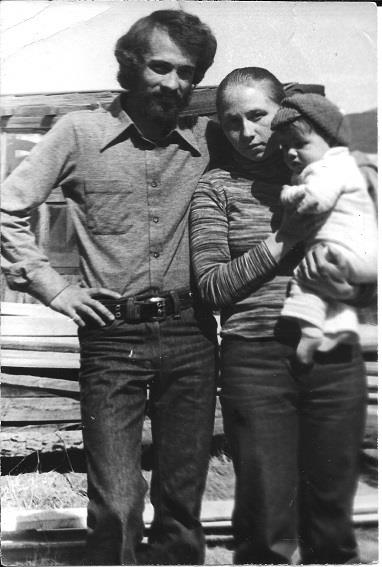
A.P. Podrabinek and Alla Khromova (1956́-2023),
Ust-Nera, 1980
In the indictment Alexander Podrabinek was charged as follows:
[1] producing and circulating in June 1979 an “Appeal to the US Congress”, which contains fabrications about the Soviet system and alleges that “the USSR has a tendency towards aggression against other States and violates international agreements. Ratification of the Salt-2 Treaty will facilitate war”.
This appeal, written jointly by Podrabinek and Tatyana Osipova, was not only not sent, let alone allowed to enter samizdat of its own accord — it was not even written ‘in a fair copy’. All the investigation had at its disposal was a draft confiscated from Osipova during a search on 11 October 1979 (CCE 54.2-1);
[2] continuing in exile to edit his book Punitive Medicine [1], for the writing of which Podrabinek has previously been convicted.
The investigation appointed a literary expert and asked him: “Do the introduced corrections strengthen the ideological tendency (condemned in court) of the work Punitive Medicine, or the reverse?” The conclusion of the expert, V. Gusev, deputy editor of the newspaper Sovetskaya Yakutia: of 23 corrections to the text, four were aimed at strengthening the ideological tendency “condemned in court”, six were not, and he submitted no opinion about the remaining 13.
In this connection Podrabinek was also charged
(a) with sending letters to the exile Mustafa DZHEMILEV containing “fabrications about the internment of mentally healthy people in psychiatric hospitals”. In the indictment it was pointed out that Dzhemilev, when interrogated as a witness in the case, “refused to give a straight answer, which … indirectly confirms the guilt of A.P. Podrabinek” (cce 60.18);
(b) circulating in May 1980 a photocopy of an historical work by an unknown author [2], sent through the post, which (according to the indictment) contained “anti-Soviet and slanderous fabrications about the history of the socialist revolution in Russia”.
Such a verdict on the text was given in the course of a ‘literary examination’ by C.G. Makarov, a senior lecturer on CPSU history at Yakut University. (Makarov was asked: “Do these pages belong in the realm of scholarly work and does the content of the pages correspond to the truth?”).
*
After Podrabinek was denied permission to engage the defence attorney he had chosen and his other petitions were not granted, he refused to take part in the court proceedings, but reserved his right to some Final Words.
*
Witnesses
Witness Shvetsov testified that he had received a photocopy of the historical text which A. Podrabinek was charged with circulating from a certain Dmitriyev. (At an interrogation on 18 June 1980, under direct pressure from Investigator Prokopev, citizen Dmitriyev testified that he had received the photocopy from A. Podrabinek.)
Witness R.S. Dorofeyeva also supported the charges against Alexander Podrabinek, stating “such people should be imprisoned”.
Alla Khromova (CCE 57.3), Podrabinek’s wife, was summoned to the court as a witness in her husband’s case. She was interrogated last.
In the course of the trial witnesses were asked questions which bore no relation to the main episodes of the indictment, e.g. did the accused listen to foreign radio broadcasts. Neither the ‘deliberateness’ nor the ‘falsity’ of the ‘fabrications’ in the charge was an object of court examination. The investigators had followed the same line.
*
Podrabinek’s Final Words
“… the guilt of A.P. Podrabinek … is fully proven by the case materials,” reads the indictment. “During a search at the home of A.P. Podrabinek … material was discovered which characterizes Podrabinek as a person likely to commit the sort of crime covered by Article 190-1 (RSFSR Criminal Code).”
In his prosecution speech, Procurator Petrov stated: “There’s no need to prove that Podrabinek’s allegations are deliberately false — that’s obvious!”
Petrov described the editorial work of the accused on the book Punitive Medicine as criminal, referring to the conclusion of expert Gusev and that Podrabinek had previously been convicted for writing this book.
*
In his closing words [3], Podrabinek first analysed in detail the investigation and court proceedings. He then proceeded to reject the arguments of the prosecution.
“Having set themselves the goal of depriving me of freedom, the investigative and judicial agencies have cooked up this charge hastily and clumsily. The charge ascribed to me is absurd and not proven, whilst the pre-trial and court proceedings have been full of violations of the Code of Criminal Procedure.
“I think that the most vital reason for taking me to court was that I was still involved in the Working Commission to Investigate the Use of Psychiatry for Political Purposes …
“Another reason for today’s trial is, of course, my ‘Appeal to the US Congress’ … That was my personal point of view. I don’t force it on anyone and I don’t even propagate it. But for the fact that I dared to express it openly I am being tried today.
“Incapable of rebutting it with words, they apply force — the usual reaction of a primitive dictatorship.
“The two other episodes of the charge are definitely not reasons for taking me to court.”
*
Podrabinek drew attention to the use of his letters to Mustafa Dzhemilev (CCE 56.22) as juridical evidence:
“This part of the indictment surprised me.
“We’re used to letters being opened and inspected, to secret searches. A charge based on private correspondence is a revival of the traditions of the evil 1930s and 1940s. It’s an alarming symptom.”
*
As regards the final episode in the indictment, Podrabinek said:
“the requirements of the Criminal Procedural Code were violated no fewer than 76 times during the pre-trial investigation, and at least 110 times during the trial itself.
“’It’s quite clear that the authorities can conduct this case only at the price of such procedural violations.”
*
Podrabinek dwelt on the refusal of the court to even attempt to prove the ‘falsity’ or ‘deliberate falsity’ of his “Appeal to the US Congress” and the book Punitive Medicine.
“… I don’t acknowledge state censorship of literature.
“I don’t acknowledge that some bureaucrat has the right to decide what I can read and what I can’t; what I can give to others and what’s barred. And I reserve the right, which internal Soviet laws do not directly specify … I reserve the right to freedom of speech.”
Podrabinek concluded:
“To sum up, it can be said that the charges brought against me should be dropped for at least two reasons: the actions with which I’m charged do not constitute a crime under Article 190-1; and there is not a single piece of evidence in the case file that the information circulated by me is false.”
Referring to the interrogation of witnesses, Podrabinek described the pressure exerted on them by the investigators and the court.
“All the more respect is due to those who were drawn into a political trial for the first time, but who could not be intimidated. I mean N. Ostrovskaya “(cce 60.10) “and Roman Belopolsky” (CCE 57.3 [3]). “As for Shvetsov and Dorofeyeva, I think they have been punished enough by being revealed to their friends, neighbours and workmates as informers.”
Dwelling on the essence of the case under examination, Podrabinek suggested that the real reason for his prosecution had not been mentioned at the trial.
A. Podrabinek ended with these words:
“In a final speech it is accepted practice to request the court to pass this or that verdict on the case.
“More by virtue of this tradition than in the hope of a just decision, I demand a verdict of not guilty in view of the lack of any crime in my actions. Nevertheless, I have no doubts that the sentence for a crime I have not committed has been long decided …
“Yet whatever camp term is meted out to me now, I remain confident that honest people will reach their own verdict on the case: Not guilty for me, guilty for my present judges.”
*
Sentence
Podrabinek was sentenced to three years of ordinary-regime camps, plus a further six months and 13 days in lieu of his remaining term of exile.
*
Reactions
On 29 January 1981, the Moscow Helsinki Group adopted Document No. 155 “The Second Conviction of the Brothers Alexander and Kirill Podrabinek” (CCE 61.16-1 this issue):
“… Despite the procedural violations committed in the pre-trial investigations and trials, despite the unproven charges against the brothers Podrabinek, it is evident from the sentences themselves that they were convicted solely for free expression of their opinions and convictions (– orally (Kirill), in writing (Alexander) –), which cannot for them be deliberately false, i.e., they have been convicted in the absence of any crime in their actions.
“Such a conviction is particularly tragic because both Kirill and Alexander fell seriously ill while serving their first sentences.
“In the harsh conditions of exile Alexander suffered from serious hepatitis which took on a chronic form. Kirill fell ill with pneumonia in prison;” (CCE 56.21) “as the result of a late diagnosis and inferior treatment, the process (tuberculosis) is developing, and at present Kirill is diagnosed as having ‘a spreading tubercular inflammation in his right lung’.
“We call on the heads of governments of the states which signed the Helsinki Agreement, and on Soviet and world public opinion, to raise their voices in defence of the freedom and life of the brothers Podrabinek.”
*
In February 1981, Alexander Podrabinek arrived [4] at a corrective-labour camp (this issue cce 61.16).
*
After the trial Podrabinek’s wife Alla Khromova requested Judge Fyodorov to return the typewriter.
Fyodorov directed her to the administrative section, where she was informed that the typewriter had been destroyed, and shown a document stating that due to its technical condition it was not suitable for second-hand sale.
==========================
NOTES
Alexander Podrabinek was released in 1984 and allowed to return to central Russia but not, in accordance with long-established rules, to live close to the Soviet capital. He and his young family settled in Kirzhach, a small town in the Vladimir Region.
Together with others, Podrabinek set up the weekly Express Chronicle (1987-2000) of which he was and remained chief editor.
*
- Punitive Medicine (Karatelnaya meditsina) was published in Russian by Khronika Press (New York) in 1977. An English version appeared two years later (Karoma Publishers, Ann Arbor).
↩︎ - The book lacked a title page and the author was unknown to Podrabinek and others.
↩︎ - A full French translation of Podrabinek’s “Final Words” (a 20-page speech) was published in the Esprit monthly (Paris, June 1981), with a commentary by T. Mathon.
↩︎ - On 4 February 1981 Podrabinek was sent to a camp in Yakutia. Its address: 677023, Yakutsk, B. Markha, penal institution YaD-40/5.
“He has high arterial pressure. He was sent to work as a loader, but in February a medical commission released him from strenuous work until 17 March.
“The doctor who examined Podrabinek told him: ‘You were able to write anti-Soviet books: now work’,” (cce 61.16, this issue).
↩︎
=================================
 A Chronicle of Current Events