*
[1] Vyacheslav Bakhmin
[2] Leonard Ternovsky
[3] Alexander Podrabinek
*
1. The Case of Bakhmin.
In April 1980, Tatyana Khromova, the wife of Vyacheslav BAKHMIN (arrest CCE 56.4), a member of the Working Commission, tried to send books to her husband through Investigator G.V. Ponomaryov (CCE 56.4) of the Moscow City Procurator’s Office. Ponomaryov is in charge of her husband’s case.
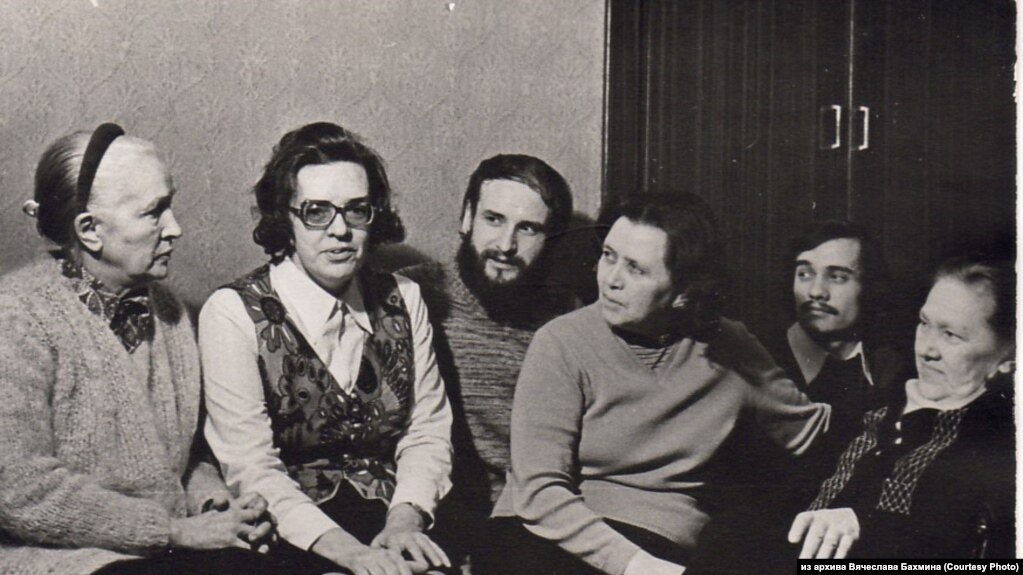
Bakhmin and Podrabinek with Zinaida Grigorenko,
Ludmila Alexeyeva, Ludmila Ternovskaya and Sophia Kalistratova
Ponomaryov told her that parcels sent to a KGB prison — Bakhmin is being held in Lefortovo, the KGB investigation prison in Moscow — are dealt with by officers of that organisation. Ponomaryov suggested to Khromova that she see the officer in charge of these matters.
When she did, however, the KGB officer was not concerned with parcels, but with Victor Bakhmin, Vyacheslav’s brother. Khromova was told that Victor was circulating a slanderous collective letter in defence of his brother (117 signatures, CCE 56.4). The letter was slanderous, he explained, because it said Vyacheslav Bakhmin was arrested in 1969 for speaking out against the Stalin cult, when in fact anti-Soviet literature had been found during a search of his home. It would be no bad thing, the KGB officer suggested, for Victor to graduate from his institute.
In May 1980, before the next parcel was due, Ponomaryov telephoned Khromova. Her husband had some requests, he told her, which she could discuss with the same KGB officer. At their meeting on 16 May, after the parcel had been delivered, Khromova was asked whether she intended to write more letters in defence of her husband. She said she did not. Her husband’s request was passed on to her.
*
On 12 May 1980, Ponomaryov for the second time (CCE 56.4) summoned the following for interrogation: Tatyana OSIPOVA, I. Filatova, A. Romanova, M. Petrenko and V. Neplekhovich.
As in other interrogations connected with similar cases, Petrenko handed the investigator a statement refusing to take part in the investigation.
Romanova was asked about her acquaintance with Bakhmin. She knew him well, she replied, and asked why he was being held in custody while his case was investigated. Ponomaryov answered: It has been sanctioned by a procurator. Romanova then refused to answer any more of the investigator’s questions. It was entered in the record that Alexandrova refused to answer questions while Bakhmin remained under arrest.
Filatova was asked about her acquaintance with Bakhmin, Alexander PODRABINEK, Leonard TERNOVSKY and Felix SEREBROV. What part did Bakhmin play in the production of the Commission’s Information Bulletins? she was asked. Several leading questions were not entered in the record. Filatova had met Bakhmin at work, she said, and knew nothing about the Working Commission and its Bulletins. She was not acquainted with Alexander Podrabinek, but knew his wife Alla Khromova, the sister of Vyacheslav Bakhmin’s wife. She had heard the other names, but was not sure she had ever met these people. In her comments on the record Filatova wrote:
“… I know Bakhmin to be an irreproachable, honest person, totally incapable of lying, much less of deliberately false slander. Therefore, I consider the charge against him absurd and, at best, a mistake.
“For this reason, I refuse to sign the record.”
Prior to the interrogation, KGB officers had a talk with Filatova’s mother about her daughter’s dangerous friendship with Bakhmin. After the talk her mother checked to see if I. Filatova (who is 22 years old) had any papers in her possession; having made sure there was nothing incriminating, she reported this to the KGB. Filatova found out, by chance, about the KGB chat with her mother and the search.
*
Osipova did not attend an interrogation on 12 May. Some days later, when at work, she was called to the personnel office, to which Ponomaryov had telephoned.
Osipova agreed to come for an interrogation on 19 May 1980, a working day; previously she had been summoned on her days off. While filling in a form, Ponomaryov asked Osipova about her civic activities. She replied that she was a member of the Helsinki Group. This “did not count”, it turned out.
Asked about her acquaintance with the accused Osipova replied that she knew Bakhmin and his civic activities, which exposed one of the most shameful pages in the life of our country: the use of psychiatry for political purposes. She was convinced that Bakhmin never resorted to slander and ‘fabrications’: the reality of daily life provided enough evidence to confirm the justness of the Working Commission’s aims and the usefulness of its activities. Osipova was asked two more questions: which materials produced by Bakhmin and published in the Information Bulletin convinced her that Bakhmin did not slander? Which facts could she cite to corroborate the assertion that the reality of daily life provided grounds for speaking of abuse of psychiatry for political purposes? Osipova refused to reply until, as she said, “a criminal case is opened against punitive medicine”. At her insistence this phrase was noted in the record.
On 19 May 1980, Ponomaryov also interrogated Boris and Marina Rumshisky, Bakhmin’s former work colleagues.
Boris Rumshisky testified that he had known Bakhmin at work since 1973 and was on friendly terms with him; Bakhmin sometimes visited him at home. When asked about the activities of the Working Commission, the publication of its Information Bulletin, and his acquaintance with other members of the Working Commission, Rumshisky gave no specific answers. For example, Rumshisky dismissed as not relevant to Bakhmin’s case questions about how he learned that Bakhmin belonged to the Working Commission, and which other Commission members he knew. At the end of the interrogation Ponomaryov informed Rumshisky that he would summon him again frequently. He threatened Rumshisky that he would advise the Visa & Registration department (OVIR) to stop considering his application to emigrate. Rumshisky entered a note about this into the record. Then Marina Rumshisky was interrogated. She did not give any significant evidence either.
*
On 3 June 1980, Ponomaryov interrogated Working Commission member Felix SEREBROV (CCE 56.4) in connection with the cases of Bakhmin and Ternovsky. First, he summoned Serebrov in order to return his wife’s savings book. Serebrov refused to answer his questions, stating that Article 190-1 (RSFSR Criminal Code) contradicts the Constitution. At present, Ponomaryov said, Serebrov “would not be needed as a witness for a long time to come.” Serebrov countered, “And as an accused?” Ponomaryov expressed the hope that his case would be handled by someone else.
On 12 June 1980, Serebrov was summoned to the Moscow City Procurator’s Office to Smirnov, who had an educational chat with him. Two weeks later Serebrov was called to a district police station; the pretext was a prophylactic check linked to his former conviction. Referring to a ministerial decree, the text of which he refused to show Serebrov, a policeman demanded a certificate from his place of work. He then asked Serebrov to write a statement declaring that he would not break the law during the Olympics. Serebrov refused, but said that he was going on holiday at that time.
The same day Ponomaryov interrogated Victor Bakhmin. Bakhmin said he knew nothing about his brother’s part in publishing the Information Bulletin, neither had he carried out any errands for Vyacheslav when he travelled to Ust-Nera to see his in-laws Alexander Podrabinek and Alla Khromova.
*
In June Ponomaryov informed Tatyana Khromova that she must find a lawyer for her husband by 13 June 1980.
In May 1980, Victor Bakhmin appealed to the International Committee of the Red Cross to provide medical assistance to his brother, who is suffering from a stomach ulcer. The administration of Lefortovo Prison had not replied, Victor Bakhmin writes, to his request for permission to send his brother the medicines he needed.
On 6 June 1980, Rostislav Yevdokimov sent a statement to Vyacheslav Bakhmin’s lawyer, asking to be called as a witness at the trial. Yevdokimov writes about the reliability of the Working Commission’s information; on the occasions when the commission did not possess exact information, he points out, it had applied to official institutions for details, but received no reply. The official institutions, therefore, were themselves responsible for any mistakes which might have appeared in the Commission’s Information Bulletin.
*
2. The Case of Leonard Ternovsky.
On 15 June 1980, Working Commission member Irina Grivnina (CCE 56.4) was detained and searched at Vnukovo Airport when returning to Moscow from the Crimea. The warrant for the search — in connection with Case No. 50633/50-79 — was issued by Investigator Yu.A. Burtsev (CCE 55.2-2, CCE 56.5).
Grivnina was told that the search was being carried out in connection with the case of Leonard TERNOVSKY (arrest, CCE 56.4), although the number of Ternovsky’s case is 49609/15-80 (there was a misprint in CCE 56). The following were confiscated in the search: a tape-recorder and a camera, tapes and film (including unused film), letters, telegrams, an address book, a notepad and photographs. The investigator expressed surprise that Grivnina was returning to Moscow when she had not intended to return until September.
On 20 June 1980, Leonard TERNOVSKY, who is being held in Butyrka Prison, was put in the punishment cells. (Ternovsky and Lavut were given ten days each in the punishment cells for attempting to contact each other. In the punishment cell Ternovsky hurt his leg while letting down his bunk. Lavut and Sokirko, who was also serving ten days in the punishment cells at the time, managed to get permission for Ternovsky to lie down in the punishment cell during the daytime. His wife found out about his injury by chance when, with the investigator’s permission, she came to bring him some items. When she made an enquiry, the procurator’s office replied that Ternovsky had been sent to the punishment cells for attempting to send a note out of the prison.
*
On 17 July 1980 Ternovsky was transferred to the prison on Matrosskaya Tishina Street. The Butyrka Prison Administration stated that in Matrosskaya Tishina he would be examined by lung disease specialists, but assured his wife that he was healthy. Investigator G.V. Ponomaryov, who is in charge of Ternovsky’s case, stated he was in perfect health and had been transferred to another prison for reasons connected with the investigation.
*
At the request of their relatives, the defence of Bakhmin and Ternovsky has been taken on by the British barristers Louis Blom-Cooper QC and B. Wrobel. On 15 May 1980 defence hearings related to both cases were conducted in London.
*
3. The Arrest of Alexander Podrabinek.
On 13 June 1980, in Ust-Nera, after a search by the Yakut ASSR Procurator’s Office — the third this year, CCE 56.4 — Working Commission member Alexander PODRABINEK was arrested.
He was charged under Article 190-1 (RSFSR Criminal Code) with the following: making a statement to the US Congress, written in June 1979 with Tatyana Osipova, concerning the SALT-2 negotiations; making amendments to his own book Punitive Medicine [1]; and the ‘circulation’ of a photocopy sent to him by post of a book about the October 1917 Revolution. The Investigator is V.N. Prokopev.
No copy of the search record was left at the house. The statutes of the “People’s Labour Alliance” (NTS) [2] received by Podrabinek through the mail, letters, and a copy of the Working Commission’s Information Bulletin were confiscated in the search.
After Podrabinek’s arrest, interrogations began in Ust-Nera of people who had visited him. They were ‘advised’ not to visit his wife if they wanted to stay out of trouble.
On Sunday morning, 15 June 1980, Roman Belopolsky was summoned for interrogation. He refused to give evidence. The investigator then ordered him to go to the procurator’s office that afternoon, with his belongings. The threat of arrest proved to be a bluff.
On 16 June 1980, the investigator permitted Alla Khromova to visit her husband. During the visit the investigator tried to persuade Alexander Podrabinek to write, requesting a pardon.
On 17 June the Moscow Helsinki Group adopted Document No. 136, “The Arrest of Alexander Podrabinek”. The document ends with the words:
“We consider the latest arrest of Podrabinek to be totally illegal. We insist that Alexander Podrabinek be released immediately and that the persecution of his family be halted.”
Since 21 June 1980, Podrabinek has been held in the city of Yakutsk at Bolshaya Markha, penal institution, IZ-16/1.
*
On Friday, 23 May 1980, Alla Khromova’s mother was called to the passport office.
They told her that her daughter Alla had lived away from Moscow too long: the question of her future residence would be resolved on 28 May 1980. She must come back to Moscow. On 27 May, Alla Khromova returned to the Soviet capital. When she went to the passport office on 28 May 1980, a stamp cancelling her Moscow residence was inserted in her passport. The decision to cancel her residence had been taken on Monday, 26 May, she was told.
All Khromova was born, grew up and resides permanently in Moscow, where she shares a flat with her mother and sister Tatyana. She has a certificate stating that she was unable to leave Ust-Nera because of the illness of her son, who was born there in December 1979.
*
On 24 June 1980, Alla Khromova appealed to the “Committee to Defend the Podrabinek Brothers” [3] and to Amnesty International:
“… My husband was arrested because even here, in exile, where he is serving his sentence, he remained a human being and could not live in the prescribed way, as all Soviet people are obliged to live. In connection with his arrest, his and my correspondence have been seized: I do not have the right to receive letters and telegrams, or to talk on the telephone, even to my own mother. Parcels containing baby food are delivered to me at the procurator’s office, where all our mail ends up.
“My husband is very ill. Some months ago, he suffered from a liver disease; he has heart trouble; he has high blood pressure.
“I ask you to do everything you can for the release of my husband. I hope that your voices will help defend him.”
==========================================
NOTES
- Podrabinek’s Punitive Medicine was published in Russian by Khronika Press (New York) in 1979; an English edition followed the next year.
↩︎ - A Russian anti-Soviet group based in Frankfurt and Paris.
↩︎ - Secretary in USA: Dr D. Shiman, College of Education, University of Vermont. Secretary in the Netherlands: Robert van Voren, Postbus 51049, 1007 EA Amsterdam.
↩︎
==============================
 A Chronicle of Current Events