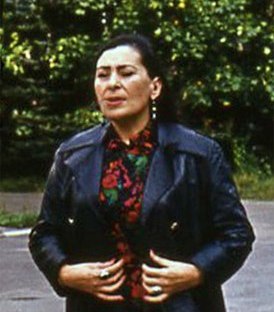
In protest against the expulsion of Victor Yerofeyev and Yevgeny Popov from the Soviet Writers Union, two other contributors to the Metropole almanac (CCE 52.14, CCE 54.21), Semyon Lipkin and his wife Inna Lisnyanskaya, have announced their resignation from the Writers Union (CCE 55.9 [14]).
*
[1]
The poet and translator Lipkin signed his statement as follows:
“Semyon Lipkin
- Member of the Writers’ Union since 1934.
- Veteran of the Great Patriotic War.
“Bearer of orders and medals:
- “People’s Poet of Kalpakia [ASSR, Uzbekistan],
- Laureate of the Rudaka [?Far Eastern] State Prize,
- Honoured Cultural Worker of Uzbekistan,
- Honoured Cultural Worker of Tadzhikistan,
- Honoured Cultural Worker of Kirgizia,
- Honoured Arts Worker of the Buryat ASSR [east Siberia],
- Honoured Arts Worker of the Kabardino-Balkar ASSR [North Caucasus].”
*
[2]
From Lisnyanskaya’s letter:
“For my modest contribution to the almanac, you’ve deprived me of the right to my profession.
“For the last 12 years my poems have been published with difficulty; now they do not appear at all. Furthermore, my translations, previously approved and partly set up in type, the fruit of five years of hard work, have been thrown into the rubbish bins of five of the capital’s publishing-houses …
“I am one of those who sent you a letter last summer saying: ‘No one must doubt that if there is no reaction to this letter, we will be placed in the same position as our colleagues Popov and Yerofeyev, since differentiated treatment of the contributors of the almanac would conflict with our sense of dignity and honour. We will be forced to leave the Writers’ Union.’
“And now I, who have no desire to fight literary or any other kind of battles, am faced with a dilemma: whether to stay in the Writers’ Union or remain a human being. I choose the latter: for if one ceases to be a human being, one can no longer be a writer. I am leaving the Writers Union, of which I have been a member for 23 years.”
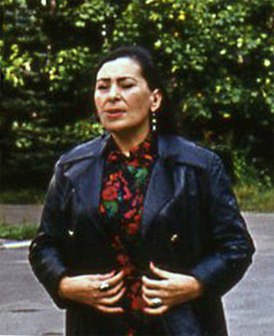
Inna L. Lisnyanskaya (1924-2014)
*
[3]
Three of the four members of the Writers’ Union who signed the ‘Writers’ Letter’ in defence of Sakharov (see CCE 56.1-2) have been expelled from the Union.
*
Prior to this, Raisa Orlova, Lev Kopelev’s wife, was expelled from the Soviet Communist Party.
In a letter of 5 February 1980 to the Party Committee of the Moscow Writers’ Organization, she reminds them that she applied to join the Party on 22 June 1941, the day of the German invasion:
“… Nowadays I try to base my attitude to people and events on the principles of goodness and justice. For this reason, the suppression of dissenters is so unbearable.
“The persecution of Sakharov is unbearable; he is the best human being I have ever met in my life. Even if I silently turned my back on this persecution, I would feel my share of the responsibility. I have always felt that the writer’s duty in Russia is not to attack, but to defend …
“I request that my case, the outcome of which has been decided in advance (I was once again convinced of this on reading the libellous article about my husband in Sovetskaya Rossiya), be heard in my absence.
“I am returning my Party Card, No. 06100731.”
*
Neither did Raisa Orlova attend the meeting of the Moscow Section Secretariat (RSFSR Writers Union).
From her letter of 14 February 1980 to the Secretariat:
“… My expulsion from the Writers Union is the culmination of a period of surreptitious exclusion; five years have already passed since my books and articles ceased to appear in print and I was forbidden to speak in public …
“I have been involved in the Writers Union for over twenty years. I shall never forget how, in 1962, the President of the Moscow organization, S.P. Shchipachev, announced in front of a large assembly that over 600 writers had been rehabilitated, 150 of them posthumously. We were horrified, but hopeful too: the crimes had been talked about openly, for all to hear.
“In those years we often heard appeals, demands and promises: ‘Such a thing will never happen again. Never again will the Writers Union take part in the repression of writers.’ Everyone still remembered the shameful ’case’ of Pasternak. In 1966 the prosecution section unanimously decided to request publication of Solzhenitsyn’s novel Cancer Ward. At that time the Writers’ Union spent more time discussing novels, poems and plays than ’personal cases’.
“… In our country the bravest appeals for humaneness and compassion have come from Andrei Dmitrievich Sakharov. Whatever the order for my expulsion says, I am being expelled for speaking out in his defence. And also for supporting my husband, Lev Kopelev, and his truthful books about our past.
“I do not have much to be proud of in my life, which has been full of mistakes, but of these things I am proud.”
*
[4]
From Felix Svetov’s 20 March letter [1] to the Secretariat of the Moscow Organization (RSFSR Writers Union):
“In the course of almost 20 years as a member of the Writers Union, the Secretariat has remembered me twice: the first time was in 1968, when I was formally reprimanded for signing a letter in defence of the imprisoned Ginzburg and Galanskov; the second was 18 months ago, when the members of the Secretariat read my article on Solzhenitsyn.
“What will it be this time?
“It would be wise not to guess. Yes, I signed letters in defence of Andrei Dmitrievich Sakharov. I signed letters in defence of Tatyana Velikanova, Father Dmitry Dudko and Father Gleb Yakunin, who have all been arrested. Or perhaps it is the fact that I acknowledge my Orthodox faith, to which I have dedicated my novel, recently published in the West? …
“It is shocking to see a professional association running ahead of the repressive agencies, passing them tips about their next victim — or didn’t you know that expulsion is the same as sanctioning repression? …
“If you expel me, you will relieve me of the heavy burden of responsibility for your crimes against literature and against Russia.
“I shall feel relieved, but how will you feel?
“Each of us has children and a conscience; even when we forget about it, our conscience exists all the same; it lives and will make itself heard sooner or later. May God allow this to happen before your deaths.”
*
[5]
From Sarra Babyonyesheva’s letter [2] of 27 March 1980 to Felix Kuznetsov, 1st Secretary, Board of the Moscow Writers Organization (RSFSR Writers Union):
“Literature has known worse and more terrifying circumstances than these, but none more petty. The most revolting thing about the present situation is its pettiness.
“For instance, all four writers who have left the Union [Georgy Vladimov, Vasily Aksyonov, Semyon Lipkin and Inna Lisnyanskaya, Chronicle] have also been expelled from the Literary Fund. The Writers Union is an ideological organization, while the Literary Fund is, as you know, a long-standing organization (I shall not remind you, who founded it or for what purpose), but it has always been non-ideological – or, as they say nowadays, humanitarian.
“The two organizations function separately. In the sad times of the persecution of Boris Pasternak, he was fortunately not expelled from the Literary Fund. Even now there are many people in the Literary Fund who are not members of the Writers’ Union.
“But a 68-year-old war veteran Semyon Izrailevich Lipkin is banned not only from the House of Literature, but is also denied access to the polyclinic.
“Pettiness distorts vision. And memory is a tenacious thing. To forget that would not be a good idea.”
=================================
NOTES
- Svetov’s wife Zoya Krakhmalnikova was soon arrested and imprisoned (Vesti, 1983, 7-3, trial). Svetov was tried in January 1986.
↩︎ - See actions of Babyonysheva in support of the exiled Andrei Sakharov (CCE 56.1-1).
↩︎
===========================
 A Chronicle of Current Events