This section has been compiled largely from four recent issues of the Information Bulletin of the Working Commission [1].
*
On 12 February and 10 April 1980, respectively, Working Commission members Vyacheslav BAKHMIN and Leonard TERNOVSKY were arrested (CCE 56.4).
In March 1980, Irina Grivnina of Moscow joined the Working Commission: her name appeared for the first time on the title page of Information Bulletin No. 22. Only one other member, Felix SEREBROV, of the Working Commission, is still at liberty.
On 5 February 1980, a consultant-psychiatrist of the Working Commission, Alexander VOLOSHANOVICH, emigrated from the USSR (CCE 56.20).
Information Bulletin No. 22 reports that “a highly qualified psychiatrist continues to assist” the Working Commission. (Later he was publicly identified, cce 61.2, as Dr Anatoly Koryagin.)
*
Special Psychiatric Hospitals [SPH]
In November 1979, exiled member of the Working Commission Alexander PODRABINEK sent a statement to N. Shchоlokov, the USSR Minister of Internal Affairs [2], concerning the pay received for their work by prisoners in Special Psychiatric Hospitals.
The pay does not correspond to the work they do, he pointed out. Podrabinek asked the Minister to reply, stating whether the Ministry of Internal Affairs intends to take the necessary steps to organize a system of payment for work done by prisoners in the SPH and to make it correspond to the relevant State laws and the Soviet Constitution.
*
A new SPH has opened in the Volgograd Region of southwest Russia, on the former site of a corrective-labour camp (403850, Kamyshinsky district, Dvoryanskoye village, penal institution YaR-154/SPB).
Major Davydov heads the new SPH. The head doctor is Captain V. Reznik, who was previously a therapist in the camp which occupied the SPH site. The head of the 3rd Section is P.A. Maryzhev. A woman, A.P. Totenko, who spent half a year as head of Section 3, resigned because she did not agree with the harsh conditions under which prisoners are held.
Section 1 contains solitary cells. Section 5 is under construction; this will consist mostly of solitary cells. The inmates are forced, under threat of treatment with neuroleptic drugs, to work without pay in the sewing workshop. Criminal prisoners from an ordinary-regime camp are used as orderlies; they beat up the inmates.
*
Dnepropetrovsk SPH (Ukraine)
In autumn 1979, Josyp TERELYA (CCE 54.15) was taken off drugs.
In March 1980, a medical commission considered whether to release Terelya, but did not discharge him. Department head N.M. Budkevich promised Terelya’s wife Olena that he would be discharged in the autumn. “The slightest deviation from the norm, as you can understand, and we start treatment,” warned the department head. Terelya “must be protected from unnecessary contacts”.
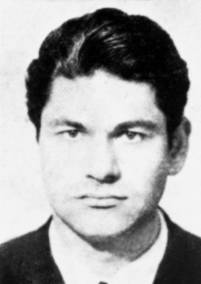
Josyp Terelya, 1943-2009
*
Chernyakhovsk SPH (Kaliningrad Region)
According to his wife, Mikhail ZHIKHAREV (CCE 51.11) has lost all his molars. After he was dispatched from Sochi to Chernyakhovsk, Zhikharev contracted a lung disease.
In December 1979, Alexander Podrabinek requested the Procurator of the Krasnodar Region (Krai) to invoke his supervisory powers and appeal against the 30 May 1978 decision of the central district people’s court in Sochi. It had ruled that Zhikharev should be transferred to an SPH, but the decision was ‘without legal grounds’. Podrabinek received a refusal from the Procurator’s office.
*
Tashkent SPH (Uzbekistan)
Head doctor R.M. Babayev has tried persistently to find out from Vladimir ROZHDESTVOV how he received a letter through unofficial channels. When Rozhdestvov refused to answer, Babayev told him that he would be given the prescribed drugs (CCE 53.21) until he answered: these drugs make Rozhdestvov bend double and writhe with pain. Babayev told Rozhdestvov not to count on a favourable decision by the next medical commission (due in May 1980).
*
In April 1980, some friends of Lev UBOZHKO (CCE 54.15) were returned a food parcel they had sent to him. A.I. Khegai, the SPH Special Department senior inspector, gave the following reason for returning the parcel: “We do not know the sender”.
*
Alma-Ata SPH (Talgar, Kazakhstan)
At the end of 1979, Nikolai BARANOV (CCE 52.7) was transferred to the Alma-Ata SPH from that in Oryol. He is being held in Section 9.
*
Sychovka SPH (Smolensk Region)
Over the past 18 months, wards are not locked and the orderlies tyrannical behaviour has ceased.
*
In the Ordinary Hospitals
Gavriil YANKOV was forcibly hospitalized (CCE 54.15) on 2 November 1979.
On 20 December 1979, Yankov talked with a psychiatric commission; on 24 December he chatted with a psychologist.
On 11 January 1980, a lawyer was sent to the hospital by V.P. Kotov, Moscow’s Chief Psychiatrist. He told Yankov that his case would soon be heard in court, and that psychiatrists would appeal on his behalf for him to be issued a temporary Moscow residence permit and given back his job. On 21 January 1980, Yankov was released from the hospital; the day before, he was told he was being discharged on Kotov’s orders, so that he could attend the hearing of his case.
On 2 April 1980, Yankov was again forcibly hospitalized. Invited to a session of the Trade Union Committee to examine his complaint that he had been illegally dismissed from work, he was arrested by policemen as soon as he arrived and taken to a police station. From there he was taken to a psychiatric hospital.
Yankov is presently being held in Section 8 of Psychiatric Hospital No. 14 (the Section Head is V.Ya. Levitsky).
*
Sergei PURTOV (CCE 53.21) has been transferred to a different section (No. 4) of the same hospital.
On 15 November 1979, a friend tried to visit him. The doctor in charge of Purtov, Alexander Yakovlevich, told him that Purtov was being held in solitary, and that only his relatives could visit him. The doctor also said he was required to give information about everybody who visited Purtov and asked the visitor to give his name: the latter refused. According to the doctor, Purtov’s health is the same as before: at present his discharge is out of the question.
*
The conditions in which Nikolai Plakhotnyuk (CCE 53.21, CCE 54.15) is being held have worsened.
He is being forced, under threat of ’treatment’, to refuse the postal-orders and parcels which are sent to him. According to his sister, materials recommending his discharge have again been sent to the court.
*
At the end of March 1980, Vladimir Borisov was again forcibly hospitalized in Leningrad (CCE 44.20) [3]. Once again, he was placed in Section 8 of the Skvortsov-Stepanov Psychiatric Hospital No. 3, under A.I. Tobak (CCE 38.10, CCE 43.7, CCE 44.21, CCE 52.7, CCE 54.15). In the middle of April, Borisov was sent for an in-patient psychiatric diagnosis.
*
Releases
Numerous admirers of Vyacheslav Zaitsev (CCE 54.15) have come to his defence.
Among them are people who have heard his lectures and read his works, e.g., “Is God’s Providence Cruel?”, “Stumbling Stones and Temptations on the Path to Faith”, “The Jews, Judaism and Christianity”, “The Evolution of the Universe and Reason”, “Why Do UFOs Fly Over the Earth?”
A 24-page collection of statements in his defence has appeared in samizdat. The words “Special Supplement to the Almanac From the Russian Golgotha” are written across the middle of the title page; at the top it reads “Those we Defend (the Case of V.K. Zaitsev)”; at the foot “Samizdat, August 1979, Moscow”. At the end of the collection is the signature of “Editor of From the Russian Golgotha Almanac, Andrei Severtsev”.
In March 1980, Zaitsev’s wife I. Konopatskaya registered as his guardian. He was then discharged from Kazan SPH and handed over to her care.
*
Zorka, head doctor of the Vitebsk Regional Psychiatric Hospital (Belorussia), has summoned Ivan Kareisha (CCE 54.15) on several occasions. ‘To whom has he complained, Zorka asked, and when? How did he send a letter out of the hospital? Why had he written about injections?’
On 7 December 1979, Kareisha was discharged from the hospital with the diagnosis ’complaining mania’. On 8 December, he was visited at home by a KGB official and a local policeman. They gave Kareisha an official warning that criminal proceedings would be instigated against him under Article 204 (Belorussian SSR Criminal Code: “systematic vagrancy or begging, and also leading a parasitical way of life over a prolonged period …”).
In January 1980, Kareisha sent the following statement to the CPSU Central Committee and to the Presidium of the USSR Supreme Soviet:
“Again and again, I have earnestly requested that my case be heard and an appropriate decision be taken: give me back my job on the collective farm [kolkhoz] where I worked until August 1974; give me work that is not beyond my strength.
“I also earnestly request that I be spared further acts of persecution, which are illegal and tyrannical. I am subjected to them only because I appeal to you and other Soviet agencies for justice …”
In February 1980, a KGB official and a policeman again visited Kareisha, but he was not at home.
*
At the end of December 1979, and again in January 1980, the following notices appeared at the Medical Institute and the University in Saratov: “Persons persecuted for reasons of nationality, religion or politics may apply to this address: …” (there followed the address of Alexander Komarov, CCE 51.11, CCE 53.21).
On 20 January 1980, Komarov was taken to the police station. There he was questioned as to who had written the notices and put them up: Komarov refused to give any explanation. He was then taken straight from the police station to Section 11 of the Saratov Psychiatric Hospital. Komarov was told that he had infringed the regulations on putting up notices: if he continued to circulate notices of this kind, warned section head Ya.S. Parfyonova, he would end up in an SPH and he was given five injections of Moditen-depo. On 26 February 1980, Komarov was discharged.
*
On 7 December 1979, Pyotr M. SEBELEV (CCE 48.12) was invited to Police Station 88 in Moscow for a chat. Instead of a chat, Sebelev was taken from the police station to Psychiatric Hospital No. 3.
The order for his hospitalization was signed by Dr L.P. Koltsova of Psychiatric Clinic No. 3, who had not seen Sebelev for several years. Sebelev was given no reason for his hospitalization, but the doctors several times expressed an interest in his acquaintance with Sakharov. In the hospital Sebelev was given Diazepam [i.e. Valium] and vitamin B6. On 3 January 1980, he was discharged.
=====================================
NOTES
- This section has been compiled largely from issues 20-23 of the Information Bulletin of the Working Commission (to Investigate the Use of Psychiatry for Political Purposes):
20 (8 December 1979)
21 (18 February 1980)
22 (5 April 1980) &
23 (21 May 1980).
↩︎ - Nikolai Shchyolokov served as USSR Minister of Internal Affairs under Brezhnev from 1966 to 1982. He committed suicide in 1984.
↩︎ - On Borisov, see CCE 11.10; CCE 14.11 [13], CCE 19.3, CCE 20.11 [16], CCE 22.8 [14], CCE 23.4, CCE 24.4, and Name Index.
↩︎
===========================
 A Chronicle of Current Events