[1]
Mikhail Zotov is searched
On 8 December 1979, Mikhail ZOTOV (CCE 51.8) was intending to fly to Moscow when he was subjected to a search at the airport in Togliatti (Kuibyshev Region, Volga Okrug).
A draft document prepared for the free trade union FIAWP, and a plan for a “Memorial to the Victims of Communism” were confiscated from him. Zotov attempted to take the papers back from the people searching him and was punched in the throat for doing so. After the search Zotov was released.
*
[2]
Searches in Leningrad
A series of searches was carried out in Leningrad in connection with “Case No. 12” (which KGB officials call, variously, the ‘Poresh Case’, the ‘Poresh-Ogorodnikov Case’, or the ‘Case of the journal Obshchina’ [CCE 54.2-1, CCE 55.2-3]). People unconnected with the Christian Seminar were subjected to searches. Many of them are unacquainted with either Poresh or Ogorodnikov.
On 29 February 1980, Yulia VOZNESENSKAYA (CCE 43.5 trial) and S. SOKOLOVA’s homes were searched. The search at Voznesenskaya’s lasted about 24 hours; 365 separate entries were made in the record. A bunch of documents was confiscated from Tatyana Goricheva (CCE 55.2-3) when she called by to see Voznesenskaya. During the search at Sokolova’s home a copy of the journal Itogi [Summary] No. 1 was confiscated (CCE 53.31 [4]).
*
On 10 March 1980, Sergei DEDYULIN (CCE 53.15) was detained at the exit from his building.
He was taken to a vigilante check-point, where the first volume of the collected works of Danil Kharms (published in West Germany) was confiscated from him. After this a search was carried out at his flat. The following items were confiscated:
- letters to French academics in which Dedyulin thanks them for speaking out in his defence regarding an earlier search;
- several books published abroad;
- documents on the Exile of Sakharov;
- bibliographic materials; and
- a card-index of mathematicians and writers who participate in the human rights movement.
Not long before this search, which was sanctioned by the Procurator’s office, Dedyulin discovered that a secret search had already been carried out at his home. That day he was urgently summoned to a teachers seminar and even taken there by car. On 10 March, following the search, Dedyulin was taken to an interrogation. He was interrogated the following day also.
*
On 11 March 1980, the physicist A. Kobak, together with Valery Sazhin (CCE 53.15), A. Mets and Ernst Orlovsky (CCE 51.19-2), were all searched.
Typewritten copies of works by Akhmatova, Mandelstam and Nabokov, and several religious-philosophical books were taken from Kobak.
Several issues of the Chronicle of Current Events and one issue of Kontinent were confiscated from Sazhin.
In Gatchina (Leningrad Region) a search was carried out at the home of the surgeon A. Mets. Notes on Mandelstam, whose work he is studying, were confiscated.
Mets was not present at the search, as he had gone to Moscow on a business trip. At the Leningrad rail station in Moscow, he was searched and an issue of the Herald of the Russian Christian Movement [Vestnik RKhD] was taken: it contains a large section about Mandelstam.
*
KGB officials came to see Ernst ORLOVSKY at work and invited him to come for a chat. Then they said that they had a search warrant and took him to his flat.
Senior Investigator Captain V.I. Aksakov led the search. Orlovsky was asked to hand over everything which might be of relevance to ‘Case No. 12 against Poresh and Ogorodnikov’, and “everything he had received from S.V. Dedyulin, except what related to Anna Akhmatova”.
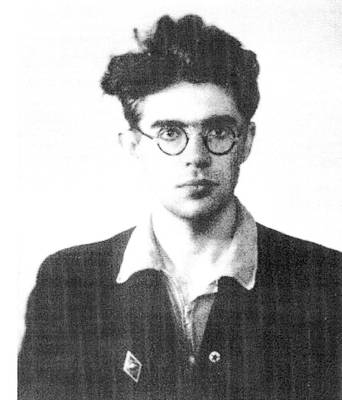
Ernst S. Orlovsky (1929-2003)
Those carrying out the search agreed not to conduct it in different parts of the flat at the same time, so that Orlovsky could always observe their actions; they also agreed to leave the room when Orlovsky left it to go to the toilet.
The record of the search was detailed, with 140 headings and many dozen sub-headings. Nevertheless, the investigators simultaneously made a more detailed inventory and regularly communicated it over the telephone. Among the confiscated items:
- Materials of the free trade union FIAWP;
- transcribed passages from Kontinent, Vremya i my and A Chronicle of Current Events;
- foreign newspapers;
- Certain samizdat and tamizdat publications:
The Gulag Archipelago, Grossman’s Forever Flowing, the collection Samosoznanie [Self-awareness], and books by Sakharov, Conquest, Djilas and Moroz; - letters and statements in defence of Velikanova, Sakharov and Kopelev;
- Copies of A Chronicle of Human Rights in the USSR (ten issues), A Chronicle of Current Events (three issues), the journals Vestnik RKhD, Syntaxis and Possev;
- articles by Orlovsky himself.
After careful examination Orlovsky was allowed to keep some materials: publications by Amnesty International, Solzhenitsyn’s “Study of a Monarch” and three articles he himself had written: “The Paris weekly newspaper Russkaya Mysl: Some comments”, “Thoughts on reading Volume 1 of The Gulag Archipelago”, and “Changes in the Hierarchy of the Soviet leadership from March 1979 to February 1980”. Neither did the investigators take excerpts from Russkaya mysl and the fortnightly Bulletin published by Kronid Lubarsky [1].
The search at Orlovsky’s flat finished at about 3.30 am. The following day, Captain Zherlitsyn interrogated Orlovsky.
The interrogation proceeded as follows:
Zherlitsyn typed a question, read it out to Orlovsky, the latter wrote down his answer, which Zherlitsyn typed into the record, and so on. Zherlitsyn insisted that Orlovsky hand over his notes on the interrogation. The latter agreed on condition that they be appended to the record. Zherlitsyn did not object.
The questions concerned Vladimir Poresh, the journals Obshchina and Itogi and the articles and materials by Orlovsky that were confiscated from him during the search. Orlovsky said he did not know Poresh and he had not read the journal Obshchina [Community], but he regarded the journal Itogi [Summary] as a very useful, well-produced publication.
Orlovsky could not remember from whom he had received: Itogi [Summary], the record of the search of Dedyulin on 6 March 1979, and other documents. He refused to say to whom he had shown the Chronicle of Human Rights, the books by Conquest and Djilas, and the journals Possev and Vestnik RKhD: he had been summoned to the interrogation not as a defendant, but as a witness.
At the end of the interrogation Orlovsky had to sign a written undertaking not to talk about the proceedings.
*
On 16 April 1980, a search was carried out at the home of the Leningrad poet Lev Druskin. It was unconnected to the case of Poresh: the warrant said the search was intended to look for drugs.
Those conducting the search made a show of rummaging around in the medicine chest and confiscated a used ampoule of Penthapon. Then they went to “look for prescriptions”, heading straight for the bookshelf on which there was tamizdat literature. A manuscript by Druskin of diary type was also confiscated. Two days later, Druskin was interrogated at his flat: he is disabled and his legs are paralysed. They asked him how he had obtained books published abroad, and about the foreigners who came to see him.
A large number of Druskin’s acquaintances were interrogated. They were asked: about visitors to the house; about foreigners; about [?comedian Mikhail] Zhvanetsky and [?actor Sergei] Yursky; and whether Druskin himself posessed issues of the Chronicle of Current Events.
Druskin has sent a telegram to Israel requesting an invitation, and also written to the KGB, asking for their cooperation in his departure from the USSR.
*
[3]
A Search of Danilyuk (Ryazan)
On 16 March 1980, Ivan Filaretovich DANILYUK [2] was detained in Ryazan.
Danilyuk had returned from Moscow and boarded a trolleybus, when a policeman and two men in civilian clothes pursued him. A few minutes later, one of them declared that Danilyuk had stolen 35 roubles from his pocket. The other turned out to be a police officer and together with the uniformed policeman he escorted Danilyuk off the trolleybus. At this point a police car approached and they were all taken to a police station. There Danilyuk was subjected to a body search. Four roubles and some kopecks were found on him, plus an appeal to the electorate from the “Elections 79” group [3], and two notebooks.
On 20 March, in a statement addressed to USSR Procurator-General Rudenko, Danilyuk wrote:
“With this letter I am notifying you, citizen Procurator-General, that it Is not excluded that next time the KGB will send not just one of their agents but several. And money will not only be stolen from a ‘passenger’ but also placed in my pocket. There will also be ‘witnesses’ present…
“A similar thing could happen to other Soviet dissidents too.”
On 15 April 1980, Danilyuk was summoned to see Yu.S. Tikhonov, Deputy Procurator of the Ryazan Region. In the presence of the head of the investigations section of the Regional Procurator’s office, Tikhonov stated that a check of his complaint had been carried out and that the theft had not been confirmed. Tikhonov said that he had talked to the ‘victim’, who admitted that it “had seemed” to him as if someone had stolen his money. Danilyuk demanded a written reply to his statement and that Zaikin be summoned a second time, together with him. Tikhonov replied that there was no need to summon Zaikin again. He promised to give a written answer.
*
[4]
The Case of Brailovsky
On 10 April 1980, searches took place in connection with Case No. 49808/13-80 at the homes of two editors of the journal Jews in the USSR (CCE 52.4-5): Moscow mathematician Victor BRAILOVSKY and physicist Yury Golfand. On 13 April, they were both intending to take part in an unofficial international symposium of the Moscow scientific seminar on collective phenomena. (Meetings of the seminar have been held by refusenik scientists every week for a number of years.)
The following items were confiscated from Golfand: his scientific works; a piece of research by Yury Orlov, written by him in the camps (CCE 54.13-1, CCE 55.3); an issue of the journal Jews in the USSR; a few books in English (fiction); the journal Physics Today, which had arrived through the post; a Hebrew dictionary; several sheets containing the songs of Alexander Galich; and letters. The search at Golfand’s was conducted by Novikov following a decree issued by Ponomarev (this issue “The Arrest of Ternovsky” CCE 56.4).
The items mostly confiscated from Brailovsky were his own scientific works. After the search Brailovsky was taken to an interrogation, which was conducted by Smirnov, the deputy head of the Investigations Section of the Moscow Procurator’s office. The questions concerned the journal Jews in the USSR and the material confiscated at the search. After the interrogation Brailovsky was presented with a warrant for his arrest under Article 190-1. Then he was transported to the detention cells, his laces and belt were removed, he was photographed and his fingerprints were taken. Five to six hours later he was again summoned to Smirnov. The latter said that the measure of restraint had been changed and that he was now only a suspect. He was made to sign a written undertaking not to leave the city. Then Smirnov again attempted to interrogate Brailovsky, but the latter refused to answer. He was released. On 20 April, the term of his undertaking not to leave Moscow expired without a charge having been brought.
*
[5]
At the same time, on 10 April 1980, V. Knyazev conducted a search at the home of the writer Gennady FAIBUSOVICH.
The following items were confiscated: a manuscript of a novel prepared for publication; manuscript notes on the history of science; the draft of an article about Blaise Pascal; a few letters; a number of books, including On Tolerance in the Catholic Church by the famous theologist K. Rahner, L. Shestov’s Good and Evil in the Teaching of Count Tolstoy and Nietzsche, the collection Vekhi [Landmarks}, and a German Theological Dictionary for the “New Testament”. A notebook was torn out of Faibusovich’s hands. During the search in the bathroom and toilet they looked intensively for ‘some object’, but did not find it.
At the same time, searches were under way in Latvia (at the homes of A. Marynsin, S. Shvortsbat, Ya. Arev and Sulimov in Riga), and at A. Taratuta’s home in Leningrad.
Books published abroad were confiscated from Taratuta, as well as his correspondence, tapes and two typewriters (Cyrillic and Latin script). After the search he was interrogated at the district internal affairs office. A few days later a summons was delivered to Taratuta’s son, who is studying at Leningrad University, calling on him to appear at the military enlistment office.
*
[6]
A Search at the Home of Kormer (Moscow)
On 24 April 1979, a search was carried out in Moscow at the home of Vladimir KORMER, the author of The Mole of History, or Revolution in the Republic of S=F.
The novel was serialized and published in Poiski Nos. 3 and 4 under the pseudonym G. Bezglasny (CCE 51.21 [18], CCE 52.17). Kormer received the first “Vladimir Dal prize” (France, 1979) for this book. During the search they looked for and confiscated Kormer‘s manuscripts and Yu. Kublanovsky’s verse (see “Between Emigration and Prison”, this issue CCE 56.20).
=================================================
NOTES
- Lyubarsky’s fortnightly bulletin, Vesti (USSR News Update), began to appear in November 1978 and continued until December 1991.
↩︎ - On Danilyuk, see CCE 32.20 [13]; CCE 45.11-3; CCE 47.4 [6] and CCE 56.14.
↩︎ - See Arrest of Mikhail Solovov, CCE 55.2-4 [7].
↩︎
===============================
 A Chronicle of Current Events