- 1. SHCHIPKOVA TRIAL
- 2. POPKOV AND BURTSEV TRIAL
- 3. INVESTIGATION OF SEMINAR
*
On 8 January 1980, a new trial (CCE 55.7) took place of Tatyana Nikolayevna SHCHIPKOVA [1], a member of the Christian Seminar.
*
On 2 March 1979, a criminal case was brought against Shchipkova under Article 206, pt 1 (RSFSR Criminal Code: “Hooliganism”). She was accused of hitting a special constable [druzhinnik] (CCE 52.11, CCE 54.19).
In autumn 1978, some policemen appeared at her home (she lives in Smolensk) and forced her to go to the district police station with them “to verify her papers”. However, they did not reach the police station. Shchipkova was taken to the railway-station and sent to Moscow with two escorts. Here she was presented with a new charge under Article 206 part 2 (“Malicious hooliganism”): the slap across the face she had given the special constable [druzhinnik] who twisted her arm had turned into “a blow with her fist”.
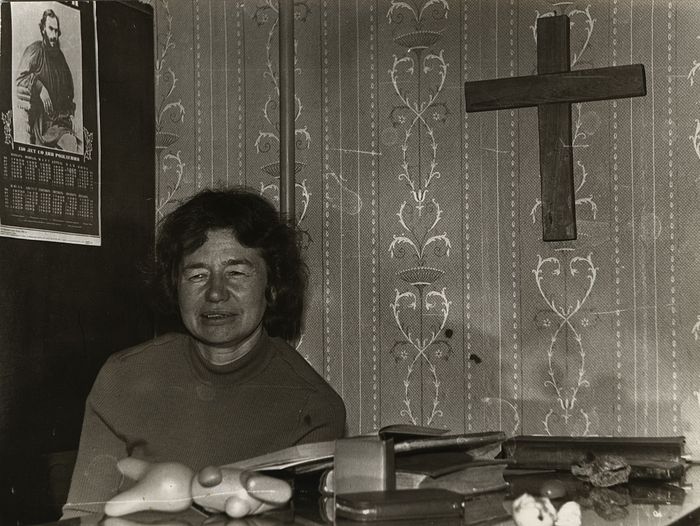
Tatyana Shchipkova (1930-2009)
On 8 January 1980, Shchipkova and her friends arrived at the people’s court in Moscow’s Lenin district. Before the court began its work, they were the first to enter the building. The hall was already filled, however, with spectators ‘in civilian clothes’ and Shchipkova’s friends were not allowed in.
Shchipkova passed a statement to the Judge: she would not enter the hall without her friends, she said. By order of Judge Dyachkov policemen took her into the hall by force. Her friends in the next room started praying for her. The man in civilian clothes who had not let them into the hall sent in policemen who demanded that they vacate the room.
*
1. THE TRIAL OF TATYANA SHCHIPKOVA
Three special constables [druzhinniki] and two policemen testified at the trial that Shchipkova had attacked the special constable [druzhinnik] with her fists.
Two witnesses described the scene of the raid on the Christian Seminar and told how a big strong fellow (the victim) had twisted the arm of 49-year-old Shchipkova while taking away her notepad. They refused to answer questions about the Christian activities of members of the seminar.
*
PROSECUTION
In his speech, the Procurator said that the actions of the police and special constables [druzhinniki] were part of the system for enforcing the residence regulations. The police had not known that Christians gathered at the flat; they had received information that a band of criminals was there. The police and special constables had been civil in their behaviour.
Shchipkova, on the other hand, had behaved provocatively towards the special constables, had stirred up the people around her and incited them to resist the authorities. She had rushed up to the victim and punched him in the face out of motives of hooliganism.
*
All this took place in a house from which some of the residents had been rehoused in connection with repair work. Consequently, this was no longer simply a residential house but a public place, which gave Shchipkova’s crime a social character.
The building was situated not far from the Smolensk Kremlin, the seat of the local Soviet government, which made the crime far more serious. Shchipkova was in the flat not as a private person but as a member of an illegal religious organization: this made the crime particularly harmful to the State. Finally, the testimonial from her previous place of work, sent at the request of the investigative agencies, described Shchipkova as inefficient and haughty towards her colleagues. She was in pursuit of cheap popularity amongst students, and fostered in them Christian moral and ethical views and norms contrary to our socialist views and norms.
Since her dismissal from the institute, she had not worked. The Procurator concluded by demanding that Shchipkova be sentenced to four years imprisonment.
*
DEFENCE
The defence lawyer presented the court with a testimonial issued to Shchipkova before the KGB began to take an interest in her. It described her as a highly qualified teacher, respected by her students and colleagues, who devoted all her time to teaching.
The procurator objected to this testimonial being added to the case: the court already had a testimonial that was more objective and issued at the request of the investigation. The defence lawyer also presented a work-book with a large number of entries expressing approval right up to the time of her dismissal: he also submitted job applications, notarized by a lawyer, to various bodies.
Shchipkova had received three rejections. One said: “We do not appoint specialists such as yourself in jobs.” Her defence lawyer proposed that the charge be reclassified under Article 193 (RSFSR Criminal Code: “Threat or force in respect of… a citizen carrying out his or her public duty”).
*
In her last words to the court, Shchipkova said she had been wrong to hit someone and repented her action, both as a Christian and in a general human sense. After a half-hour consultation the verdict was announced: she was guilty and must serve three years in an ordinary-regime camp.
According to the judgment, the evidence of the defence witnesses was not accurate: as friends of Shchipkova, they were not objective and had sought to shield her.
*
2. The Case of Victor Popkov and Vladimir Burtsev
In Smolensk (Central Russia) on 2 January 1980, Judge S.I. Torkhov sentenced Victor Popkov, a member of the Christian Seminar (CCE 55.2), to 15 days in jail.
On 4 January, the term during which Popkov was to find himself a job expired. The management of the organisations to which he applied first agreed to hire him, but later refused.
Popkov was charged under Article 209 (RSFSR Criminal Code: “… leading over a lengthy period of time an alien, parasitical way of life”). On 24 January 1980, a search was carried out at his flat. Popkov’s mother was told that her son was suspected of selling diamonds, but if this was not proved he would be tried under Article 209.
*
BURTSEV
Another member of the Christian Seminar Vladimir Burtsev [2] was twice summoned from Moscow to Smolensk to be interrogated about the Popkov case. Burtsev did not go.
On 8 February 1980, Senior Investigator R. Shunayev of the Smolensk Internal Affairs department came to Moscow and interrogated T. Lebedeva (CCE 54.4), a participant of the Christian Seminar. Shunayev presented her with Popkov’s evidence that he had been in Moscow from 1 August to 10 November 1979. Lebedeva confirmed this evidence.
The same day, at about 6 pm, Vladimir Burtsev was arrested near his home. A search was carried out at his flat in his absence, from 9 to 11 in the evening. A notebook belonging to Burtsev’s wife and the journalist’s identity-card of his stepfather were taken. Burtsev was taken to Smolensk and charged under Article 196, pt 1 (RSFSR Criminal Code: “The forgery, manufacture or selling of forged documents, stamps, seals or blank forms”). Popkov was also charged under pts 1 & 3 of the same article: respectively, “Forging … a document…” and “Using a document known to be false”.
According to the charges, when in August 1979 Burtsev [] organised a brigade to work in Surgut (west Siberia) he included Popkov. The latter gave Burtsev his work-book and a written commitment, but at the last moment he had not been able to go. In his place Burtsev took another worker who had been paid as if he were Popkov.
When the work ended, Burtsev had written a letter of resignation in Popkov’s name to get back his work-book.
*
2.2 THE TRIAL OF POPKOV AND BURTSEV
Popkov and Burtsev were put on trial on 8-9 April 1980 in Smolensk.
Popkov was charged under two Articles of the RSFSR Criminal Code: 196, pts. 1 & 2, and 209. Burtsev was prosecuted under Article 196, pt. 1. Judge Torkhov again presided in court.
The procurator did not take part in the case. Popkov was defended by A.V. Rakhmilevich (cf. CCE 53.9), Burtsev by L.A. Polyakova; both attorneys came from Moscow. Entry to the courtroom was unrestricted. A ‘special public’ was present, as well as a correspondent from a local newspaper.
Rakhmilevich said that there was no evidence of a crime for any of the three articles with which his defendant was charged, and called for his acquittal. Rakhmilevich also pointed out that Popkov’s detention in January 1980 had not been properly documented (there was no record, date, etc), and yet Judge Torkhov had sentenced him to 15 days in jail. Polyakova demanded the acquittal of Burtsev.
*
SENTENCE
The court found both guilty under Article 196 pt. 1 (RSFSR Criminal Code: “The forgery, manufacture or selling of forged documents, stamps, seals or blank forms”) and sentenced each to 1 ½ years in ordinary-regime camps.
*
3. THE CHRISTIAN SEMINAR INVESTIGATED
On 30 January 1980, a search was carried out in Smolensk at the home of Victor Savik, a participant in the Christian Seminar. The following two days Savik was interrogated about the case of Vladimir Poresh (CCE 55.1).
*
YERMOLAYEV
At the beginning of February, Sergei Yermolayev, already convicted and imprisoned (CCE 54.12), was interrogated about the Christian Seminar. His interrogators tried to persuade him to assume the role of someone deceived into joining an anti-Soviet organization.
On record, Yermolayev wrote that his friends Alexander Ogorodnikov, Vladimir Poresh and Tatyana Shchipkova were deeply moral and honest people; they were devoted to the Church and incapable of crime. Their arrest and the instigation of criminal cases against them was an attempt to crush the Christian movement. They could not expect any other evidence from him, added Yermolayev.
Yermolayev was interrogated two more times.
The last interrogation took place on 6 March 1980. That day Yermolayev was unexpectedly taken from a long visit to an interrogation. A KGB investigator interrogated him for three hours. Only two questions were asked: “Who took part in compiling the second issue of Obshchina (the journal ‘Community’)?” “What was Ogorodnikov’s role in its publication?”
Yermolayev refused to answer.
The investigator promised that he would be put in the punishment block, transferred to heavy manual labour and deprived of medical care. All these threats were made against Yermolayev in the presence of the prison administration.
*
TATYANA LEBEDEVA
On 14 February 1980, T. Lebedeva was summoned to the Moscow KGB.
At first a Leningrad investigator interrogated her about the case of Vladimir Poresh. He showed her detailed evidence from Poresh about himself. Several times during the interrogation KGB Investigator Kapayev dropped in and demanded that he interrogate Lebedeva about the case of Lev Regelson, another member of the Christian Seminar (CCE 55.2 wrongly stated that Regelson was a member of the Christian Committee). When the Leningrad investigator released Lebedeva, she refused to take part in a second interrogation.
On 27 March, Lebedeva was nevertheless interrogated about Regelson. She refused to answer any questions. Then Investigator Kapayev started threatening her with imprisonment and discussing with his colleagues what would happen to Lebedeva’s nine-year-old daughter after her arrest. The threats were repeated at following interrogations.
On 31 April 1980, the deputy chief of the local police station summoned Lebedeva for a chat. It was conducted not by him, however, but by a man in his office who refused to give his name or to show his documents. The tone of the ‘chat’ was sharp; her interrogators shouted at Lebedeva and again threatened her with ‘consequences’.
*
Alexander Ogorodnikov [3] has been transferred from a prison in Leningrad (CCE 55.2) to another in Kalinin [Tver].
On 25 April 1980, the Leningrad City Court sentenced Vladimir Poresh (CCE 57.1) under Article 70 (RSFSR Criminal Code) to five years in a strict-regime camp and three years of exile. (Poresh was arrested on 1 August 1979, CCE 54.2-1.)
=====================================
NOTE
- On Tatyana Shchipkova, see CCE 52.11, CCE 54.19, CCE 55.7 and Name Index.
↩︎ - On Burtsev, see CCE 54.2-1, CCE 55.2 and CCE 57.19.
↩︎ - On Ogorodnikov, see CCE 51.15, CCE 52.11, CCE 55.2-3 and Name Index.
↩︎
=========================
 A Chronicle of Current Events