- 4-1. Josif Zisels (Chernovtsy)
- 4-2. Eduard Kuleshov (Taganrog); Mark Morozov; the journal Poiski [Searches]; Jews in the USSR journal; Other incidents
*
[2]
The Kuleshov Case
On 6 December 1978 Eduard Yakovlevich KULESHOV (CCE 51.8) was arrested in the city of Taganrog (pop. 276,444; 1979). The arrest was accompanied by searches at the homes of Kuleshov and his relatives “with the purpose of discovering and confiscating literature of a criminal character”.
Kuleshov is being held in Investigations Prison No. 2 in Taganrog (Rostov Region, South Russia). He has been charged under Article 190-1 (RSFSR Criminal Code). The charge is similar to the formal warning issued to Kuleshov by the KGB in February 1978: making tape-recordings of Western radio broadcasts of The Gulag Archipelago and distributing these among his acquaintances. The investigation refers to the evidence of M. Slinkov (CCE 51.8) and A. Kurbatsky. At first Klimenko, a Senior Investigator of the Taganrog procurator’s office was handling the case; then Investigator Netsvetai replaced him. At present Pavlenko is conducting the investigation.
On 14 December 1978 Mikhail Kukobaka was interrogated in connection with the Kuleshov case
(CCE 51.8). The former was then being held under investigation in Bobruisk Prison. Kukobaka refused to give any evidence.
On 5 January 1979 Eduard Kuleshov was moved to an unheated cell. On 9 January, on the instructions of prison head Pshenichny, Kuleshov was thrown into a punishment cell for five days for “slandering the administration”: he had sent a protest to the procurator after warders beat up a mentally-ill prisoner.
It was demanded from Kuleshov’s cell-mates, the criminals Panchenko and Bespalov, that they sign statements that he was allegedly conducting anti-Soviet agitation in the cell. When Bespalov refused to do this, he was informed that they would sign for him anyway. In the event, the evidence of not only Panchenko but also Bespalov turned up in the case file. According to Bespalov, the organizer of this fabrication was Kovtun, deputy procurator of Taganrog.
Afterwards, said Bespalov, he was summoned a second time, accused of telling Kuleshov about the fabrication of false evidence and beaten up. After the beating he signed “some bit of paper”.
*
[3]
The Morozov Case
Mark MOROZOV, arrested on 1 November 1978 (CCE 51.8), has been charged under Article 70 (RSFSR Criminal Code) [1].
He is accused of drawing up and distributing, in spring 1978, leaflets containing appeals to fight for the release of Alexander Ginzburg, Yury Orlov and Anatoly Shcharansky. The case is being conducted by a KGB investigative group headed by Major N.N. Belyayev. Other members of the group are E.M. Saushkin (one of Ginzburg’s investigators), A.S. Solonchenko, V.V. Renev, B.M. Kruglov, N.A. Oleshko and F.N. Volkov.
Soon after his arrest, apparently, Morozov gave detailed evidence about himself and other people. He composed the text of the leaflet with A. Gorelov, Morozov told the investigator, and had organized its photographic reproduction through Igor Zhiv (in a laboratory of the research institute where Zhiv works). His son-in-law Alexander Gotovtsev had typed up the leaflet, he said, and his former wife Inna Morozova and even his 11-year-old son Dmitry knew about the leaflet.
Morozov also gave investigators names of those to whom he had given, or with whom he had exchanged, ‘ideologically harmful’ literature. Among them were his former wife, his daughter Irina Gotovtseva, her husband, the Slepak family and Yury Grimm. Morozov also testified that Grimm had obtained an apparatus for him to reproduce the leaflets. The witnesses summoned to investigations were confronted with extensive lists of such literature, written by Morozov.
*
Inna Vladimirovna MOROZOVA was summoned on numerous occasions to interrogations at Lefortovo, and the KGB investigators came for ‘chats’ with her at home.
They tried to get Morozova to confirm her former husband’s evidence. If she refused to do so, they hinted, they would interrogate her 11-year-old son and bring a charge against her daughter Irina. Morozov’s fate, they said, was in her hands. Inna Morozova demanded a face-to-face encounter with Mark Aronovich. At the beginning of February, a similar confrontation was arranged with her former husband: Morozov asked her to confirm his evidence (“otherwise they won’t believe me”); he told her this evidence would not harm any of his friends or “the movement as a whole”; and would help him (Morozov).
Several days later, on 12 February, Inna Morozova agreed to sign the requested evidence.
*
Irina Gotovtseva and Alexander Gotovtsev were also summoned to interrogations on several occasions; they refused to give evidence.
During the winter of 1978-1979 acquaintances of Morozov were interrogated more than once. They included the Gorelovs (husband and wife), Lev Gendin (CCE 47.3-3), Albina Yakoreva (CCE 51.19), Roy Medvedev and Yury Grimm. In February Vladimir Skvirsky (CCE 51.19) was interrogated in Butyrka Prison.
Igor Zhiv was repeatedly summoned for interrogation in connection with the Morozov case. He refused to give evidence.
In mid-January 1979, Zhiv was summoned to the police station, where he was interrogated about some beatings which had taken place on the evening of 13 January. Investigators Captain Vernego and Lieutenant Besheny explained that they were interested in Zhiv because the victim gave evidence, allegedly, that “a man with a beard” had attacked him. The investigators also interrogated acquaintances of Zhiv, asking mainly about details of his personal life.
At the same time the KGB continued to summon Zhiv. He did not attend one of the interrogations, but he had a sickness certificate and informed Investigator Saushkin. The next day he found out that reprisals had been taken at work against the doctor who wrote the certificate.
*
[4]
The case of the journal “Poiski” [Searches]
On 25 January 1979 searches were carried out at the flats of members of the Poiski [Searches] editorial board (CCE 51.21 [18] & CCE 52.17): Raisa Lert, Valery Abramkin, Yury Grimm (CCE 46, CCE 47 & CCE 51.21 [18]) and Victor Sokirko (CCE 47.16, CCE 49.20 [3] & CCE 51.21 [18]). There were also searches at the flats of Gleb Pavlovsky and Victor Sorokin.
The searches were conducted by the Moscow City Procurator’s Office.
Some of those taking an active part in the searches did not present their documents and were not mentioned in the records of the searches. The warrants stated that the searches were being conducted in connection with Case No. 46012/18-76.
In 1976-7 the homes of Victor Nekipelov (CCE 42.3), Yu. Gastev (CCE 43.7 [7]) and members of the Ukrainian (CCE 43.6 [2]) and Moscow (CCE 44.2.1) Helsinki Groups were searched in connection with the same case. Investigators sometimes called it “the case of the Chronicle“.
During the searches, personal records, typewriters, clean paper and carbon paper were removed. 73-year-old Raisa Lert, who was ill at the time, was forced to leave her bed. Among other things, Malva Landa’s pension book was confiscated from her.
From Valery Abramkin they took the works of Daniil Kharms, material about him, and the book Adventures and Agents, published in 1924 (in the USSR). Investigator Kravtsov supervised the search.
They broke in the door of Grimm’s flat, when he was sleeping after a long work shift.
They removed photographs of his friends and acquaintances and a collection of the theoretical military works of Pyotr Grigorenko. During the search a member of the editorial board of Poiski, Pyotr Egides, came to the flat. He was subjected to a body-search and a notebook was removed. Investigator Pantyukhin conducted the search.
From Sokirko, apart from the Chronicle, samizdat collections “In Defence of Economic Freedoms”, the collection Live Not by Lies (CCE 32.18 [1]) and the book written by Sokirko himself, A Soviet Reader Works Out His Convictions … (CCE 49.20 [4]), were confiscated. They also removed home-made film strips of his travels around the country. Investigator G.V. Ponomaryov supervised the search.
Only one of the six people conducting the search at Pavlovsky’s home gave his name. Among the items confiscated were articles by the pre-1917 revolutionary Vera Zasulich (1849-1919).
At the search of Sorokin’s flat, a man took part who, the evening before, had introduced himself as a meter inspector for the All-Union Census (held on 17 January 1979). The fifth number of Poiski, which was ready for issue, was removed, as were materials related to it and a light meter. Investigator Borovik supervised the search.
*
Immediately after the searches Abramkin, Grimm and Sokirko were taken for interrogation. The next day Pavlovsky, Victor Sorokin and his wife S. Sorokina, and L. Maikova were interrogated.
In February 1979 the series of interrogations was repeated.
Investigator Burtsev is playing an active part in the interrogations. Each person whose flat was searched was informed that he or she was a witness in the case, instituted three years before, but that no one had yet been charged.
On 31 January 1979 the editors of Poiski issued a statement:
“This action represents an attempt to crush the journal and stop its publication. The attempt is a further step along the path of systematic repression of people’s uncensored thought, which arises spontaneously and strives for expression …
“Not resolute enough to enter into dialogue with independently thinking citizens, the authorities deliberately hand them over to the gendarmes, fully aware of the falsity of the charges brought against them.
“We protest at the reprisals against our journal and appeal for support to all democratically thinking people in our country and abroad.
“For our part, we assure our readers that the independent Moscow journal Poiski will go on appearing, and we will try to realize all our plans, although the conditions under which we work must not be forgotten.”
Another statement, “On the Persecution of the Journal Poiski”, was signed by Georgy Vladimov, Lev Kopelev, Vladimir Kornilov, Pinkhos Podrabinek, Andrei Sakharov, Natalya Kuznetsova and Malva Landa:
“The search for mutual understanding through open argument and peaceful dialogue is today the main condition for the preservation of peace both within the country and on the whole planet — peace between individuals who think differently, between different nations and States. Such a search naturally implies a struggle of ideas. But in this battle the sole weapon is the word, not repression by censorship or criminal prosecution.”
On 11 February 1979 a search was conducted at the home of Yu. Velichkin, a 54-year-old invalid of the Fatherland War. This was also in connection with Case No. 46012/18-76.
*
[5]
The Case of the “Jews in the USSR” journal
On 21 December 1978 a further series of searches was conducted in connection with the case of the journal Jews in the USSR (Case No. 41035/38-75). For the journal itself, see CCE 36, CCE 37 & CCE 45.
In Moscow Victor BRAILOVSKY and Larissa VILENSKAYA (CCE 43 & CCE 47) were subjected to searches. (For Brailovsky, see CCE 43, CCE 45, CCE 46 & CCE 47.) Articles and books on Jewish history and philosophy, and typewritten literary materials were taken. At Brailovsky’s home they also confiscated academic articles on mathematics, his Lenin Library reader’s ticket and tape-recordings (one of a nightingale’s song, another of the voice of a child).
On the same day there was a further search in Moscow in connection with the case, plus three in Riga and three in Leningrad. From one of the people searched, a doctor, they confiscated a microscope.
*
A series of interrogations followed, involving a wider range of people, in the same towns and in connection with the same case. The interrogations were repeated in late January and in February,
Moscow. On 21 September 1978 a search was conducted in the flat of orientalist Isaac M. FILSHTINSKY. Books on Jewish history, religion and philosophy, the journal Jews in the USSR (three numbers), and Solzhenitsyn’s The First Circle and One Day in the Life of Ivan Denisovich were confiscated.
In February 1979, Filshtinsky was dismissed from the USSR Academy of Sciences’ Oriental Institute.
I.M. Filshtinsky is 60 years old. He is well known in the USSR and abroad as the author of numerous works on Arabic studies; not long ago two volumes of his major work on medieval Arab literature were published. He was working on the third volume when he was dismissed. During the Stalin era Filshtinsky spent six years in the camps.
*
[6]
Other incidents
MOSCOW. During the night of 13-14 January two young people, Sergei YERMOLAYEV (b. 1959) and Igor POLYAKOV (b. 1954), shouted in a carriage of a Moscow Metro train: “The Communist Party is a criminal gang. Down with the Communist Party!” (Later they explained they had acted from a desire “to put freedom of speech to the test”.)
In the half-empty carriage two people with little red books immediately stood up. One was a KGB official, the other a retired official of the NKVD, the 1930s predecessor of the KGB). With the help of a third passenger, they detained the experimenters and took them to a police station. There the ex-NKVD official stated that if they let the youths go, he would “kill them himself”. The youths were not released, however, but detained. At first the police held them in a cell at the station and planned to charge them with ‘petty hooliganism’ (under the Code of Administrative Offences). Later, unexpectedly, they were sent to Butyrka Prison and charged under Article 206, pt. 2 (RSFSR Criminal Code: “malicious hooliganism”) [2].
On 18 January 1979 searches were conducted at the flats of Yermolayev and Polyakov. The Calf and the Oak by Solzhenitsyn (a typewritten copy) and The Faculty of Useless Things by Yury Dombrovsky were confiscated from Yermolayev; nothing was confiscated from Polyakov.
Sergei Yermolayev (CCE 48.8 [3], CCE 49.14 [3]) and Igor Polyakov are participants of Alexander Ogorodnikov’s Christian Seminar. (For the Seminar, see CCEs 41-49 [3] and CCE 52.11 in the present issue).
*
KIEV. On the afternoon of 30 December 1978, Viktor MONBLANOV (b. 1940) went out on to Kreshchatik, the city’s central boulevard, with a placard attached to his chest. It read “Freedom for Prisoners of Conscience!”
In one hand Monblanov held a mug to collect donations for prisoners; in the other, a Bible. He walked a block along Kreshchatik, gathering a crowd of about forty people around him. On October Revolution Square Monblanov made a speech to the public. He spoke of the Christian tradition of mercy to prisoners, of help for them, and of the heavy lot of people convicted for their beliefs.
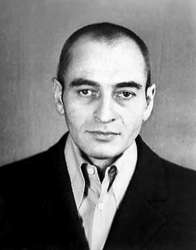
Victor V. Monblanov (1940-2014)
The reaction of the crowd varied.
Several people threw money into the mug, one asked Monblanov to continue, another demanded that he “stop the farce”. One of the listeners tore up the placard and tried to hit the speaker.
The speech was interrupted by the police, who arrested Monblanov and dispersed the crowd. At the time of the arrest even five-rouble notes were found in the mug.
Monblanov was taken to the prison distribution centre, where he was held until 5 January 1979 as he refused to give his name. On 4 January KGB (or police) officials discovered his name and address for themselves and conducted a search of his home. A criminal case under Article 206, part 2 (equivalent in UkSSR Criminal Code, “malicious hooliganism”) was instituted against Monblanov. The investigation accuses Monblanov not only of making a public speech, but also of allegedly threatening one of those present, a certain Dil (the one who tore up the placard), and also of resisting the police [4].
On 5 January Monblanov was sent to the Pavlov Hospital for a psychiatric examination.
On 16 February 1979 a commission, headed by Professor Lifshits, reported that it had not found any mental abnormalities in him. However, the investigators took the decision to conduct a second examination, in the special, i.e., KGB, department of the same hospital.
During the two weeks following the first examination, they refused to inform A.N. Yakovleva, Monblanov’s wife, of her husband’s whereabouts. KGB officials told her that he had apparently been released and that “his name is no longer on the books”.
Earlier Monblanov worked as an assistant director at the Kiev Studio of Popular-Scientific films.
*
KIEV. During the night of 3-4 February 1979 a search, authorized by the Ukrainian Republican KGB and Procurator’s Office, was conducted at the home of Yury BADZIO. The manuscript of a book “The Right to Live” was confiscated [5].
It is a philosophical work, over 400 pages long, on which Badzio has been working for over seven years. It contains an analysis of the works of Marx, Lenin and Stalin and the decisions of Party congresses, and it discusses the great significance of the national-liberation movement at the present time. The work was not circulated; even Badzyo’s wife had not read it. They also confiscated a manuscript, a selection of poetry.
Yury Badzio is a Master of Philological Sciences. Until 1968 he worked for the “Youth of Ukraine” publishing house. He was dismissed for ideological reasons. For the past seven years he has worked as a loader in a Kiev bread factory.
======================================
NOTES
- Mark Morozov was later sentenced to five years of exile, and was sent to Norilsk above the Arctic Circle. See CCE 53.14 and Name Index.
↩︎ - In September 1979 (CCE 54.12 [2]) Yermolayev was given four years in hard-regime camps and Polyakov, three and a half years.
↩︎ - On the Christian Seminar, see CCE 41.4, CCE 43.9, CCE 46.8, CCE 49.14 [2] and CCE 52.11.
↩︎ - In April 1979 (CCE 53.8) Victor Monblanov was given four years in ordinary-regime camps.
↩︎ - Yury Badzio was arrested in April 1979 (CCE 53.17).
↩︎
===================================
 A Chronicle of Current Events