- 4-1. Josif Zisels (Chernovtsy)
- 4-2. Eduard Kuleshov (Taganrog); Mark Morozov; the journal Poiski [Searches]; Jews in the USSR journal; Other incidents
*
On 8 December 1978 Josif Zisels was arrested in his flat in Chernovtsy (West Ukraine).
In 1969, Josif Samoilovich ZISELS graduated with distinction from the Department of Theoretical Physics, Chernovtsy University. From April 1971 until his arrest, Zisels worked at the Chernovtsy Radio & Television Centre as a technical control engineer.
In August 1972, Zisels was expelled from the Komsomol for a speech at a trades union meeting in which he defended his colleague Trikhter, who had applied to emigrate to Israel. The Director of the Radio & Television Centre, M.N. Voitsev, afterwards demanded that Zisels “voluntarily hand in his resignation”. Zisels refused. The Director then created an atmosphere of continual slander and fault-finding around him. Zisels was not sacked, however.
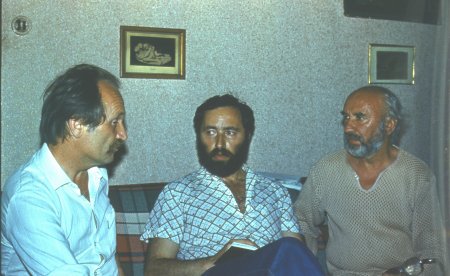
Josif Zisels, b. 1946 (centre) with Chornovil and Krasivsky [1988 photo]
In August 1976 Josif Zisels and several of his friends were interrogated by the Chernovtsy KGB.
In December 1976, the regional newspaper Soviet Bukovina published an article by V. Pelekh, “The Poor in Spirit”. It presented Zisels and his friends as morally harmful individuals who, among other amoral acts, read the works of Solzhenitsyn (CCE 44.15 [4]).
In February 1977 Zisels was issued a warning under the Decree of 25 December 1972. He refused to counter-sign the warning statement. KGB officials suggested more than once to Zisels that he should leave the USSR, but he refused.
On 10 November 1978 a 12-hour search was conducted in Zisels’s flat (CCE 51.8). Formally, the search was conducted in order to confiscate pornographic materials linked to the case of Margulis, who was married to Josif’s sister.
On 8 December 1978 a second search was conducted in Zisels’s flat. The following items were confiscated:
- Stretton’s book, The Achievement of Sexual Harmony (a typewritten translation from English);
- the Strugatskys’ book, An Inhabited Island (cut out of a Soviet journal);
- Voltaire’s History of the Russian Spirit (published 1889);
- synopses of the books Chaadayev by A. Lebedev and The Life of Jesus by Ernest Renan;
- The text of the article “The Poor in Spirit”, Sovetskaya Bukovina;
- handwritten copy of a document sent to the organizations where people mentioned in the article work by the Chernovtsy KGB;
- notes on a meeting at the Television Committee which discussed “The Poor in Spirit”;
- A description of the warning issued to Zisels in February 1977; a list of samizdat literature then returned to him;
- Copies of the minutes (a) of the trades union meeting at which Zisels defended Trikhter, and (b) of the Komsomol meeting at which Zisels was expelled;
- 85 receipts for telephone calls;
- letters from the Kalynets family (containing poems), and from Mikhail Lutsik, Gabriel Superfin, Zinovy Krasivsky, Stepan Sapelyak (with poems), Vladimir Slepak, Georgy Davydov and others (13 in all);
- 41 post-office receipts for money orders, parcels, small packets, recorded delivery and registered letters;
- 24 photographs of Alexander Ginzburg, Pinkhos Podrabinek, Valentyn Moroz, Zinovy Krasivsky, Ivan Kandyba, Mikhail Lutsik, Ida Nudel, Vyacheslav Chornovil, Lev Lukyanenko, Igor Pomerantsev, Stepan Sapelyak and others.
After the search, although no arrest warrant was produced, Zisels was taken to the police station for interrogation and locked in a cell. Since 9 December 1978 Josif Zisels has been in an investigations prison [1].
On 9 December Josif’s brother Semyon (Zisels) appealed to the President of the USA, James Carter:
“I am writing to you because on 8 December 1978, the eve of the 30th anniversary of the Universal Declaration of Human Rights, my brother Josif Zisels was arrested.
“On graduating with distinction from the Faculty of Theoretical Physics at Chernovtsy State University in 1969, he was obliged to take work which was not in his specialist field. The path to science was closed to him for one simple reason: he is a Jew. I know that my brother wished to give his inexhaustible energy and outstanding abilities to theoretical physics and thus be useful to his country …
“My brother decided to devote himself to the fight against the violation of human rights, the most distressing issue in our country. This pain is part of that pain of all mankind which is tormenting the world at the present time. One cannot call it an domestic affair limited to our country. I ask you, therefore, to speak out in defence of my brother Josif Zisels.”
The Region Procurator’s Office is conducting the pre-trial investigation of Josif Zisels’s case.
During the first stage of the investigation witnesses connected with the events of 1976 were called. They were asked to attach to the current record the explanations they had given to the KGB in August 1976. N.V. Kruglova, an employee of Chernovtsy University, and her son Valery confirmed that in August 1976 Zisels gave them the Gulag Archipelago to read. Engineer Roman Blitt, summoned to the investigation from Kazan (Tatarstan), confirmed that he had borrowed the collection From Under the Rubble from Josif [2].
Semyon Zisels refused to confirm the explanations which he had given to the KGB in 1976, on the grounds that the literature they were talking about (e.g., The Gulag Archipelago) does not contain slander.
Josif’s wife Irena Zisels refused to give evidence on her husband’s case after the first interrogation and sent this statement to the Regional Procurator’s Office:
“As the wife of Josif Zisels, fully sharing his convictions, I took part to the same extent as he in helping political exiles and prisoners in psychiatric hospitals, and in other activities to defend the rule of law.
“All this activity breaks not one of the laws of the USSR or the Ukrainian SSR, nor the Final Act of the Helsinki Conference or the UN’s Universal Declaration of Human Rights.
“I demand that my husband be released immediately and the case quashed. I give early notification that I categorically refuse to take part in the pre-trial investigation as a witness.
“I consider it my duty to inform you that, sharing my husband’s convictions, I took part together with him in activities to defend the rule of law, equally openly and not breaking the law. I consider that neither I nor my husband has committed a crime. But if my husband’s case is not quashed, then I am ready to stand trial together with him and on the same grounds.”
In addition, Irena Zisels sent numerous petitions on such matters as making him subject to a less severe form of restriction than arrest, on providing a meeting with him, and on allocating him a diet corresponding to his state of health.
*
Witnesses were then summoned who were connected, in the opinion of the investigators, with Zisels’s activities in 1978.
A note (handwritten by Josif) expressing doubt about the official version of the death of Baptist Victor Sedletsky was confiscated from Irena Zisels’s friend Marina Pototskaya during a search on 8 December 1978. At the interrogation Marina replied to the investigator’s question about this note that it just happened to be in her possession and that she had no knowledge of its contents. On the evening before Marina’s interrogation her father was summoned to the Procuracy. Investigator Yevtukhov, trying to put pressure on Marina through him, hinted at possible reprisals against her and her husband — an officer in the Soviet Army.
On 8 January a resident of Tomsk, S. Shinkarenko, who had been a guest of the Zisels family in summer 1978, was summoned for interrogation. The investigator, who had a tape of an eavesdropped conversation, asked Shinkarenko to confirm that Josif had been talking about psychiatric hospitals in the USSR and about the artificially created famine in the Ukraine at the end of the 1920s and beginning of the 1930s. Shinkarenko refused to confirm this.
In addition, in January the Baptist N. Gavrilov and the Jewish refuseniks M. Grauer and M. Osnis were interrogated.
On 29 January the wife and brother of Josif Zisels wrote to the Moscow Helsinki Group. They requested them to do all they could to publicize the illegal actions of the investigative organs in order to secure the observance of legality and the release of Josif Zisels.
============================================
NOTES
- Later, in April 1979, Zisels was given a three-year sentence (CCE 53.6): he would suffer in the camps from an untreated ulcer (CCE 57.19). See also the account of Zisels’ life as a dissident on the Kharkiv Human Rights Protection Group website.
↩︎ - Alexander Solzhenitsyn et al, From under the Rubble, Collins & Harvill, 1975, English edition; published in Russian by YMCA press (Paris) in 1974.
↩︎
================================
 A Chronicle of Current Events