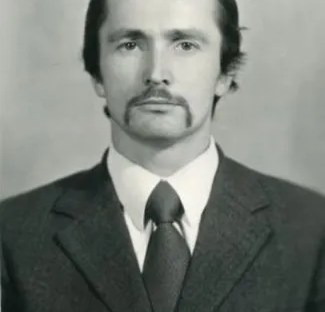
On 7-8 February 1979, in the town of Radomyshl (Zhytomyr Region) the trial of Vasyl OVSIYENKO took place. He was charged under Article 188-1, pt. 2 (UkSSR Criminal Code: “Resisting a Police Officer …”).
The Judge was Kovalenko; the Procurator, L. Sitenko; and the defence lawyer, S. M. Martysh (who defended Alexander (Oles) Serhiyenko in June 1972: CCE 27.1; CCE 38.21, CCE 46.10-2).
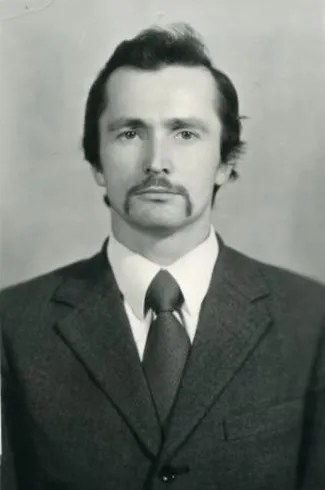
Vasyl V. Ovsienko (1949-2023)
*
Vasyl Vasilovich OVSIYENKO (b. 1949) completed his studies at the Language and Literature Faculty of Kiev University and worked as a teacher until he was arrested in 1973.
He was then sentenced to four years imprisonment in a strict-regime camp under Article 62 (UkSSR Criminal Code = Article 70 of the RSFSR Code) as part of the case of the Ukrainian Herald (CCE 30.6). In the camps (CCE 35.7, CCE 39.2-1) Ovsiyenko developed a chronic disease of the stomach and intestines. After his release in 1977 he was sent to live in the village of Lenino, Radomyshl district (Zhytomyr Region) where he was placed under administrative surveillance. The surveillance was extended three times, the last time on 5 September 1978 (CCE 51.12). Ovsiyenko worked as an artist (CCE 45.11-1).
In the autumn of 1978, Ovsiyenko applied to the Supreme Soviet of the Ukrainian SSR for permission to emigrate. Only during the investigation did it become known that the American Professor Iwan Chinchenko had sent him an invitation and a guarantee of financial security.
*
The “Incident”
On 18 November 1978, two acquaintances visited Ovsiyenko. They were both members of the Ukrainian Helsinki Group: Oksana Meshko, mother of the prisoner O. Serhiyenko; and Olha Orlova, sister of the prisoner Serhiy Babych.
When Ovsienko was escorting his guests to the bus back to Radomyshl, all three were detained on the pretext of establishing their identities by: Police Captain Slavinsky, who was in charge of the surveillance of Ovsienko; local policeman Lieutenant Bazlenko; and a person later identifying himself as Smagly, an official of the Zhytomyr Region department of Internal Affairs. The detainees were taken to the village Soviet. The people present there were sent away. Then, taking the detainees into separate rooms, they started to interrogate them.
They searched the women’s bags but found nothing. A statement was drawn up in which it was said that they had refused to communicate the purpose of their visit. Afterwards they were invited to leave the village. As the last bus had gone, they were forced into a police car and driven to Radomyshl. At the same time Captain Slavinsky interrogated Ovsiyenko. They demanded that Ovsienko persuade his guests to leave willingly under police escort. He refused.
*
Ovsienko described the actions of the police as banditry, whereupon Slavinsky promised him to “start a case” against him. Left alone with Ovsiyenko, Slavinsky swore at him rudely, grabbed him by the collar and threw him at the door. Ovsiyenko shouted: “Help! They’re beating me!” Smagly and the village Soviet chairman came running at the shout. Ovsienko asserted that Slavinsky had attacked him. Slavinsky denied everything. Ovsienko was allowed to leave soon afterwards.
On 1 December 1978, Ovsiyenko sent a complaint about the actions of Slavinsky, Bazlenko and Smagly to the Radomyshl people’s court; as it turned out, they had forestalled him.
On 8 December 1978, Investigator K.N. Dyachenko informed Ovsiyenko that a criminal case had been brought against him under Article 188-1 (UkSSR Criminal Code). They took a signed undertaking from Ovsienko not to leave the village. In spite of Ovsienko’s statements and protests, the investigator did not summon either Oksana Meshko and O. Orlova as witnesses, or Smagly. During both the investigation and the trial, Slavinsky denied that Smagly had been present during the incident.
Even during the investigation, the lawyer Martysh petitioned for the case to be closed because of the absence of those involved at the time of the crime. Investigator Dyachenko turned down the petition. (The records of the pre-trial investigation also contained the following: “… the possibility of prosecuting Oksana Ya. Meshko for spitting at Police Lieutenant Bazlenko is rejected, due to the absence of the evidence.”)
*
The Trial
Oksana Meshko was evicted from the courtroom before the trial began. She then handed in a written protest, arguing that she and O. Orlova were the only witnesses of the incident: her evidence, therefore, must be heard by the court.
From Ovsiyenko’s indictment: “… resistance to the police … threatened Lieutenant Bazlenko … attacked Captain Slavinsky, seized him round the chest and tore two buttons from his raincoat.”
The principal witness at the trial was a woman called Kolbasyuk, an employee of the children’s room at the police station. As became clear, Kolbasyuk was not present during the event — her evidence about the place where the incidents took place differed from that of Slavinsky. The indictment included Kolbasyuk’s allegation that Ovsienko attacked Slavinsky with his fists, threw him at the door, seized him by the raincoat and tore off two buttons. At the trial, Kolbasyuk refused to confirm that Ovsiyenko had attacked Slavinsky with his fists. Asked how Ovsienko had pushed Slavinsky, Kolbasyuk said that he had pushed him with his shoulder. As far as the buttons were concerned, she said perhaps they were badly sewn on.
Another witness claimed to have seen everything through a window of the village Soviet. During the trial it came to light that the blinds on the window in question had been drawn; it was impossible to see anything through it. The majority of witnesses simply maintained that they had seen Slavinsky and Ovsiyenko arguing about something at the door of the village Soviet.
The only piece of material evidence was Slavinsky’s raincoat with the two torn-off buttons. Presented to the investigators 29 days after the incident, it was not examined by experts. From Ovsiyenko’s final speech:
“Everyone here present, from judges to the public, understands perfectly well what is going on here: that I offered no resistance at all to the authorities, that the whole case is a complete and utter fabrication, on the worst models of Stalin and Beria’s times. And again, as in those times, the KGB plays the role of orchestrator. It was at their request that the scenario of this comedy was drawn up — on such a primitive level, moreover, that the Judge is forced to dodge and lie.”
The court sentenced Vasyl Ovsiyenko to three years’ imprisonment in strict-regime camps. After the reading of the verdict, he was placed under guard in the courtroom.
Protests
On 5 February 1979, Victor Nekipelov, Tatiana Velikanova and Alexander Lavut issued a statement, “The New State Mob Law”:
“We demand an open court investigation, with the participation of the public, an independent lawyer and representatives of the Ukrainian and Moscow Helsinki Groups — and an inquiry into all the circumstances of the ‘case’.”
After the trial the Ukrainian Helsinki Group published a statement:
“The case of Vasyl OVSIYENKO … is just one illustration of the state of human rights in the Soviet Union. It shows the discriminatory policy of the government towards the emigration of persons of Ukrainian origin, especially Ukrainian dissenters.”
Political exile Mikhail Kheifets sent protests to Radomyshl (even before the trial) and to Zhytomyr.
Political exile Vasyl Stus telegraphed Andrei Sakharov on 16 February 1979:
“I am beginning a political hunger-strike: to protest against the conviction of Vasyl OVSIYENKO; to demand his release; and the punishment of the parties guilty of this judicial frame-up.”
On 16 February Mikhail Melnik (CCE 51.8 [11]) sent a letter to the editors of the Soviet Ukraine and Ukrainian Youth newspapers, requesting their intervention in Ovsienko’s case:
“Practically every person who has served a sentence under Article 62 (UkSSR Criminal Code) has been compelled within a short period, one to three years, either to emigrate or to find himself imprisoned yet again. One cannot help being troubled by this state of affairs in Ukraine.”
===========================================
 A Chronicle of Current Events