[1]
Decree of the USSR Supreme Soviet Presidium
NOT FOR PUBLICATION [1]
The abolition of restrictions on choice of place of residence, formerly stipulated for certain categories of citizens.
The Presidium of the USSR Supreme Soviet decrees:
(1) That the restrictions on choice of place of residence, stipulated by the decree of the Presidium of the USSR Supreme Soviet (13 December 1955) with regard to Germans and members of their families, and the decree of the Presidium of the USSR Supreme Soviet (22 December 1956) with regard to former Greek and Turkish citizens and Iranian subjects and all stateless persons, are to be lifted.
(2) That the persons affected by the above restrictions, and members of their families who are citizens of the USSR, are to enjoy the right of all citizens to choose their place of residence within the whole territory of the USSR, in accordance with the existing laws on employment and the passport system; that foreign citizens and stateless persons are to be treated in accordance with the law on the residence of foreigners and stateless persons in the USSR.
(3) That the USSR Ministry of Justice, together with the USSR Ministry of Internal Affairs and the Committee of State Security [KGB] at the USSR Council of Ministers, are to submit acknowledgement of the loss of force of the legislative acts stipulating restrictions on specific nationalities which were resettled in the past from their places of habitation to other regions in the USSR.
- N. Podgorny, Chairman of the Presidium of the USSR Supreme Soviet
- M. Georgadze, Secretary of the Presidium of the USSR Supreme Soviet
Moscow, Kremlin.
3 November 1972, No. 3521-3.
*
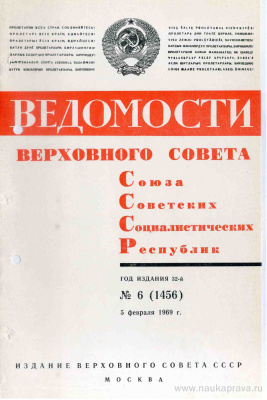
Gazette of the USSR Supreme Soviet (issue 6, February 1969)
*
[2]
FOR OFFICIAL USE ONLY.
Order No. 10-dek of the Head of Glavlit [2] at the USSR Council of Ministers.
Moscow 14 February 1974
The removal of works by Solzhenitsyn, A. I., from libraries and bookstores.
The following separately published works of Solzhenitsyn, A. I., and also journals in which they were printed, are to be removed from all public libraries and bookstores:
One Day in the Life of Ivan Denisovich, in the journal Novy Mir, No. 11, 1962.
- The same. Novella. Moscow: Gospolitizdat publishers, 1963. (Roman-gazeta No. 1, 700,000 copies.)
- The same. Novella. Moscow: Sovetsky Pisatel publishers, 1963. 100,000 copies.
- The same. Novella, in two volumes. Moscow: Uchpedgiz publishers, 1963. Vol. 1, 75 pp., 250 copies. For the blind.
- The same. Novella Vol. 2, 80 pp., 250 copies. For the blind.
Two short stories: “An Incident at Krechetovka Station” and “Matryona’s House”, in the journal Novy Mir, No. 1, 1963.
“For the Good of the Cause”, in the journal Novy Mir, No. 7, 1963.
“Zakhar-Kalita”, in the journal Novy Mir, No. 1, 1966.
Foreign publications (including journals and newspapers) containing works by the said author are also to be removed.
P. Romanov.
*
The “Chronicle” reminds readers that Alexander Solzhenitsyn was forcibly deported from the country on 13 February 1974, CCE 32.1.
The following document, dating from the time of the last elections (June 1974), has come into the possession of the “Chronicle”.
*
[3]
ABSENTEE VOTERS
- To the Secretary of the Party Organization,
- To the Enterprise Head
The Agitation Collective of electoral district No. [number] for elections to the USSR Supreme Soviet informs you that on [date] 1974, Comrade [name], who works at your place of employment, was given Authorization No. [number] to vote [elsewhere].
You are asked to investigate whether his / her absence from the electoral district on the day of the elections was genuinely necessary.
Please send your report on the measures taken to the Electoral Commission, at the following address: [address].
- Leader of the Agitation Collective,
- Chairman of the District Electoral Commission
Cases are known (comments the “Chronicle”) of people reporting to their workplace administration that they have been given absentee voter certificates [3].
*
[4]
Edict No. 677 (28 August 1974) of the USSR Council of Ministers established new
“Regulations on the Passport System in the USSR”.
This edict and the text of the ‘Regulations’ are published in full in the official publication Collection of Decrees Issued by the Government of the Union of Soviet Socialist Republics (No. 19, 1974), and in the journal Socialist Legality (No. 12, 1974).
Open publication of the full text of the ‘Regulations’ is something new: the “Regulations on Passports” which are still in force (but will be superseded by the new ‘Regulations’) were accessible only in part.
*
[5]
On the same day, 28 August, the USSR Council of Ministers adopted Edict No. 678:
“Several Rules Concerning the Registration [propiska] of Citizens”.
This edict consists of ten points. Only the first four points were published, however (in the same sources as Edict No. 677, [4] above), without indication that they are only part of the text.
The other six points are marked “NOT FOR PUBLICATION”.
The “Chronicle” publishes below a synopsis of these points: their full text has been published in the “Archive of the Chronicle”, No. 2.
According to Point 5, those who have been punished by imprisonment or exile for actions which come under certain Articles of the Criminal Code cannot be registered in cities, towns, districts or areas in a special list (“forbidden areas”) until the expiry of their record of conviction or until their conviction is lifted by the method established by law.
These particular Articles of the Criminal Code (listed in point 5) include, of course, Articles 64-73 (RSFSR Criminal Code: the so-called “especially dangerous crimes against the State”). In addition, they list one article not formerly included: Article 190-1 (RSFSR Criminal Code).
According to Point 6, the restrictions established in point 5 do not apply
- to persons released from imprisonment by amnesty or pardon;
- to persons to whom a court has applied Article 37 (Fundamentals of Criminal Legislation: “Assignment of Punishment Lighter than that Provided by Law”);
- to persons serving terms of imprisonment for offences committed before they reached the age of 18 years;
- to invalids of the first category (Group I); to men over 60; to women over 55; or to women who have children who are still minors.
[Point 7 [4]
According to Point 8, persons who are not permitted to register for residence in the “forbidden areas”, cannot be accepted for employment in those areas.
Point 9 states that the edict does not apply to Moscow, or to population centres located in the wooded parkland ‘defence ring’ around Moscow, or to population centres which are administratively and economically subordinate to the Moscow Region Soviet Executive Committee.
Moscow and the above-mentioned population centres are dealt with, as before, in edict No. 585 of the USSR Council of Ministers (25 July 1964) and in points 8-10, 18, 23, 27 (apart from its last paragraph) and 28 of the “Regulations on Registration” confirmed by that edict.
In addition, the currently applicable rules of registration for border zones and areas designated by the USSR government to be under special regimes are also preserved unchanged.
====================================
NOTES
- Compare these examples with Loeber’s analysis in Social Issues, 9 (CCE 19.12 [2]) of the extensive non-publication in the USSR (80%) of normative and other acts.
↩︎ - Glavlit = the Main Administration for the Prevention of State Secrets Appearing in the Press. On the early history of Glavlit and Soviet censorship, see CCE 14.9.
↩︎ - The officially reported 99% turnout at Soviet “elections” (post-Stalin) never corresponded to reality. In the perestroika years it was admitted that around 75% of the electorate turned out to vote.
↩︎ - See Archive of the Chronicle, No. 2 (1974).
↩︎
===========================
 A Chronicle of Current Events