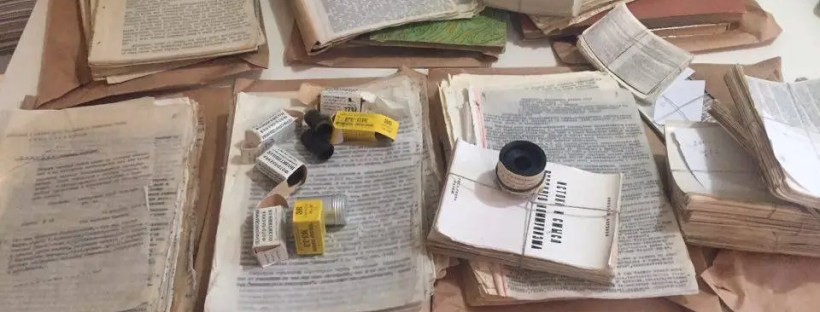
FOURTEEN ENTRIES
(Periodicals, 11-14)
[1]
Lev Kopelev
“In Memory of Alexander Galich” (February 1978, 12 pp.)
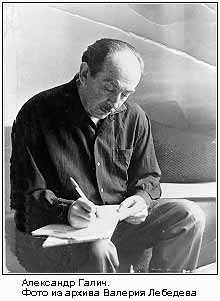
Alexander Galich, 1918-1977
*
[2]
Raisa Lert
“Full Circle…” (February 1978, 13 pp.)
An essay written in April 1977, it says that the crushing of dissenters is reviving the patterns of demagoguery of the 1930s and 1940s (CCE 46.20 [4]). It is supplemented by a postscript in which the author observes: the more the authorities drag out the Orlov-Ginzburg-Shcharansky case, the more the tendentious, premeditated and unobjective nature of the charges become apparent. The author suggests that the USSR and USA ‘exchange’ defence lawyers:
“Why is it possible to exchange political prisoners but not defence lawyers? Perhaps this would further the interests of detente and humanism more than the sessions of any commissions or sub-commissions.”
*
[3]
Andrei Sakharov
“Nuclear Energy and Western Freedom” (11 October 1977, 5 pp.)
Against anti-nuclear attitudes widespread in the West: nuclear energy threatens the environment far less than traditional energy; its development is a guarantee of the West’s greater independence from sources of chemical fuel that they cannot fully control.
*
[4]
Tatyana Khodorovich & Victor Nekipelov
“Oprichnina’-77 in the Prisons and Camps” (Oct 1977, 8 pp.)
The third in the series of “Oprichnina-77” articles (CCE 45.20, CCE 46.20) is about Mordovian Camp 1 (special-regime).
The article is saturated with facts and contains the authors’ deeply emotional reflections on the inhuman conditions of this prison-camp and on the suffocating atmosphere, one of the consequences of which are the conflicts which flare up from time to time between political prisoners (CCE 47.9-1).
The authors cite an old article by Valentyn Moroz on the psychology of the prisoner.
*
[5]
Victor Nekipelov
“Oprichnina-77 Continues”, 4th issue
“The KGB’s ‘Moral Feat’ for Christmas” (30 December 1977, 2 pp.)
A response to the arrest of Kirill Podrabinek (CCE 48.7).
*
[6]
Victor Nekipelov & Tatyana Osipova
“Oprichnina-78 — Political reprisals using criminal means” (February 1978, 5 pp.)
A continuation of the same series. The article’s material concerns the reprisals against Felix Serebrov, Georgy Goldstein, Kirill Podrabinek, Vadim Smogitel and Shagen Arutyunyan: 15-day jail sentences, beatings and house-arrests.
*
[7]
Victor Nekipelov
“To Find Someone” (4 pp.)
An article about the fate of a driver from Veshenka station, Ivan Fyodorovich Radikov (b. 1939).
After sending letters in 1973 to the writer Mikhail Sholokhov and the Communist Party Central Committee Radikov was charged under Article 190-1 (RSFSR Criminal Code) and arrested. In April 1974 the Serbsky Institute ruled him not responsible.
The article ends with an appeal to trace Radikov. A letter to Sholokhov with a similar appeal is appended to the article.
*
[8]
S. Cheremukhin
“Moscow Museum visitors” (January 1978, 2 pp.)
People from districts near and far from the Soviet capital make trips to Moscow to buy provisions. An increasingly common format for such trips is “excursions to the revolutionary museums”.
As a result everyone is happy: the museums, the local Party committees and the ‘excursionists’.
*
[9]
Georgy Belyakov
“Ivanov’s Swamp” (1965, 74 pp.)
In 1965 Georgy Belyakov (b. 1935), then a fifth-year student of the Moscow Literary Institute, presented the story “Ivanov’s Swamp” as a diploma work.
The story was approved by the editors of the journals Novy Mir and Yunost (Youth), but it was not published in view of the acute nature of the problems raised and their presentation. In 1966 Belyakov submitted his resignation from the Party, after which he was arrested and, under Article 70 (RSFSR Criminal Code), given five years in a labour camp. Subsequently the RSFSR Supreme Court reclassified the charge under Article 190-1 and reduced the term to three years.
The story “Ivanov’s Swamp” describes in an emotional and talented way a contemporary Russian village castrated by the collective farm system.
*
[10]
Anon
“The Forcible Resettlement of Tadzhik Mountain-Folk” (February 1976, 3 pp.)
An article by an anonymous author about events that took place in the 1960s.
In an effort to meet the lack of labour on the cotton fields, the authorities resettled several tens of thousands of mountain-folk (among them a small nation, the Yagnobtsy) on the plains. The police took part in the resettlement. The settlements of the Yagnobtsy, which bore the features of their ancient, distinctive culture, were destroyed.
In the unfamiliar conditions of the plains an enormous mortality rate developed, especially amongst children and old people.
“Many Yagnobtsy continue to regard the mountains as their homeland and dream of returning there …”
***
PERIODICALS
[11]
37
“Thirty-Seven” magazine (Nos. 7-12)
The contents of Nos 1-6 of this Leningrad journal were described in CCE 43.16.
Nos. 7-8 published: verse by S. Stratonovsky and V. Aleinikov: a story by B. Ivanov, “Podonok”; articles by Olga Sedakova on the work of Rilke and by N. Golubev, “On a Poem by Mandelstam”; and materials from a religious-philosophical seminar on the theme of “Christianity and Humanism”.
No. 9 contains: verse by I. Burikhin: a short novel by N. Malakhovskaya, “Windowless Dungeon”; verses and translations by 20 authors in memory of the translator and poetess T. G. Gnedich who died in November 1976; a paper by B. Groys “Dostoevsky and Kierkegaard’”; a literary-critical review by G. Somov;, two articles on the work of Josif Brodsky; seven letters of Nikolai Gumilyov; and materials from a religious-philosophical seminar about “Problems of the New Christianity”.
No. 10 contains: verse by Olga Sedakova; critical articles about the work of writers Yury Trifonov and V. Rasputin, film producer G. Panfilov, of Leningrad non-figurative artists, and of philosophical and theological works by T. Goricheva, B. Inozemtsev and E. Pazukhin.
No. 11 publishes: verse by E. Shvarts and E. Feoktistov; an article by V. Azaryan on the work of film producer Tarkovsky; travel notes of pilgrims to the Pskovo-Pecherskaya monastery; and a review article by E. Giryayev, “A Religio-Philosophical Seminar in Leningrad”.
No. 12 published: verse by Aronzon; a short story by B. Ulanovsky, “Albinosy”; an article by N. Kornilov about Nikita Mikhalkov’s film “An Unfinished Piece for Mechanical Piano”; and a confession-like account by G. Grigoryeva of her experiences on the path to religion.
***
LITHUANIAN PERIODICALS
[12]
LAISVES SAUKLYS
“Herald of Freedom”, Nos 4 (Oct) and 5 (Dec) 1976
No. 4 opens with an article by Gintautas, “Let’s Straighten our Backs”, on the problem of national renaissance.
Skirmantas’s article “Prisoners of Dangerous Myths” criticizes the book published abroad by emigrant Lithuanian priest Jucevicius in which the author praises the present authorities in Lithuania for the development of Lithuanian culture.
The issue also contains a statement by L. Simutis to the Presidium of the USSR Supreme Soviet of 20 August 1970 (CCE 18.3 and CCE 44.17-3).
*
No. 5 contains an article, “The Felled Oak”, by K. Gintaras dedicated to the memory of the talented artist Arunas Tarabilda (1935-1969). Tarabilda did much to preserve ancient monuments. For participation in student protests he was expelled from the Artistic Institute and subjected to shadowing. He lived in great poverty and died of a stroke.
*
AUSRA, 8 & 9
[13]
AUSRA, 8
“The Dawn”, No 8 (48), Oct. 1977, 49 pp.
The article “What Then Should We Do?” develops the thought that to preserve Lithuanian nationhood it is necessary to have a loving concern for national history and a real consideration for one’s native language, one must preserve and strengthen one’s faith and strive for moral improvement.
The note “Freedom — Only for the State” examines several articles of the new Constitution.
Under the general title “When the Sweetbriar Blooms” there is a selection of poems, three of which are by Antanas Cinge, a political prisoner who worked on gold prospecting in Bodaybo (Irkutsk Region, Siberia). In the preface it says of the other poems that their authors have not been found, but that these songs are close and memorable to many Lithuanians “who heard and sang them in the forests, in the camps, in the taiga”.
In this number are also published the record of the search at Petkus’s flat on 23 August 1977, documents of the Lithuanian Helsinki group and the “Resolution of the Chief Committee of the National Movements of Estonia, Latvia and Lithuania” (short summary CCE 47.5).
*
[14]
AUSRA, 9
No. 9 (49), Jan 1978, 50 pp.
The article “What sort of pastors does Lithuania need?” signed by ‘A Group of Lithuanian Priests and Believers’, gives a short history of the persecution of the Catholic Church in Lithuania over the past 38 years.
V. Karalius’s article “From the History of the Lithuanian Youth Movement” describes the groups of historians and investigators of local lore who are constantly persecuted by the authorities.
In his article “A Disgraced Science” R. Galvidis demonstrates that it is hard for talented and honest Lithuanian scholars in the humanities to gain acknowledgement.
In an Open Letter from A. Zuvintas to Tomas Venclova, “Lithuanians and Jews”, the author expresses his opinion on the question as to why in Lithuania, where there had never been oppression of the followers of other religions, with the arrival of the Germans bestial beatings-up of Jews took place (more than half the members of the Lithuanian Communist Party were Jews, and therefore hatred towards the communist oppressors was manifested in this terrible way during the years of the German occupation).
In the journal are also described the disturbances in Vilnius and the case of Balys Gajauskas (CCE 47.5, and CCE 48.15-1).
====================================
 A Chronicle of Current Events