On 1 June 1976, Valentyn MOROZ should have been transferred to a labour camp after six years in Vladimir Prison (CCE 17.2). Since March 1976, Raisa Moroz has received no letters from her husband.
*
In answer to many inquiries the prison governor informed her that Valentyn Moroz had been sent to “a medical institution” to determine the type of physical work he was fit to do in the camp. Attempts to find out from the prison administration what kind of “medical institution” met with no success.
Raisa Moroz then travelled to Moscow and made inquiries at the Main Administration for Corrective Labour Institutions and the Medical Department of the USSR Ministry of Internal Affairs. Even here she did not obtain an answer immediately.
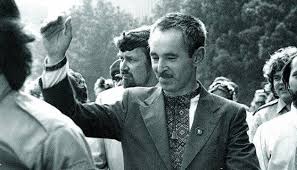
Valentyn Moroz (1936-2019)
Asked if this “medical institution” was connected with psychiatry, a (female) official named Kalinchets from the medical department responsible for the Vladimir Region, refused to answer. If it was a psychiatric hospital, Raisa Moroz told Kalinchets on 17 May 1976, she would not keep quiet, as she was convinced of her husband’s sanity: “You’ll have another Plyushch on your hands.”
The next day Raisa Moroz was received by V.N. Popov, deputy head of the Ministry of Internal Affairs’ Medical Department.
There were five other people in his office. Her husband, said Popov, was at the Serbsky Institute for “a physical examination”. There, it turned out, Valentyn Moroz had arrived on 10 May for a psychiatric diagnosis: it had been observed lately that he was in “a depressed mood”. The examination would continue for about a month. Raisa Moroz was told this by her husband’s doctor, Margarita Felixovna (her surname is secret [1]). The doctor also informed her that Moroz was calm, polite and friendly, and on good terms with his neighbours.
On 19 May 1976, Valentyn Moroz was allowed an hour’s visit from his wife.
He told her that V.L. Rogov, a psychiatrist with the Vladimir Region health department, had mentioned two symptoms in his referral: (a) Moroz had practised self-mutilation; (b) he was excessively religious. (Rogov also cited religious faith as a symptom of illness when he referred Igor Ogurtsov (CCE 1.6) for psychiatric diagnosis. Experts later declared Ogurtsov to be healthy.)
Raisa told her husband that she would get him out of this psychiatric hospital, even if it killed her. Grateful for her determination, Moroz said only that it might not lie within her power to do so. “I am not alone,” she replied, “everyone has already heard that you’re here.”
*
The Chronicle would like to remind its readers of the following.
Valentyn Yakovlevich MOROZ (b. 1936), a Ukrainian historian and journalist, was first arrested during the August 1965 campaign of repression against intellectuals in the Ukraine. Ivan Svetlichny, the Goryn (Horyn, Ukr.) brothers, Mikhaylo Osadchy, Ivan Gel (Hel, Ukr.) and others were also then arrested for the first time. Moroz was sentenced to four years in a camp and was sent to Mordovia. There he wrote his now famous “Report from the Beria Reserve” [2].
On 1 June 1970, nine months after his release, Valentyn Moroz was arrested once again, because of his “Report” and three other articles circulated in samizdat. He was sentenced to nine years loss of liberty: six in prison followed by three in a camp, and then five years in exile (CCE 17.2).
In August 1972, a convicted criminal, who had been put in the same cell, slashed Moroz’s stomach with a sharpened spoon handle. This incident Rogov now calls self-mutilation; at the time the prison governor confirmed in writing that it had been an attack.
After this Moroz was placed in a solitary cell “at his own request”. There in 1974 he began a 145-day hunger-strike (CCE 32.12 & CCE 33.7).
The threat of psychiatric repression against Valentyn Moroz, suggested by V.L. Rogov, was reported in the Chronicle (CCE 36.6).
*
Recently, the US Congress announced that Valentyn Moroz was on a list of persons in whose fate the Congress was taking a special interest.
========================================
NOTES
- The doctor’s full name was Margarita Felixovna Taltse. She had worked at the Serbsky Institute since the 1940s and was deputy to D.R. Lunts, head of the Institute’s Section 4 [correction CCE 41.15].
See also Bloch & Reddaway, Russia’s Political Hospitals, 1977 (Chapter Five, ‘The Practice: Criminal Commitment’, p.150).
↩︎ - The text of “Report from the Beria Reservation” was translated and published in full in Michael Browne (ed.), Ferment in the Ukraine, Macmillan: London, 1971 (pp. 119-153).
↩︎
==============================
 A Chronicle of Current Events