Expulsion from the USSR & Leningrad Writers Unions
- 17-1. Lydia Chukovskaya
- 17-2. Vladimir Voinovich
- 17-3. Dismissal of Yefim Etkind
*
Expelled from the USSR Writers’ Union
A meeting of the Prose Section Bureau was arranged several times and cancelled for lack of a quorum: the majority of bureau members failed to appear “because of illness”. The meeting eventually took place on 30 January 1974.
Georgy Radov was in the chair. He made a brief report:
“In 1968 Voinovich signed a letter in defence of the anti-Sovietists Ginzburg and Galanskov [CCE 2.1 (14)]. The Secretariat issued him a reprimand for this.
“In 1969 The Life and Extraordinary Adventures of Ivan Chonkin was published [abroad] in Grani. He received a severe reprimand and a warning.”
Paderin then asks whether Voinovich has read The Gulag Archipelago [1]. Voinovich refuses to answer.
*
Brovman: “How did the letter to Pankin [2] get into [the émigré journal] Possev?”
Voinovich: “It was an Open Letter: anyone could publish it.”
Radov: “But didn’t you try to publish it in our press?”
Voinovich: “I sent it to Komsomolskaya Pravda. They could have published it.”
*
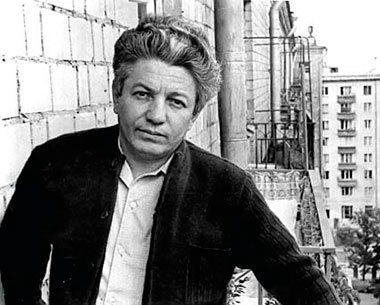
Vladimir Voinovich (1932-2018)
*
The floor was given to Voinovich.
“My letter may seem fantastic but there is no fantasy in it [3].
“It decodes what Pankin said in his interview: the All-Union Agency for Authors’ Rights (VAAP) will now decide for an author where and what he may publish. As regards my words about Lefortovo or Butyrka Prison, Pankin said that authors who publish without going through his Agency can expect ‘certain consequences’. What that means is well known.
“They want to deprive writers of their last right — the right to dispose of their own manuscripts; perhaps you don’t need this right, but I do.”
Krasilshchikov said that by the nature of his work he had read all anti-Soviet publications.
After mentioning the pretenders to the Tsarist throne (including the false Anastasia) and the computers that forecast the impending demise of the Soviet system, Krasilshchikov referred to Voinovich:
“Voinovich hedges and twists.” Krasilshchikov preferred the conduct of Vladimir Maximov, he said. He challenged Voinovich:
“Stop hedging and say outright that you’re an opponent of our system.”
Voinovich: “You people do not amount to a system.”
*
Voinov believed that Voinovich handed over his letter to a foreign correspondent and this was how it got into Possev.
Lydia Fomenko asked why Voinovich was so bothered about his rights. She, Fomenko, wasn’t bothered about her rights … it was all Dostoevskyism … “An underground man”.
*
Lesnevsky kept calling Voinovich familiarly by his first name, ‘Volodya’.
There was no ready-made decision about his expulsion, he said; Volodya still had time to think about it. Lesnevsky was amazed by Volodya’s words that he was not being published. The important thing for a writer is not to be published but to write. The Agency for Authors’ Rights (VAAP) was a wonderful organisation, which would help us wage a struggle with the West and win. Win with subtlety.
Berezko talked about Chonkin. Not one writer has ever portrayed the People satirically.
Voinovich: What about Shchedrin?
Berezko: Shchedrin didn’t portray the People.
Voinovich: Who are the inhabitants of Foolstown, then? [4]
Radov: The Foolstown people are bureaucrats.
Berezko: And it’s a completely different period now. Chonkin is literary hooliganism.
*
Korolkov says that the nature of Voinovich’s work makes it necessary for him to have dealings with the NTS [5] … He is sure that the letter was written to help Solzhenitsyn.
Brovman: Voinovich is addressing his comrades from the NTS.
(He proposed that Voinovich be expelled from the Writers’ Union.)
Irma Guro: … The putrid smell of a provocation.
Voinovich said he had not himself transmitted his letter directly to the West but had been quite sure it would appear there and had nothing against this.
Amlinsky said that he had always felt respect for Voinovich’s creative work … If he now dissociated himself from the letter, it might still be possible to do something. Nothing had been decided yet.
A. Starikov: … why does he attack the Agency for Authors’ Rights (VAAP)? … I don’t know what to do …
Radov (summing up): … Nothing has been decided in advance. We are now giving you the floor. … You can still change the situation.
*
Voinovich said that he would adhere to his former position … He recalled the trial of Sinyavsky and Daniel and the case of Solzhenitsyn …
“I shall now answer Paderin’s question. I have not yet read The Gulag Archipelago, but I know Solzhenitsyn. I know his previous works and I trust him, whereas I don’t trust you. He is a wonderful writer. He fought in the war, he is courageous as a man and a citizen …
“Think it over. Your consciences will sooner or later torment you. Maybe you don’t think you have any, but you do, and sooner or later they will torment you.”
Radov read out some sheets of paper typed in advance. The content is standard and ends
“… recommend expulsion to the Secretariat.”
During the voting it turned out that not only members of the Prose Section’s Bureau but also of its so-called ‘activist group’ had been present and voted.
Two writers who had wanted to come and speak in Voinovich’s defence had not been allowed into the meeting.
*
The expulsion from the Union of Writers was confirmed on 20 February at a meeting of the Secretariat of the Moscow section of the RSFSR Writers’ Union. Voinovich did not go to the meeting but sent an open letter to the Secretariat.
The letter discloses the reasons why Voinovich did not attend the Secretariat meeting; these related both to the circumstances of the meeting, which was announced as a closed event, and to the Secretariat itself, its composition and activities.
“We have nothing to say to each other, nothing to argue about,” writes Voinovich, “because I say what I think, while you say what you are ordered to.”
==============================================
NOTES
- The Gulag Archipelago was published in Russian in December 1973 by the YMCA Press in Paris.
↩︎ - In August 1973 when the Soviet regime created VAAP, the All-Union Agency for Authors’ Rights, Boris Pankin was appointed director. (Much later he served briefly under Gorbachev as foreign minister.)
On the prospects for the new Agency, see CHR, 1973 (Nos. 1, 4 & 5-6) and CHR 1974 (No. 7). VAAP wished to make itself the only channel through which Soviet authors could sell their rights or receive royalties.
↩︎ - Voinovich’s letter to Pankin was not included in this issue of the Chronicle. The original Russian text may be found online here. Dated 2 October 1973 and published widely in the West, his letter was a response to Pankin’s interview in Literaturnaya gazeta (26 September 1973).
↩︎ - A reference to the Story of A Certain Town (1870) by Saltykov-Shchedrin.
↩︎ - The People’s Labour Alliance or NTS (founded in 1930) was an anti-Soviet émigré organization based in Paris and Frankfurt.
↩︎
=======================================
 A Chronicle of Current Events